1868 25C BG-799S (Regular Strike)
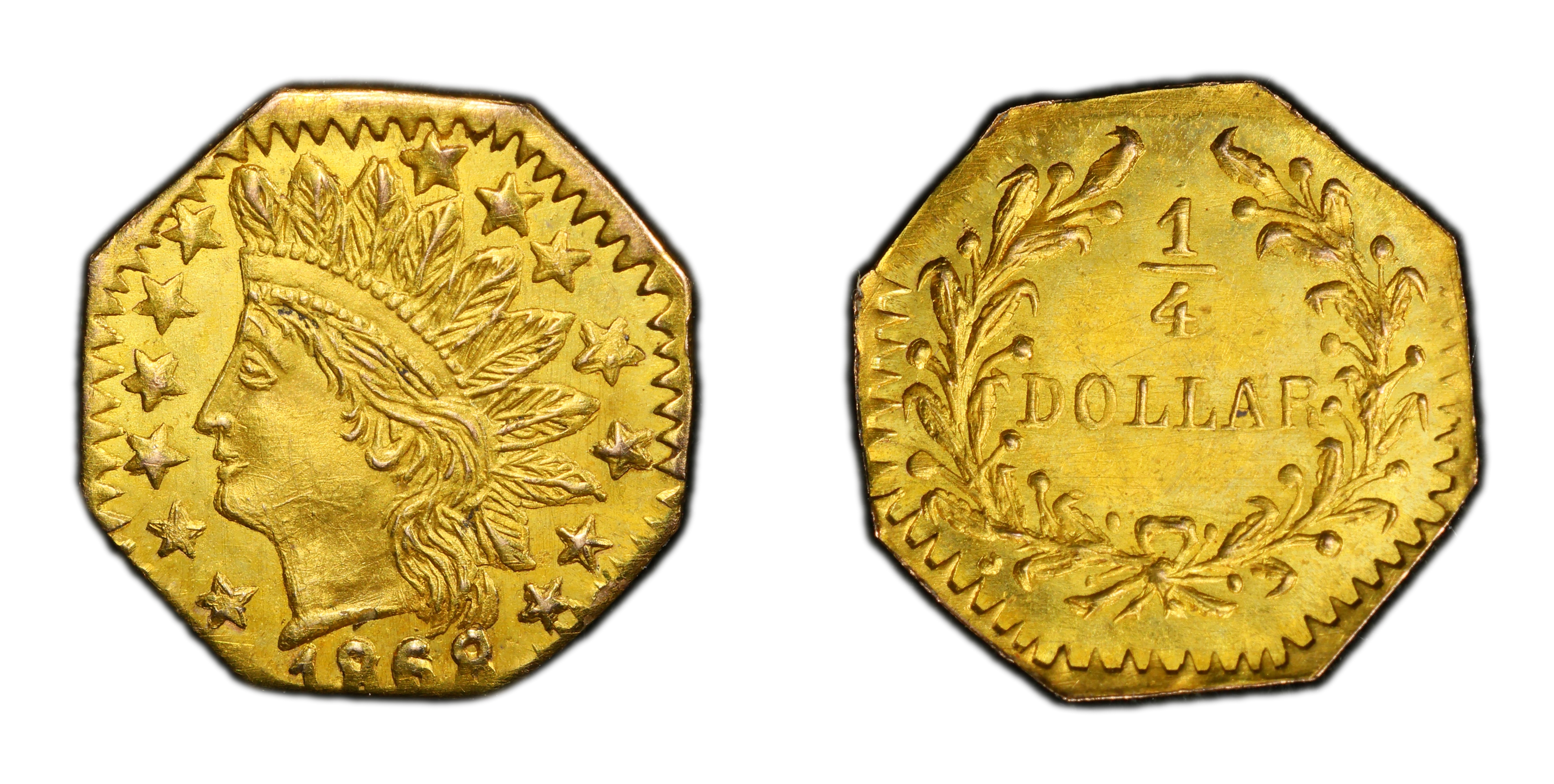
Obverse & Reverse
The 1868 25C BG-799S is a fascinating and enigmatic product of the post-Gold Rush era in California. While the initial wave of 'Period One' fractional gold (1852-1857) was struck by jewelers and assayers to alleviate a critical shortage of small-denomination coinage, the context for this piece is entirely different. By the late 1860s, the San Francisco Mint was producing ample federal coinage, rendering private issues unnecessary for commerce. The Coinage Act of April 22, 1864, officially outlawed private coinage, pushing any subsequent production into a legally gray, clandestine area. The BG-799S, despite its 1868 date, is what numismatists refer to as a 'backdated' or 'suppressed' variety. Research by Walter Breen and Ronald J. Gillio establishes its actual period of manufacture as 1881-1883. These later 'Period Three' issues were not intended for circulation but were created purely as souvenirs and collectibles, sold to tourists and the burgeoning numismatic community. Their production was a direct violation of federal law, hence the use of an earlier, pre-enforcement date to obfuscate their origin. These pieces were struck by unknown manufacturing jewelers in San Francisco who recognized the nostalgic appeal of Gold Rush-era coinage. The BG-799S is a tangible link to this final, secretive chapter of private minting in the United States, representing a transition from utilitarian coinage to pure numismatic novelty. Its extreme rarity today suggests a very small production run, likely made to order or sold in very limited quantities before enforcement of the 1864 Act was fully tightened in 1883, bringing the era of California Fractional Gold to a definitive close.
Associated EventPost-California Gold Rush Souvenir Period
Reason For MintingTo be sold as a collectible souvenir, circumventing federal laws against private coinage by using a backdate.
Minter HistoryThe specific minter of the BG-799S is unknown, a common trait for the 'Period Three' issues. They were part of a group of skilled manufacturing jewelers in San Francisco who continued to produce fractional gold pieces after their practical need had vanished. These craftsmen leveraged their die-sinking and coining skills to tap into a market for Gold Rush memorabilia, operating secretively to avoid federal prosecution. Their work is characterized by established designs like the Indian Head, but often with unique die characteristics and, in this case, deceptive dating.
Historical SignificanceThe BG-799S is significant not as a circulating coin, but as an artifact of numismatic history itself. It represents a rare, clandestine issue created after private coinage was outlawed, highlighting the continued romanticism of the Gold Rush and the birth of a collector market for these miniature gold pieces. Its backdating is a key feature, speaking to the legal pressures under which its anonymous maker operated.
N/A
Denomination25C
Minting Period1881-1883 (Backdated 1868)
Assayer/MinterUnknown San Francisco Jeweler
Geographic OriginSan Francisco, California
Obverse DescriptionA stylized Indian Head facing left, with a feathered headdress. The portrait is surrounded by thirteen six-pointed stars, representing the original colonies.
Obverse Inscription1868
Reverse DescriptionThe denomination '1/4' appears within a decorative wreath of two laurel branches tied with a bow at the bottom. The word 'DOLLAR' is below the fraction. A key diagnostic for the BG-799S variety is a small raised dot or 'berry' located just to the right of the 'R' in DOLLAR.
Reverse Inscription1/4 DOLLAR
CompositionGold
Stated Fineness Actual FinenessVariable, typical of Period Three issues, generally ranging from 14 to 21 carats (.583 to .875 fine).
Diameter9.70 mm
EdgePlain
Extremely Low
Survival EstimateFewer than 10 believed to exist
Rarity ScaleR-7+ to Low R-8
This coin is highly sought after for its extreme rarity, its status as a clandestine and backdated issue, and its connection to the final chapter of the California Fractional Gold series. It represents a trophy-level acquisition for the advanced specialist.
Key VarietiesBG-799S is a major variety itself. It is part of a small family of dies sharing the same general design. Similar varieties include BG-799R and BG-799T, which are distinguished primarily by the style and punching of the '1/4' numerator on the reverse. No proof or presentation strikings are known or expected for this issue, as the entire mintage was of a special, non-circulating nature.
Authentication TipsAuthentication is critical. Refer to high-resolution images in the Breen-Gillio reference ('California Pioneer Fractional Gold'). The primary diagnostic is the small 'berry' to the right of the R in DOLLAR. The coin's fabric, strike characteristics, and specific die markers must match known genuine examples. Be wary of modern replicas, which often have a soapy, cast-like appearance, incorrect weight, or lack the crisp detail of a struck piece. Certification by PCGS or NGC is highly recommended for any transaction involving this variety.
Shopping ConsiderationsFor a potential buyer, any authenticated example is a major prize. A 'premium quality' specimen would exhibit a sharp strike, particularly on the Indian's portrait and the details of the wreath. Look for clean, lustrous surfaces with minimal contact marks; many surviving examples are in high Mint State grades as they did not circulate. Attractive, original orange-gold or reddish toning is highly desirable. Avoid examples that have been cleaned, tooled, or mounted in jewelry. Given the rarity, even a problem-free MS-62 would be a cornerstone piece, while anything finer is a world-class rarity.
A coin's grade is its condition, rated on a 1-70 scale. For rare coins, this is the most critical factor in determining value, as a tiny difference in preservation can mean a huge difference in price.
Relevant Grade TypesAll original examples of BG-799S are considered business strikes (Mint State, or MS) as they were produced for sale to collectors, not for circulation. No wear from commercial use is expected. While some may exhibit prooflike surfaces from polished dies, no true Proof (PR/PF) strikings from this period are known. Later replicas or fantasy pieces are not considered part of the original issue.
Mint State CharacteristicsIn uncirculated (MS) condition, the BG-799S should display full mint luster, often with a flashy or satiny texture. The strike can be variable, but high-quality examples will show strong definition on the feathers of the headdress and the individual leaves in the wreath. Due to the nature of their production, some minor planchet imperfections or slight weakness in peripheral areas may be present and considered normal. Small, scattered contact marks are typical, but large, distracting marks will limit the grade.
Circulated Wear PatternsAs these pieces did not circulate, any wear is considered post-mint damage rather than honest circulation. If a specimen were to show friction, it would first appear on the highest points: the cheek and brow of the Indian portrait, and the tips of the leaves and the bow on the reverse wreath. However, the grading focus for this issue is almost exclusively on the quality of the strike and the preservation of the original mint surfaces.
Key Factors For ValueRarity is the dominant value factor; simply being a genuine BG-799S makes it valuable. Beyond that, the numerical grade is paramount. A higher grade (e.g., MS-64 vs. MS-62) commands a significantly higher price. Key determinants include surface quality (pristine, lustrous surfaces are prized over those with significant marks or hairlines), sharpness of the strike (a bold strike is rare and desirable), and overall eye appeal. A CAC sticker indicating premium quality for the grade would add a substantial premium.
PCGS Price Guide
| Grade | Price | Population |
|---|---|---|
| 61 | $1,200.00 | 1 |
| 62 | $1,400.00 | N/A |
| 62+ | $1,500.00 | N/A |
| 63 | $2,000.00 | N/A |
| 63+ | $2,500.00 | N/A |
| 64 | $3,250.00 | 6 |