1866 G50C BG-903, PL (Regular Strike)
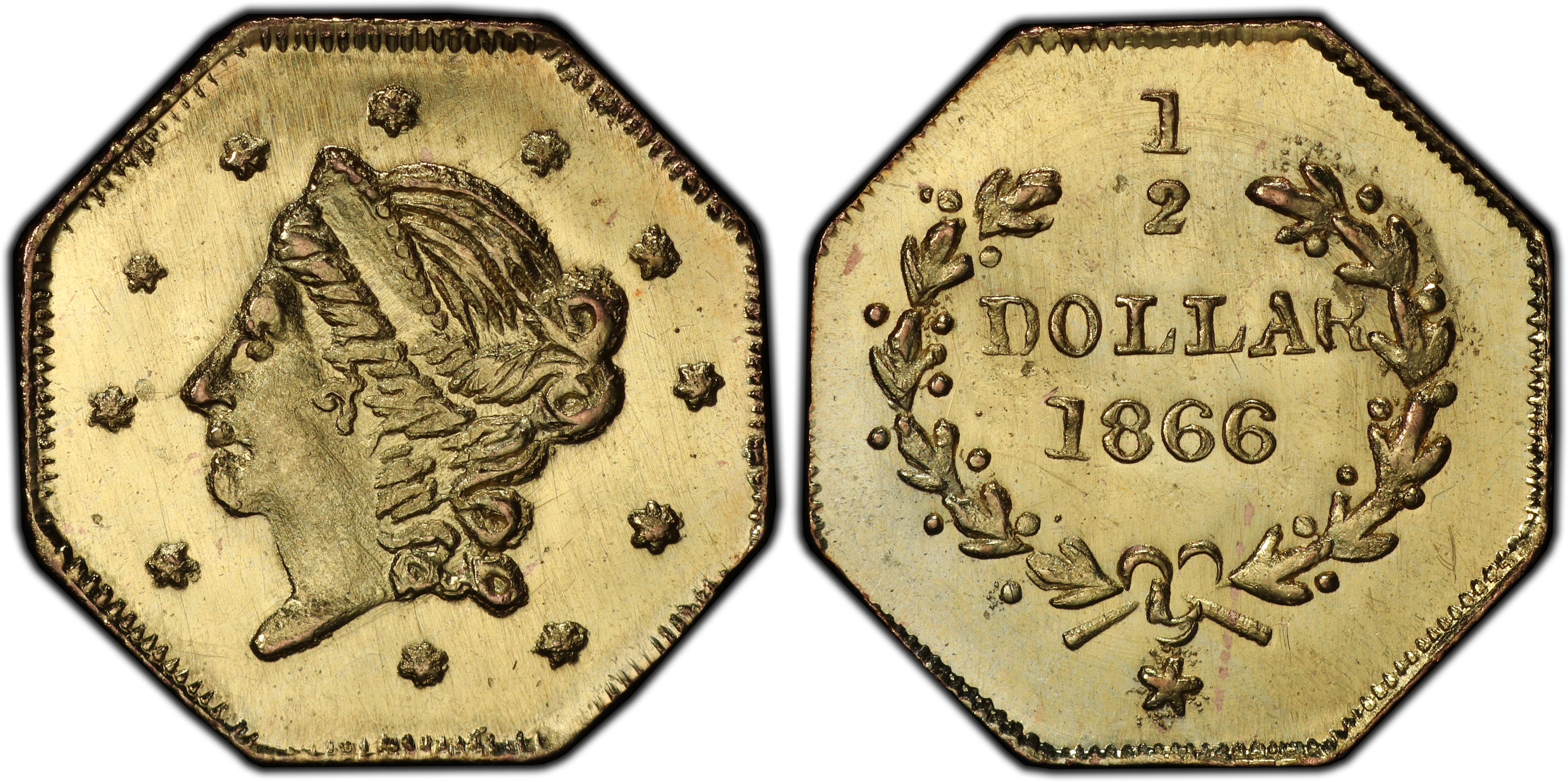
Obverse & Reverse
The 1866 Octagonal 50 Cents, cataloged as Breen-Gillio 903, is a quintessential example of a 'Period Two' California Fractional Gold piece. By the mid-1860s, the initial impetus for these tiny gold coins—a severe shortage of small change during the Gold Rush—had largely subsided. The establishment and robust production of the San Francisco Mint in 1854 had supplied the region with ample federal coinage. Consequently, the private production of fractional gold shifted from a necessity of commerce to a new, lucrative enterprise: the souvenir and jewelry trade. These later issues, often termed 'jeweler's pieces,' were not intended to circulate as money, but were instead marketed to tourists, sentimental former miners, and citizens back East who were captivated by the romance of the California Gold Rush. Unlike their 'Period One' predecessors which were generally of honest weight, Period Two pieces were notoriously underweight for their face value, with their gold fineness varying wildly from as low as 14-karat to near-pure gold, depending on the maker's integrity and intent. The production of BG-903 in 1866 occurred just two years after the Coinage Act of 1864, which explicitly outlawed private coinage. However, the law was weakly enforced by the Secret Service in distant California until the early 1880s, allowing firms like Frontier & Co. to continue their prolific output. These pieces were typically struck by hand, using a hammer to strike an upper die, which resulted in inconsistent strike quality and frequent die cracks. Their octagonal shape was a popular novelty, harkening back to the massive $50 'slugs' of the early 1850s. Today, BG-903 is not just a relic of the Gold Rush, but a tangible link to the burgeoning tourism industry of post-Civil War San Francisco and the clever jewelers who capitalized on the nation's fascination with its Western frontier.
Associated EventPost-Gold Rush Souvenir Trade
Reason For MintingPrimarily struck as souvenirs and for use in jewelry, capitalizing on the romanticism of the California Gold Rush for a tourist and mail-order market.
Minter HistoryFrontier & Co. was a prominent San Francisco-based jewelry and die-sinking firm active during the second period of fractional gold production. The firm evolved from an earlier partnership, Frontier, Deviercy & Co., which was active in the early 1850s. Led by Pierre Frontier and Eugene Deviercy, both French jewelers, the company was a significant producer of these small gold pieces. By 1864, the enterprise was known as Frontier & Co. They shared die punches and other equipment with a small circle of other San Francisco jewelers, leading to a family of related designs. Their workshop was a key source for the many varieties of Liberty Head and Indian Head pieces struck from the late 1850s through the 1870s, catering to the strong demand for Gold Rush mementos.
Historical SignificanceThe BG-903 represents the transition of California fractional gold from a circulating medium of exchange to a commercial souvenir. Its existence demonstrates the lax enforcement of federal coinage laws on the West Coast and the successful marketing of the Gold Rush legend to a national audience. These pieces are a key part of the numismatic story of American expansion and the commercialization of historical events.
N/A
Denomination50 Cents
Minting Period1866
Assayer/MinterFrontier & Co. (formerly Frontier, Deviercy & Co.)
Geographic OriginSan Francisco, California
Obverse DescriptionA head of Liberty facing left, her hair tied in a bun at the back. She wears a coronet, though the word 'LIBERTY' is not visible on this small scale. The portrait is encircled by 11 five-pointed stars.
Obverse Inscription Reverse DescriptionThe denomination '50 CENTS' is displayed on two lines within a delicate wreath composed of two olive branches. The wreath is open at the top and tied with a bow at the bottom. The date '1866' appears below the bow, inside the lower rim.
Reverse Inscription50 CENTS 1866
CompositionGold
Stated Fineness Actual FinenessVaries, typically 14 to 21 karats for Period Two issues.
Weight0.75 grams
Diameter10.90 mm
EdgePlain
Unknown; considered very scarce.
Survival Estimate31-45 known (High R-5). Some sources suggest a higher rarity of R-6.
Rarity ScaleHigh R-5
The BG-903 is sought after for its classic Liberty Head design, scarce R-5 rarity, and octagonal shape, which is highly popular among collectors of the series. As a 'Period Two' issue, it tells the fascinating story of the Gold Rush souvenir trade. High-grade, prooflike examples are particularly prized.
Key VarietiesThe BG-903 is itself a distinct die variety within the broader series. No major sub-varieties, patterns, or official restrikes are widely recognized for this specific Breen-Gillio number. The primary variations among surviving examples relate to die state (evidence of cracks or polishing) and strike quality inherent in the original hand-hammering process.
Authentication TipsAuthentic BG-903 examples will have a denomination ('50 CENTS') on the reverse; many modern replicas or tokens omit this or replace it with 'CALIFORNIA GOLD'. The style of the lettering, stars, and Liberty's portrait should precisely match plates in the Breen-Gillio reference. Genuine pieces often show weakness in the strike, particularly on the highest points of Liberty's hair and the center of the wreath. Replicas are often sharply struck with unnaturally flat, lifeless surfaces. Weight and size should be very close to the known specifications (approx. 0.75g, 10.9mm).
Shopping ConsiderationsA premium quality BG-903 will exhibit a sharp strike for the issue, with clear details on Liberty's hair and the wreath's leaves. Look for examples with original, lustrous surfaces, often with a semi-prooflike or prooflike (PL) appearance from polished dies. Avoid coins that have been harshly cleaned, which strips the original patina and imparts hairline scratches. Also beware of pieces that have been removed from jewelry, looking for evidence of solder, rim damage, or tooling. The natural toning is typically a pleasing reddish-gold or orange-gold hue. Weakness on the date or stars is common, but examples with a bold date command a premium.
A coin's grade is its condition, rated on a 1-70 scale. For rare coins, this is the most critical factor in determining value, as a tiny difference in preservation can mean a huge difference in price.
Relevant Grade TypesAll original 1866 BG-903 pieces were struck as business strikes, though many were made with polished dies to appeal to souvenir buyers, resulting in prooflike (PL) surfaces. They are found in Circulated grades (AU-50 to AU-58 are most common for pieces that were handled) and Mint State (MS, 60-70). No true Proofs from the original minting period are known to exist. Any claims of a 'Proof' would refer to a special striking or later issue and must be authenticated with extreme prejudice.
Mint State CharacteristicsUncirculated examples are defined by the presence of original mint luster. For BG-903, this luster is often frosty or satiny, and on select specimens, deeply reflective and prooflike. Strike weakness is common and not necessarily a grade determinant; look for flatness on the stars and the highest points of the hair. Due to the softness of the gold and the hand-striking process, even high-grade Mint State examples will typically show some minor planchet irregularities or light contact marks from handling and storage over 150+ years.
Circulated Wear PatternsWear first appears on the highest points of the design. On the obverse, check the hair above Liberty's eye and ear, and the cheekbone. On the reverse, the highest leaves of the wreath and the knot of the bow will show the first signs of friction. On lower-grade circulated examples (VF and below), the stars will begin to lose their points and the fine details of the wreath will merge.
Key Factors For ValueFor the BG-903, value is driven by three main factors: grade, surface quality, and eye appeal. A high Mint State grade (e.g., MS-64 or higher) carries a significant premium. Surface quality is paramount; an example with original, undisturbed luster and minimal contact marks is far more desirable than a cleaned or polished coin of the same grade. Finally, eye appeal, which includes a sharp strike, attractive original toning, and a prooflike designation, can add substantially to the value. A CAC sticker on a certified coin provides third-party verification of quality for the grade and often results in a higher market price.
PCGS Price Guide
| Grade | Price | Population |
|---|---|---|
| 66 | $3,750.00 | 1 |