1876 G25C BG-880 (Regular Strike)
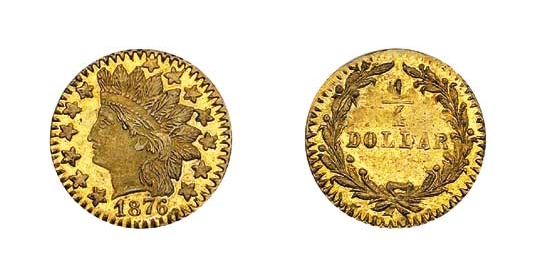
Obverse & Reverse
The 1876 BG-880 25-cent piece emerges from the second period of California Fractional Gold production (1859-1882), a fascinating era that saw these miniature gold coins transition from a necessary medium of exchange to popular souvenirs. The initial 'Period One' (1852-1857) issues were born of a genuine crisis in commerce during the Gold Rush: a massive influx of gold dust and nuggets with a severe shortage of small denomination federal coinage for daily transactions. Jewelers and assayers stepped into the breach, creating 25-cent, 50-cent, and one-dollar gold pieces that, despite their minuscule size, facilitated trade. However, by 1857, the San Francisco Mint was in full operation, alleviating the small-change shortage. The continued production of fractional gold pieces thereafter shifted in purpose. The 'Period Two' issues, including this 1876 piece, were primarily struck by jewelers as keepsakes and mementos of the romanticized Gold Rush era. These coins were lighter and often of lower fineness than their Period One predecessors, clearly not intended to circulate at face value but rather to be sold at a premium to tourists and collectors. The year 1876 was significant as it marked the Centennial of the United States, and there was a burgeoning market for historical and commemorative items. This specific variety, BG-880, features a Native American head, a popular and symbolic motif of the American West. Although the Coinage Act of 1864 made private coinage illegal, the law was not strictly enforced against these small, token-like pieces until the early 1880s, allowing their production to flourish. These pieces, often crudely struck by hand using a hammer method, represent the persistent entrepreneurial spirit of California and the lasting legacy of the Gold Rush in American culture.
Associated EventPost-California Gold Rush Souvenir Market
Reason For MintingPrimarily created as a souvenir or collectible item for the tourist trade, not for general circulation, capitalizing on the nostalgia of the Gold Rush.
Minter HistoryThe specific minter for BG-880 is unknown, which is common for 'Period Two' California Fractional Gold. Production during this time was dominated by various San Francisco jewelers, such as Frontier, Deviercy & Co. and others, who saw a commercial opportunity in manufacturing these small gold tokens. They operated outside the federal system, and attribution is often based on die characteristics and diagnostics rather than explicit mint marks.
Historical SignificanceThis coin is a tangible artifact of the commercialization of the Gold Rush legend. It represents a shift from utilitarian private coinage to souvenir production and is part of a widely collected series that captures the mythology of the American West. Its existence highlights a period of lax federal enforcement regarding private minting.
N/A
Denomination25 Cents (Quarter Dollar)
Minting Period1876
Assayer/MinterUnknown private minter, often attributed to jewelers in San Francisco.
Geographic OriginSan Francisco, California
Obverse DescriptionFeatures a stylized head of a Native American facing left, adorned with a feathered headdress. The portrait is encircled by 13 six-pointed stars representing the original colonies.
Obverse InscriptionNo textual inscription on the obverse.
Reverse DescriptionA simple wreath of two olive branches, tied with a ribbon at the bottom, encircles the denomination. The date '1876' is positioned below the wreath.
Reverse Inscription1/4 DOLLAR
CompositionGold
Stated Fineness Actual FinenessVariable, but generally lower than monetary-issue gold, often in the .500 to .800 range.
Weight0.24 grams
Diameter9.50 mm
EdgePlain
Unknown, but likely a few thousand pieces.
Survival EstimateSeveral hundred, perhaps 200-400 in all grades.
Rarity ScaleR-5
Collectors are drawn to the BG-880 for its classic 'Indian Princess' design, its connection to the Centennial year, and its status as an accessible example of the popular California Fractional Gold series. Its tiny size is also a point of significant novelty and fascination.
Key VarietiesThe primary catalog number is Breen-Gillio 880 (BG-880). While there are no major recognized varieties of BG-880 from the period, collectors should be aware of closely related BG numbers from the same year with different die characteristics. There are no known official restrikes or patterns. The collecting world of California Fractionals is, however, rife with contemporary counterfeits and later-made copies (often unmarked jewelry pieces or base metal electrotypes), which are not considered part of the core numismatic series.
Authentication TipsAuthentic pieces exhibit a specific die state and strike characteristics. Look for a slightly crude, hand-struck appearance, not a modern, machine-made look. The stars and feathers may show some softness. Counterfeits are widespread; many are underweight, have a soapy or cast-like appearance, or are made of gold-plated base metal. Comparison with high-resolution images of certified examples is essential. The '-G' in the full BG attribution often refers to the maker's mark 'G' (for Gaime, a known jeweler), which is not present on this variety.
Shopping ConsiderationsA premium quality example for its grade will possess a sharp strike, especially on the high points of the feathers and the digits of the date. Original, uncleaned surfaces with some remaining luster are highly desirable. Due to their small size, these coins are rarely found without some contact marks or light friction. Avoid examples that have been harshly cleaned, polished, or used in jewelry (showing signs of solder or mounting). Eye appeal is paramount; a well-centered strike on a clean planchet commands a significant premium.
A coin's grade is its condition, rated on a 1-70 scale. For rare coins, this is the most critical factor in determining value, as a tiny difference in preservation can mean a huge difference in price.
Relevant Grade TypesOriginal period issues were business strikes. Although intended as souvenirs, they were made using the same methods as circulating coins and are found in both Circulated (1-58) and Mint State (MS, 60-70) grades. No original Proofs (PR/PF) of this variety were struck. Any piece described as a 'Proof' is likely a later-date fantasy piece or a misattribution of a sharply struck, lustrous Mint State coin.
Mint State CharacteristicsUncirculated examples of BG-880 often display a soft, satiny luster rather than a hard, frosty one. The strike is characteristically weak in the center, particularly on the details of the headdress and the wreath. Planchet quality can be inconsistent, with minor natural imperfections. Bag marks, while present, are often less obtrusive due to the coin's minuscule size, but light friction from handling is common even on high-grade pieces.
Circulated Wear PatternsWear first appears on the highest points of the design: the cheek and the upper feathers of the headdress on the obverse. On the reverse, the leaves and the bow of the wreath will show the first signs of friction. In lower grades (VF and below), the stars will begin to merge with the fields, and the date and denomination will become weak.
Key Factors For ValueThe primary drivers of value are grade and surface preservation. An example with original, undisturbed luster and minimal contact marks will command a strong premium. Sharpness of strike is a key differentiator; a coin with a fully struck date and clear feather details is highly sought after. Eye appeal, encompassing attractive original gold toning and a clean planchet, is crucial. Third-party certification by PCGS or NGC is standard for this series, and a CAC sticker, indicating premium quality for the grade, adds a significant premium.
PCGS Price Guide
| Grade | Price | Population |
|---|---|---|
| 60 | $350.00 | N/A |
| 61 | $425.00 | N/A |
| 62 | $500.00 | 3 |
| 62+ | $525.00 | N/A |
| 63 | $600.00 | 11 |
| 63+ | $675.00 | N/A |
| 64 | $850.00 | 9 |
| 64+ | $1,250.00 | N/A |
| 65 | $3,000.00 | 4 |