1874 G50C BG-958, PL (Regular Strike)
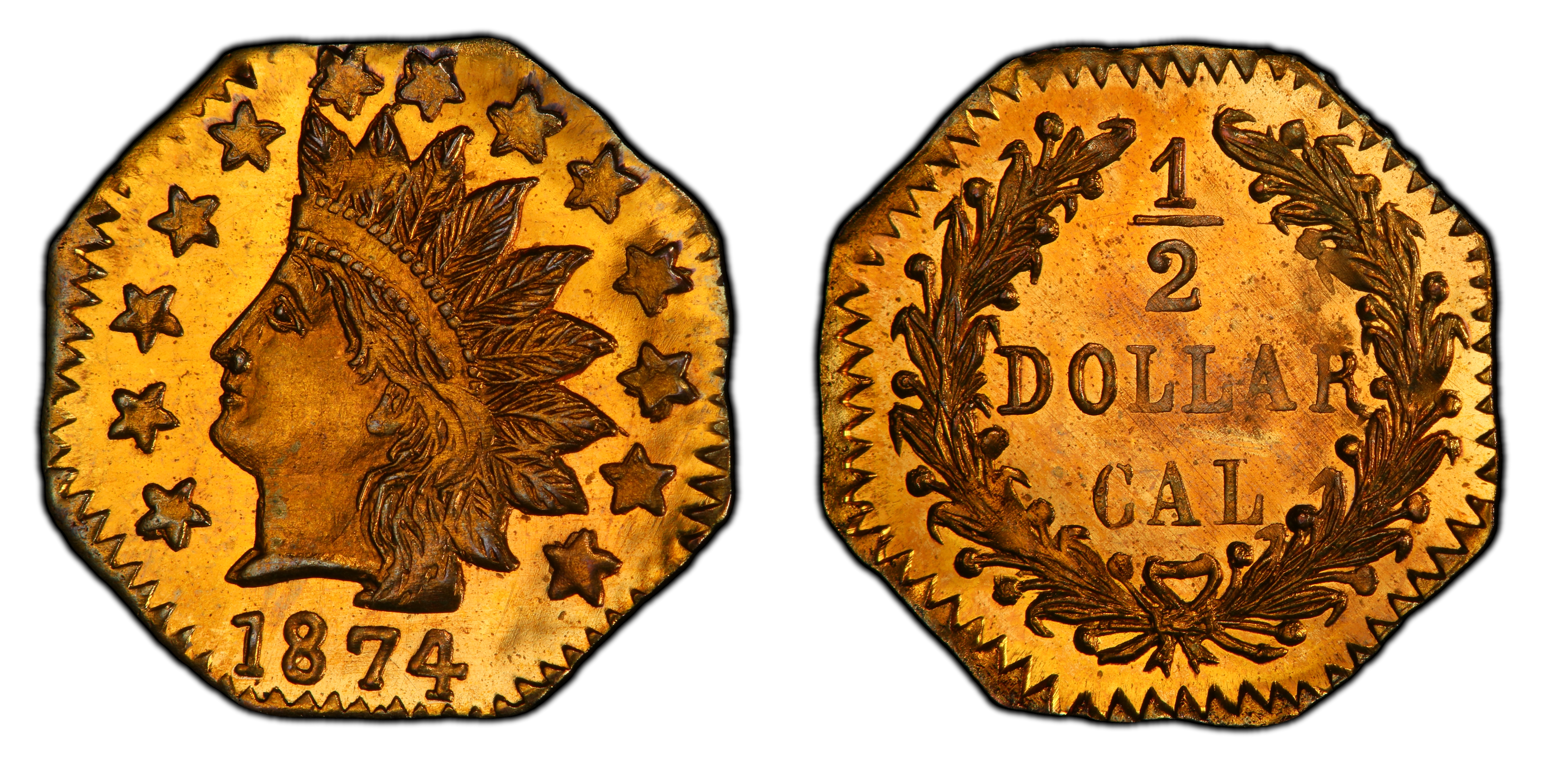
Obverse & Reverse
The 1874 BG-958 50 Cents piece is a fascinating artifact from the second period of California Fractional Gold production (1859-1882). Unlike the Period One issues, which were struck out of genuine commercial necessity to alleviate a severe shortage of small change during the initial Gold Rush, the Period Two pieces, often termed 'jeweler's issues,' occupy a more complex space in numismatic history. By the 1870s, the United States Mint in San Francisco was fully operational, and the acute need for private coinage had subsided. However, the romance of the Gold Rush and the novelty of tiny gold coins had created a strong demand for them as souvenirs, keepsakes, and items of jewelry. Enterprising jewelers and craftsmen in San Francisco continued to strike a wide variety of fractional denominations, often with more imaginative and sometimes cruder designs than their predecessors. These pieces were technically illegal following the Private Coinage Act of 1864, but enforcement was lax until the early 1880s. The BG-958 was struck in this environment. It was not intended to be a primary medium of exchange but rather a popular memento that captured the spirit of California's gold heritage. These coins were lightweight for their stated value, a common characteristic of jeweler's issues, as their worth was derived more from their novelty and material than their bullion content. The octagonal shape was a deliberate callback to the massive $50 'slugs' of the U.S. Assay Office, adding to their historical allure. The Large Head Indian design was a popular motif of the era, reflecting a national fascination with Native American imagery, albeit a romanticized one. Despite being souvenirs, many of these pieces did see some limited circulation, passed between individuals as curiosities or small gifts. Their modern numismatic significance is immense; they represent the closing chapter of America's vibrant private and territorial gold coining tradition, a final echo of the '49ers' spirit before federal authority fully consolidated the nation's monetary system.
Associated EventCalifornia Gold Rush (Later Souvenir Period)
Reason For MintingPrimarily struck to satisfy the robust demand for souvenirs and novelty items related to the California Gold Rush, rather than for circulation.
Minter HistoryThe specific minter or jeweler who created the dies for BG-958 is unknown, a common trait for many Period Two California Fractional Gold varieties. Production was decentralized among various San Francisco-based jewelers who struck them in small batches. These craftsmen operated outside the federal system, and records of their specific output are virtually nonexistent. Their primary business was jewelry and precious metal work, with the minting of these small gold pieces being a profitable sideline.
Historical SignificanceThe BG-958 is significant as a representative of the 'jeweler's issue' or Period Two fractional gold coins. It marks the transition of private gold coinage from a vital necessity for commerce to a popular souvenir industry, reflecting California's evolving identity and the enduring legend of its Gold Rush.
N/A
Denomination50 Cents
Minting Period1874
Assayer/MinterUnknown Private Minter
Geographic OriginSan Francisco, California
Obverse DescriptionFeatures a large, stylized bust of a Native American chief facing left, wearing a feathered headdress. The portrait is encircled by 13 five-pointed stars, representing the original colonies. The date '1874' is positioned below the bust.
Obverse Inscription1874
Reverse DescriptionA simple wreath composed of two branches tied by a ribbon at the bottom. The denomination '1/2' is in the center of the wreath. The inscription 'CAL.' is located above the wreath, and 'DOLLAR' is below it. The entire design is enclosed within the octagonal border of the coin.
Reverse InscriptionCAL. 1/2 DOLLAR
CompositionGold
Stated Fineness Actual FinenessVariable, but generally lower than federal coinage of the era, typical for Period Two issues.
Weight0.24 grams
Diameter10.00 mm
EdgePlain
Unknown, but extremely small.
Survival Estimate13-30 coins
Rarity ScaleHigh R-6
The BG-958 is highly sought after due to its extreme rarity, attractive Indian Head design, and classic octagonal shape. As a Period Two issue, it is a key component for specialists seeking to build a comprehensive collection of the entire California Fractional Gold series. Its scarcity ensures it is a highlight of any advanced collection.
Key VarietiesThe primary variety is the BG-958A. This variety was created when the reverse die was heavily polished, completely effacing the 'CAL.' above the wreath. The BG-958A is also a high rarity. No special collector restrikes or patterns from later periods are known to exist for this specific die pair.
Authentication TipsGenuine examples are very thin and struck on solid gold planchets. The strike is often uneven, with some softness in the high points. Look for a slightly prooflike or reflective surface, which is common for this issue. Counterfeits are often thicker, have a soapy or cast-like appearance, incorrect weight, and may be gold-plated base metal. The style of the engraving, particularly the shape of the numerals and letters, should be compared to known genuine examples. Authentication by a major third-party grading service is highly recommended.
Shopping ConsiderationsA premium quality example for this variety is defined by a sharp strike, especially on the Indian's cheek, the details of the headdress, and the numerals of the date. While many exhibit prooflike surfaces, finding one with deep, radiant reflectivity adds significant eye appeal. Original, uncleaned surfaces with a warm, reddish-gold patina are highly prized. Look closely for evidence of tooling in the fields or around the devices, as these rare coins were sometimes repaired. Avoid examples that have been used in jewelry, looking for signs of mounting or solder on the edges. Given the rarity, even problem-free circulated examples in AU grades are considered major acquisitions.
A coin's grade is its condition, rated on a 1-70 scale. For rare coins, this is the most critical factor in determining value, as a tiny difference in preservation can mean a huge difference in price.
Relevant Grade TypesAll original 1874 BG-958 coins were struck as business strikes, though they were intended as souvenirs and often have a prooflike (PL) appearance from polished dies. They are found in Circulated grades (AG-3 to AU-58) and, more frequently for this variety, in Mint State (MS-60 to MS-70). No true Proofs were struck during the original period of issue, and no later-date restrikes are known.
Mint State CharacteristicsUncirculated examples of BG-958 typically exhibit flashy, prooflike fields. The quality of the strike can vary; weakness is often seen on the high points of the Indian's hair and the center of the wreath on the reverse. The surfaces are very soft and susceptible to contact marks and hairlines, so a 'clean' MS example is rare and commands a significant premium. Luster is typically reflective rather than satiny. Some examples are known to be double-struck in the collar, which is a desirable characteristic.
Circulated Wear PatternsWear first appears on the highest points of the design: the Indian's cheekbone, the eyebrow ridge, and the feathers at the very top of the headdress. On the reverse, the highest points of the wreath's leaves and the fraction '1/2' will show the first signs of friction. In lower grades (VF and below), the stars on the obverse will begin to lose their sharpness, and the legends on the reverse will become soft.
Key Factors For ValueFor the BG-958, rarity is paramount, but within the small surviving population, value is driven by several factors. A sharp, well-centered strike is a primary determinant of quality. Surface preservation is critical; an example with minimal contact marks and clean, original prooflike fields will be valued far higher than a scuffy or cleaned piece of the same grade. Eye appeal, including any attractive toning (often a subtle rose or lilac patina over the gold), can add a significant premium. A CAC sticker for this issue is highly desirable, indicating a premium quality coin for the grade.
PCGS Price Guide
| Grade | Price | Population |
|---|---|---|
| 66 | $2,400.00 | 2 |