1852 G50C BG-963 (Regular Strike)
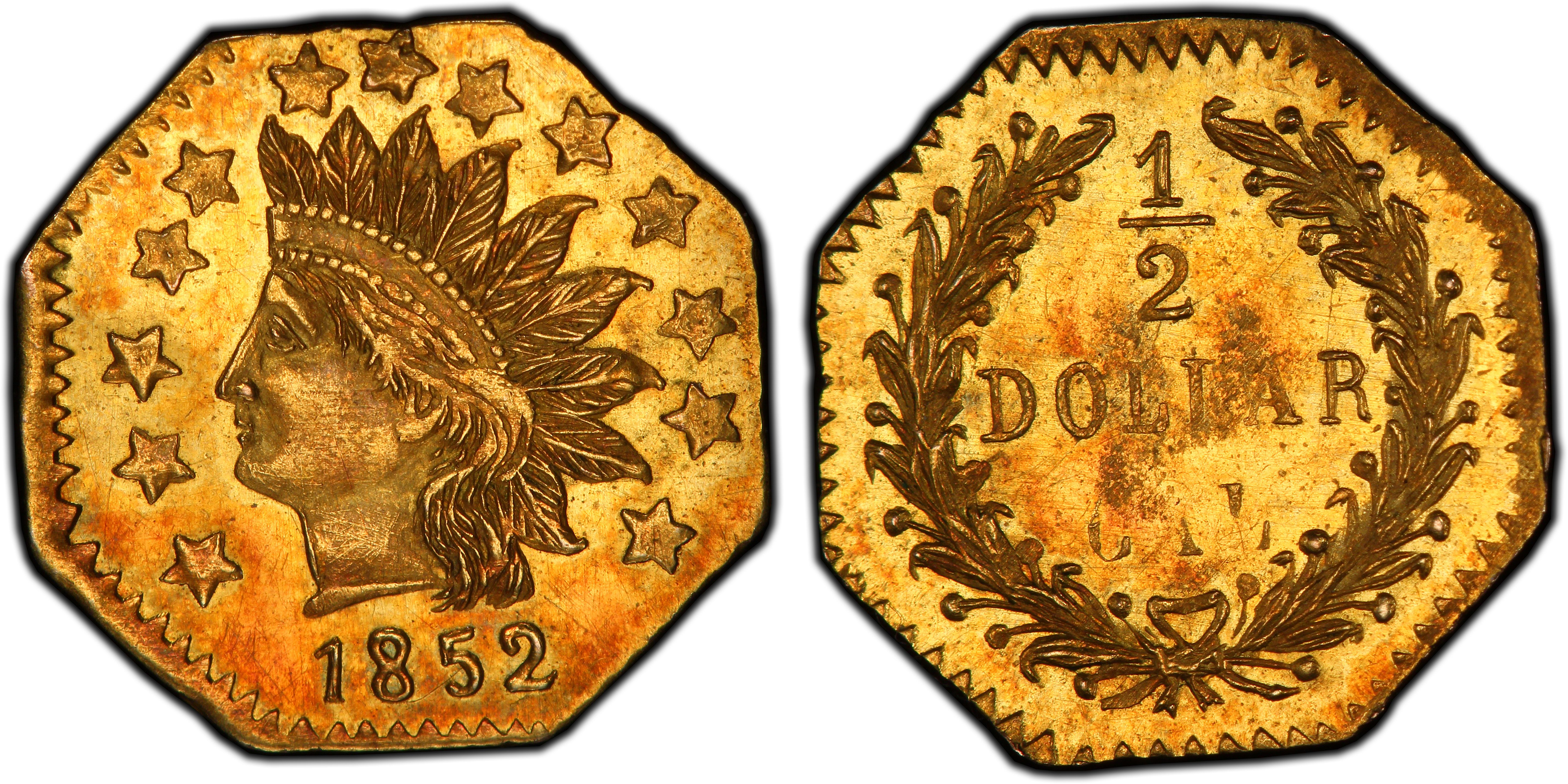
Obverse & Reverse
The 1852 BG-963 octagonal half dollar is a quintessential artifact from the chaotic, formative years of the California Gold Rush. Following the discovery of gold at Sutter's Mill in 1848, a massive influx of prospectors and merchants flooded into California, creating a vibrant but haphazard economy. While vast quantities of raw gold dust and nuggets were extracted, the region suffered from a severe, chronic shortage of circulating small-denomination coinage. Daily transactions for essentials like food, lodging, and tools were incredibly cumbersome, often relying on imprecise 'pinches' of gold dust, a system ripe for dispute and inconsistency. The United States government was slow to respond; the San Francisco Mint would not begin full operations until 1854. Into this economic vacuum stepped enterprising private jewelers and metallurgists, many of French origin, located primarily in San Francisco. Beginning in 1852, they began striking fractional denominations—quarter dollars, half dollars, and dollars—to facilitate everyday commerce. These initial issues, known as 'Period One' (1852-1857) fractionals, are considered by numismatists to be legitimate, circulating media of exchange born of necessity. The BG-963, with its crude but earnest 'Indian Princess' design, was struck during this earliest phase. The production methods were primitive, often involving hand-cut dies and manual screw presses or even the hammer method, resulting in coins of varying strike quality and irregular planchets. Though accepted in trade, these coins were technically underweight for their face value, a fact generally overlooked in the inflationary boom economy where any form of convenient currency was welcome. As federal coinage became more plentiful after 1854, the need for these private issues waned, and they transitioned from essential currency to popular souvenirs of the Gold Rush, eagerly purchased by miners to send back east. The Coinage Act of 1864 officially outlawed private currency, but the law wasn't strictly enforced until 1883, allowing a second period of 'jeweler's issues' (struck mainly as keepsakes) to flourish. The BG-963, as a Period One issue, remains a direct, tangible link to the initial crisis of commerce that defined one of America's most pivotal economic and social transformations.
Associated EventCalifornia Gold Rush
Reason For MintingTo alleviate a severe shortage of small-denomination coinage for daily commercial transactions in Gold Rush-era California.
Minter HistoryThe specific minter or jewelery firm responsible for the BG-963 die pair is not definitively known, which is common for many Period One California Fractional Gold varieties. The style of engraving and method of production are consistent with the work of several French-emigre jewelers known to be operating in San Francisco during 1852-1853. These craftsmen, including figures like M. Deriberpe, Antoine Louis Nouizillet, Pierre Frontier, and Eugene Deviercy, typically did not sign their earliest work. They operated small, private workshops, creating dies by hand and striking coins on demand to meet the immediate needs of the local economy. Their collective output, though not officially sanctioned, was crucial for the functioning of commerce in the region before the establishment of the San Francisco Mint.
Historical SignificanceAs a 'Period One' issue, the BG-963 is a historically significant piece that served as circulating money during the peak of the Gold Rush, representing a private solution to a government failure in supplying adequate coinage to the frontier.
K-Unlisted
Denomination50 Cents
Minting Period1852
Assayer/MinterUnknown Private Minter
Geographic OriginSan Francisco, California
Obverse DescriptionAn archetypal 'Indian Princess' head, facing left. The portrait is somewhat crudely engraved, with simple facial features and a feathered headdress. The portrait is encircled by thirteen five-pointed stars, typically unevenly spaced and of varying sharpness. The date '1852' appears below the bust.
Obverse Inscription1852
Reverse DescriptionThe denomination '50 CENTS' is enclosed within a wreath. The wreath is composed of two branches tied with a bow at the bottom. The legend 'CALIFORNIA GOLD' encircles the wreath along the octagonal border.
Reverse InscriptionCALIFORNIA GOLD / 50 CENTS
CompositionGold
Stated Fineness Actual FinenessVariable, typically 0.800 to 0.900. Period One fractionals were struck from native California gold bullion, which naturally contained significant amounts of silver, resulting in a slightly lower fineness and lighter color than federal issues.
Weight0.75 grams
Diameter11.20 mm
EdgePlain
Unknown
Survival Estimate13 to 30 pieces known
Rarity ScaleR-6
The BG-963 is highly sought after as a representative of the earliest, most historically significant period of California Fractional Gold. Its appeal lies in its crude charm, octagonal shape, classic 'Indian Head' motif, and direct connection to the urgent commercial needs of the Gold Rush. As an R-6 variety, its absolute rarity is a major driver for advanced collectors.
Key VarietiesThe BG-963 is a single, specific die marriage. Within the broader series, there are no known official restrikes or patterns associated with this variety. The primary variations in this series are the hundreds of different die pairings (BG numbers) produced by numerous private minters. No special collector issues of BG-963 are known to exist.
Authentication TipsAuthentic BG-963 specimens exhibit a characteristic crude engraving style and often a weak or uneven strike. The planchets are typically hand-cut and may show file marks or slight irregularities. The gold color should be slightly pale or 'lemony' due to the natural silver alloy. Key diagnostics include the exact positioning of the date relative to the bust and the alignment of letters and stars. Counterfeits, especially modern replicas, often feature a bear on the reverse (no genuine Period One fractionals do), are frequently gold-plated base metal, and may have a sharp, modern, machine-struck appearance that is too 'perfect' for the period. Third-party authentication is strongly recommended for any potential purchase.
Shopping ConsiderationsFor a 'premium quality' BG-963, a buyer should prioritize a bold strike, especially on the high points of the Indian's cheek and the wreath details. Given the primitive manufacturing, perfectly centered and fully struck examples are rare and command significant premiums. Look for original, uncleaned surfaces with some remaining mint luster; a pleasing, honest 'skin' is far more desirable than a bright, dipped appearance. Check carefully for evidence of having been mounted in jewelry, such as solder marks, tooling, or edge damage, which are common problems for this series. A sharp, clear date is also a key value attribute. Weakness on peripheral lettering is common and should be expected.
A coin's grade is its condition, rated on a 1-70 scale. For rare coins, this is the most critical factor in determining value, as a tiny difference in preservation can mean a huge difference in price.
Relevant Grade TypesOriginal BG-963 coins were business strikes intended for circulation and are found in Circulated grades (AG-3 to AU-58) and, very rarely, in Mint State (MS, 60-70). No proofs were struck during the original minting period. While some later-period jeweler's issues (post-1857) were struck on polished planchets giving a 'proof-like' (PL) appearance, these are distinct from this earlier, circulating issue.
Mint State CharacteristicsAn uncirculated BG-963 will exhibit frosty or satiny mint luster, though it is often subdued due to the quality of the planchet and strike. A sharp strike is paramount, but even high-grade examples will show some softness in the design, particularly around the periphery. Contact marks are common due to the softness of the gold and rough handling in bags, but large, distracting marks on the central devices will detract significantly from the grade and eye appeal.
Circulated Wear PatternsWear first appears on the high points of the design: the Indian's cheekbone, the feathers in the headdress, and the highest leaves of the wreath on the reverse. On moderately circulated examples (Fine to Very Fine), significant detail will be lost in the hair and feathers, and the individual leaves of the wreath will begin to merge. In lower grades, the stars and legends become faint, and the date can be partially obliterated.
Key Factors For ValueBeyond the numerical grade, value is driven by strike quality, surface preservation, and eye appeal. A sharply struck coin with minimal distracting marks will always command a premium over a weakly struck or heavily marked coin of the same grade. Original, uncleaned surfaces with a hint of reddish or mellow toning are highly prized by experienced collectors. The presence of a CAC sticker, indicating a premium quality coin for the grade, adds a significant premium for this and other Territorial gold issues.
PCGS Price Guide
| Grade | Price | Population |
|---|---|---|
| 60 | $600.00 | N/A |
| 61 | $650.00 | 2 |
| 62 | $700.00 | N/A |
| 62+ | $735.00 | N/A |
| 63 | $800.00 | 7 |
| 63+ | $875.00 | N/A |
| 64 | $950.00 | 6 |
| 64+ | $1,075.00 | N/A |
| 65 | $1,400.00 | 2 |