1853 G$1 BG-505, PL (Regular Strike)
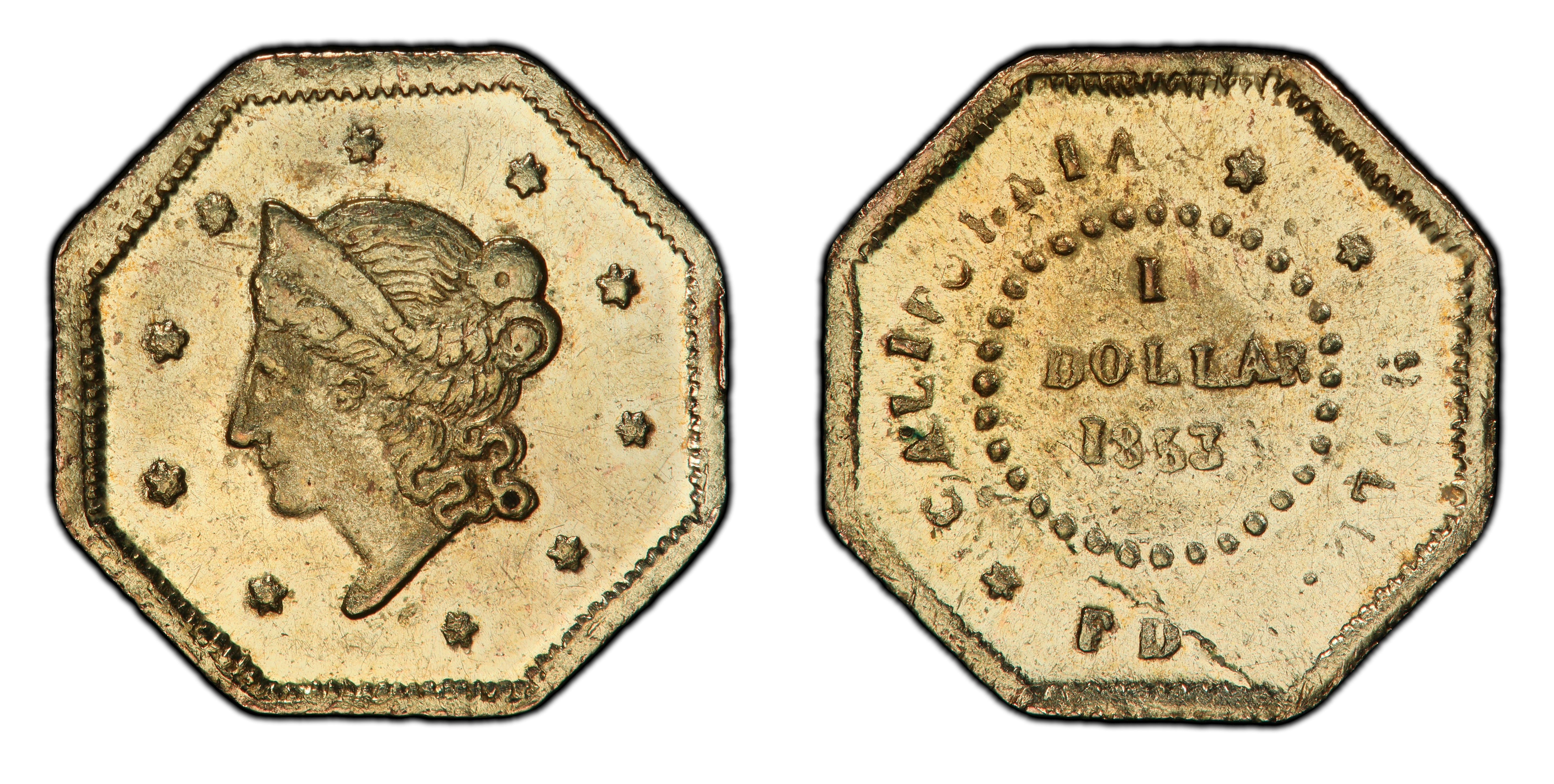
Obverse & Reverse
The 1853 Nouizillet Gold Dollar, cataloged as Breen-Gillio 505 (BG-505), is a fascinating artifact from the chaotic and vibrant economy of the California Gold Rush. Following the discovery of gold at Sutter's Mill in 1848, a massive influx of prospectors and merchants flooded into California. This rapid population growth created a severe shortage of circulating coinage, particularly for small-scale daily transactions. While the newly established U.S. Mint in San Francisco would not begin operations until 1854, the immediate economic need was met by a host of private minters. Jewelers, assayers, and metallurgists stepped into the breach, producing a wide array of tokens and coins, often with inconsistent weights and fineness. These 'California Fractional Gold' pieces, struck in denominations of 25 cents, 50 cents, and one dollar, served as a vital, albeit unregulated, medium of exchange. They were used to buy everything from a meal to a mining pan. Antoine Louis Nouizillet, a French jeweler and watchmaker who had immigrated to San Francisco, was one of the most prolific of these private minters. His 1853 Gold Dollar, with its distinctive 'Large Liberty Head' design, was one of his earliest issues. These pieces were not official government currency and their value was based on the public's trust in the issuer's reputation. The BG-505 was likely struck in limited quantities, intended to satisfy local commercial needs. However, the variable quality of private gold and the passage of federal laws in 1864 criminalizing private coinage eventually led to the decline and disappearance of these pieces from circulation. Many were melted down over the years, contributing to their present-day rarity. The BG-505 stands as a tangible link to the entrepreneurial spirit and economic necessity that defined one of America's most dynamic historical periods.
Associated EventCalifornia Gold Rush
Reason For MintingTo alleviate a severe shortage of small-denomination coinage for everyday commercial transactions in Gold Rush-era California.
Minter HistoryAntoine Louis Nouizillet was a French immigrant, likely arriving in San Francisco in the early 1850s to capitalize on the opportunities presented by the Gold Rush. He established himself as a jeweler and watchmaker, skills that provided him with the necessary metallurgical and engraving expertise to venture into private coining. From his shop, he produced a significant number of different varieties of California Fractional Gold pieces between 1852 and 1856. His work is characterized by a distinctive style, often featuring a somewhat crude but charming Liberty Head motif. While not as refined as the products of the official U.S. Mint, his coins were essential to the local economy and represent an important chapter in the history of private American coinage.
Historical SignificanceThe BG-505 is a quintessential example of 'Period One' (1852-1857) California Fractional Gold, representing a privately-issued solution to a government failure in supplying adequate currency during the Gold Rush. It highlights the resourcefulness of local artisans and entrepreneurs and serves as a direct monetary artifact of the turbulent but enterprising economy of mid-19th century San Francisco. Its existence underscores the practical challenges faced by pioneers and merchants in a region suddenly rich in gold dust but poor in standardized currency.
N/A
Denomination$1
Minting Period1853
Assayer/MinterAntoine Louis Nouizillet
Geographic OriginSan Francisco, California
Obverse DescriptionA large, somewhat crude bust of Liberty facing left, with thirteen stars surrounding the portrait. The date '1853' is positioned below the bust. The design is attributed to Nouizillet and is distinct from the federal Liberty Head design of the era.
Obverse Inscription1853
Reverse DescriptionThe denomination '1' is centrally located, surrounded by the word 'DOLLAR'. A wreath of two branches, tied with a bow at the bottom, encircles the denomination. The legend 'CALIFORNIA GOLD' is inscribed around the periphery, inside a beaded border.
Reverse InscriptionCALIFORNIA GOLD 1 DOLLAR
CompositionGold
Stated Fineness Actual FinenessTypically around .850 to .900, though it can vary.
Weight1.00 grams
Diameter13.90 mm
EdgePlain
Unknown, but presumed to be very small.
Survival EstimateFewer than 75
Rarity ScaleR-6 (13 to 30 known)
This coin is highly sought after for its historical importance as a genuine 'Period One' California Fractional Gold piece, its direct connection to the Gold Rush, and its high rarity. The primitive yet charming design and the story of its private issuance in San Francisco add significant allure.
Key VarietiesThe BG-505 itself is the key variety. No major sub-varieties from the original minting period are widely recognized. There are no known patterns, trial pieces, or later-date restrikes associated with this specific Nouizillet issue. Collectors should be aware of contemporary counterfeits and modern replicas, which are entirely different items.
Authentication TipsAuthentic examples often show a slightly crude, hand-engraved quality. Check for die characteristics specific to BG-505, such as the exact positioning of the stars and letters. The weight and diameter should be close to the specifications, though slight variations are common. Many fakes are cast rather than struck, so look for a soft, soapy appearance and the absence of sharp striking details. Edges on genuine pieces are typically plain and can show file marks from planchet preparation. Compare against high-resolution images of certified specimens.
Shopping ConsiderationsA premium quality example for this issue is one that retains strong striking details, particularly on Liberty's hair and the leaves of the wreath. Many specimens are weakly struck, especially in the centers. Look for pleasing, original surfaces with some remaining mint luster; a reddish-gold or deep yellow-gold patina is often seen and is desirable. Avoid examples that have been harshly cleaned, polished, or show signs of tooling or repair, as these issues drastically reduce value. Small, honest planchet flaws or adjustment marks from the private minting process are generally accepted by specialists and can be part of the coin's character.
A coin's grade is its condition, rated on a 1-70 scale. For rare coins, this is the most critical factor in determining value, as a tiny difference in preservation can mean a huge difference in price.
Relevant Grade TypesOriginal period issues like the BG-505 were business strikes intended for circulation. They are found in Circulated grades (AG-3 to AU-58) and, very rarely, in Mint State (MS-60 to MS-70). No Proof (PR/PF) examples were struck by Nouizillet during the original period of issue, and no later-date Proof restrikes are known to exist for this variety.
Mint State CharacteristicsAn uncirculated BG-505 is exceptionally rare. Such a piece would exhibit full, unbroken mint luster, which is typically soft and satiny rather than deeply frosty. The strike is a key consideration; many are weakly struck in the center, so a coin with sharp details on Liberty's hair curls and the wreath's leaves commands a significant premium. Due to the rudimentary minting process and soft gold, even Mint State examples will likely display minor planchet imperfections or light handling marks from their brief time in commerce before being saved.
Circulated Wear PatternsWear first appears on the highest points of the design. On the obverse, this is Liberty's cheek, the hair just above the ear, and the highest curls of hair. On the reverse, friction will first be evident on the numeral '1' and the high points of the wreath leaves and bow. In lower grades (VG and below), the date and legends will become weak, and Liberty's facial features will be significantly worn down.
Key Factors For ValueRarity is the primary driver of value for this issue. Beyond that, the most significant factor is surface quality. An example with original, uncleaned 'skin' and attractive eye appeal is worth multiples of a harshly cleaned or polished specimen in the same technical grade. Strike sharpness is also critical; a well-struck coin with full details is highly desirable. Finally, certification by a top-tier grading service (PCGS or NGC) is essential for market acceptance, and a CAC sticker indicating premium quality for the grade will add a substantial price premium.
PCGS Price Guide
| Grade | Price | Population |
|---|---|---|
| 63 | $4,500.00 | N/A |
| 63+ | $5,000.00 | N/A |
| 64 | $6,750.00 | 1 |
| 64+ | $7,500.00 | N/A |
| 65 | $9,000.00 | N/A |