1874 G25C BG-845 (Regular Strike)
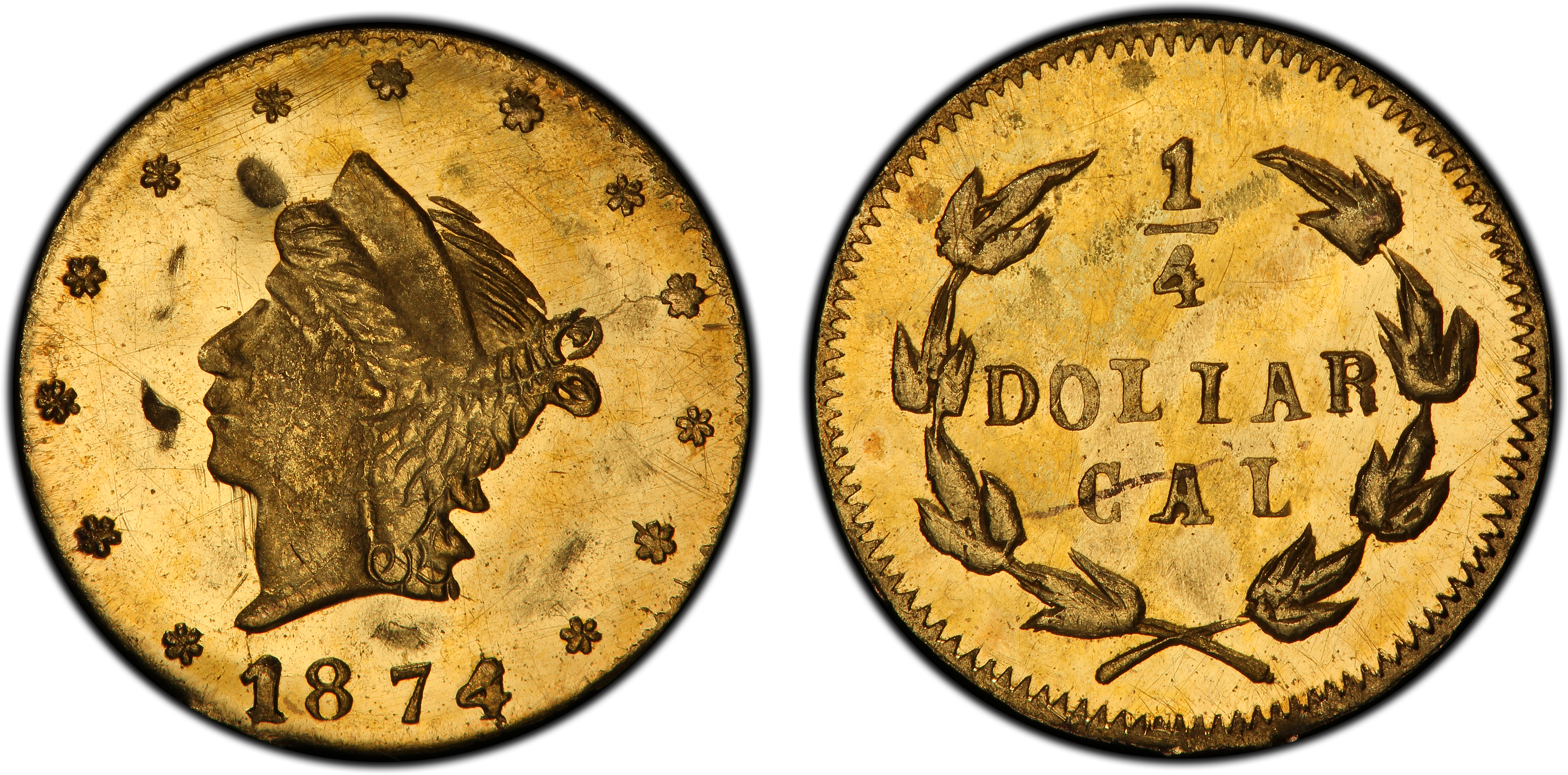
Obverse & Reverse
The 1874 BG-845 25 Cents is a quintessential example of 'Period Two' California Fractional Gold. By the mid-1870s, the acute shortage of small change that had plagued California during the initial Gold Rush had largely been resolved by the output of the San Francisco Mint. The impetus for producing these minuscule gold pieces had shifted dramatically from commerce to souvenir and novelty. Unlike their 'Period One' predecessors (1852-1857), which were struck with at least a nominal intent to circulate and often contained close to their face value in gold, Period Two issues were created primarily by jewelers for the tourist trade, as keepsakes of a visit to the romanticized West, and for use in jewelry. The Coinage Act of 1864 had explicitly prohibited private coinage, but enforcement by the Secret Service was inconsistent and focused on pieces that too closely resembled federal issues. The jewelers of San Francisco and other locales continued to produce these denominated tokens, often undeterred, until a more serious crackdown in the early 1880s. The year 1874 was a time of continued economic development in California, but also one of significant national economic turmoil following the Panic of 1873. While the state's economy was somewhat insulated by its gold production, the desire for small, affordable gold trinkets likely remained strong among visitors and residents alike. These pieces were not intended for circulation; they were underweight, often of debased fineness, and served as charming mementos. The BG-845, with its classic Liberty Head motif, would have evoked the design of official U.S. gold coinage, adding to its appeal as a souvenir. Its R-6 rarity today indicates a very small original production run, likely numbering in the mere hundreds, if not dozens, with very few surviving for modern collectors.
Associated EventPost-Gold Rush Economic Period
Reason For MintingPrimarily struck as a souvenir or for use in jewelry, not for circulation, during a period when the initial shortage of small change had subsided.
Minter HistoryThe specific maker or jeweler responsible for the BG-845 die pair is unknown to numismatic researchers. During 'Period Two' (1858-1882) of California Fractional Gold production, many varieties were created by a number of San Francisco-based jewelers such as Robert B. Gray & Co. and the Levison Brothers, but specific attribution for this variety has been lost to history. These minters operated in a legal gray area, creating pieces that were technically illegal but often tolerated as tokens.
Historical SignificanceThe BG-845 is significant not as a circulating coin, but as a tangible artifact of California's transition from a frontier economy to a more established society with a burgeoning tourist trade. It represents the commercialization of the Gold Rush legacy, where the romance of gold was captured and sold in miniature, souvenir form. Its existence highlights a fascinating and often overlooked chapter of American private minting history after the Civil War.
BG-845
Denomination25 Cents
Minting Period1874
Assayer/MinterUnknown
Geographic OriginSan Francisco, California
Obverse DescriptionA small Liberty Head, facing left, modeled after the contemporary designs on federal gold coinage. The portrait is surrounded by 13 six-pointed stars, representing the original colonies. The date, 1874, appears below the bust truncation.
Obverse Inscription1874
Reverse DescriptionThe denomination, presented as '1/4 DOLLAR CAL.', is enclosed within a wreath. The wreath is composed of two olive branches tied together with a bow at the bottom.
Reverse Inscription1/4 DOLLAR CAL.
CompositionGold
Stated Fineness Actual FinenessUnknown, but Period Two issues are notoriously variable and often of lower fineness than official U.S. coinage (which was .900 fine). Fineness could range from 9 to 14 karats.
EdgePlain
Unknown
Survival Estimate13-30 coins known
Rarity ScaleR-6
This coin is highly sought after due to its high rarity (R-6), classic Liberty Head design, and its status as a representative of the popular and historically rich California Fractional Gold series. As a 'Period Two' issue, it tells the story of the souvenir and jewelry trade that grew from the Gold Rush legend. High-grade, problem-free examples are exceptionally rare and command strong premiums.
Key VarietiesNo major varieties are listed for BG-845 in standard references. The 'Regular Strike' designation is standard for this issue. No known patterns, trial pieces, or official restrikes exist. All known examples are considered original business strikes, albeit for souvenir purposes.
Authentication TipsAuthentic pieces should exhibit a sharp, albeit sometimes uneven, strike from manually operated presses. The stars and lettering, while small, should be well-defined on high-grade examples. The surfaces of uncirculated pieces often have a prooflike or satiny finish characteristic of the series. Beware of modern replicas, which are common for all fractional gold. Replicas often have incorrect design details (such as a bear on the reverse), a soapy or cast-like appearance, wrong weight, and are typically made of brass or thinly plated base metal. Genuine pieces must have a denomination; pieces marked 'CAL GOLD' without a denomination are tokens.
Shopping ConsiderationsFor a premium quality BG-845, a buyer should seek an example with a sharp strike, particularly on Liberty's hair details and the leaves of the reverse wreath. Original, lustrous surfaces are paramount; many surviving pieces have been cleaned, polished, or previously mounted as jewelry. Look for remnants of solder or tooling under magnification. An attractive reddish-gold or mellow original toning is highly desirable. Avoid specimens with significant planchet flaws, harsh cleanings, or notable distracting marks. Given the R-6 rarity, any example without impairment is a significant find. Third-party certification by PCGS or NGC is highly recommended for authenticity and liquidity.
A coin's grade is its condition, rated on a 1-70 scale. For rare coins, this is the most critical factor in determining value, as a tiny difference in preservation can mean a huge difference in price.
Relevant Grade TypesOriginal period issues were business strikes intended for the souvenir market, not for circulation, but they are graded on the same scale. They are found in Circulated (1-58) and Mint State (MS, 60-70) grades. No true Proof (PR/PF) examples of this variety were struck during the original period. Some Mint State pieces may exhibit prooflike (PL) surfaces due to the manner of their manufacture (struck on polished planchets), but these are distinct from true Proofs.
Mint State CharacteristicsUncirculated examples of BG-845 are characterized by their luster, which is typically either satiny or semi-prooflike. The strike can be inconsistent; a well-struck piece will show clear definition in the strands of Liberty's hair and the individual leaves on the reverse wreath. Weakness is common in the center of the coin due to the challenges of striking such a small piece. Small planchet flaws or adjustment marks are not uncommon and should be evaluated for their impact on eye appeal. Contact marks, even small ones, can be very distracting on such a tiny coin and will significantly impact the grade.
Circulated Wear PatternsAlthough not intended for circulation, some pieces may show wear from handling or use in jewelry. Wear first appears on the highest points of the design: the hair above Liberty's eye and ear, her cheekbone, and the highest leaves and bow of the wreath on the reverse. On more heavily worn examples, the stars and letters in the legends will begin to weaken and merge with the fields.
Key Factors For ValueThe primary drivers of value for an 1874 BG-845 are its rarity and grade. Surface quality is critical; a coin with original, undisturbed luster and pleasing eye appeal will command a significant premium over one that is cleaned, polished, or damaged. Strike quality is also key; collectors will pay more for a sharply struck example where the fine details are clear. The absence of planchet problems or distracting marks is a major plus. Certification by a top-tier service (PCGS or NGC) is essential, and a CAC sticker on a certified coin would add a further premium, confirming its quality for the assigned grade.
PCGS Price Guide
| Grade | Price | Population |
|---|---|---|
| 55 | $420.00 | 2 |
| 55+ | $430.00 | N/A |
| 58 | $475.00 | 2 |
| 58+ | $495.00 | N/A |
| 60 | $600.00 | 1 |
| 61 | $700.00 | 5 |
| 62 | $825.00 | 7 |
| 62+ | $950.00 | N/A |
| 63 | $1,250.00 | 2 |
| 63+ | $1,425.00 | N/A |
| 64 | $1,750.00 | 2 |