1870 G25C BG-808 (Regular Strike)
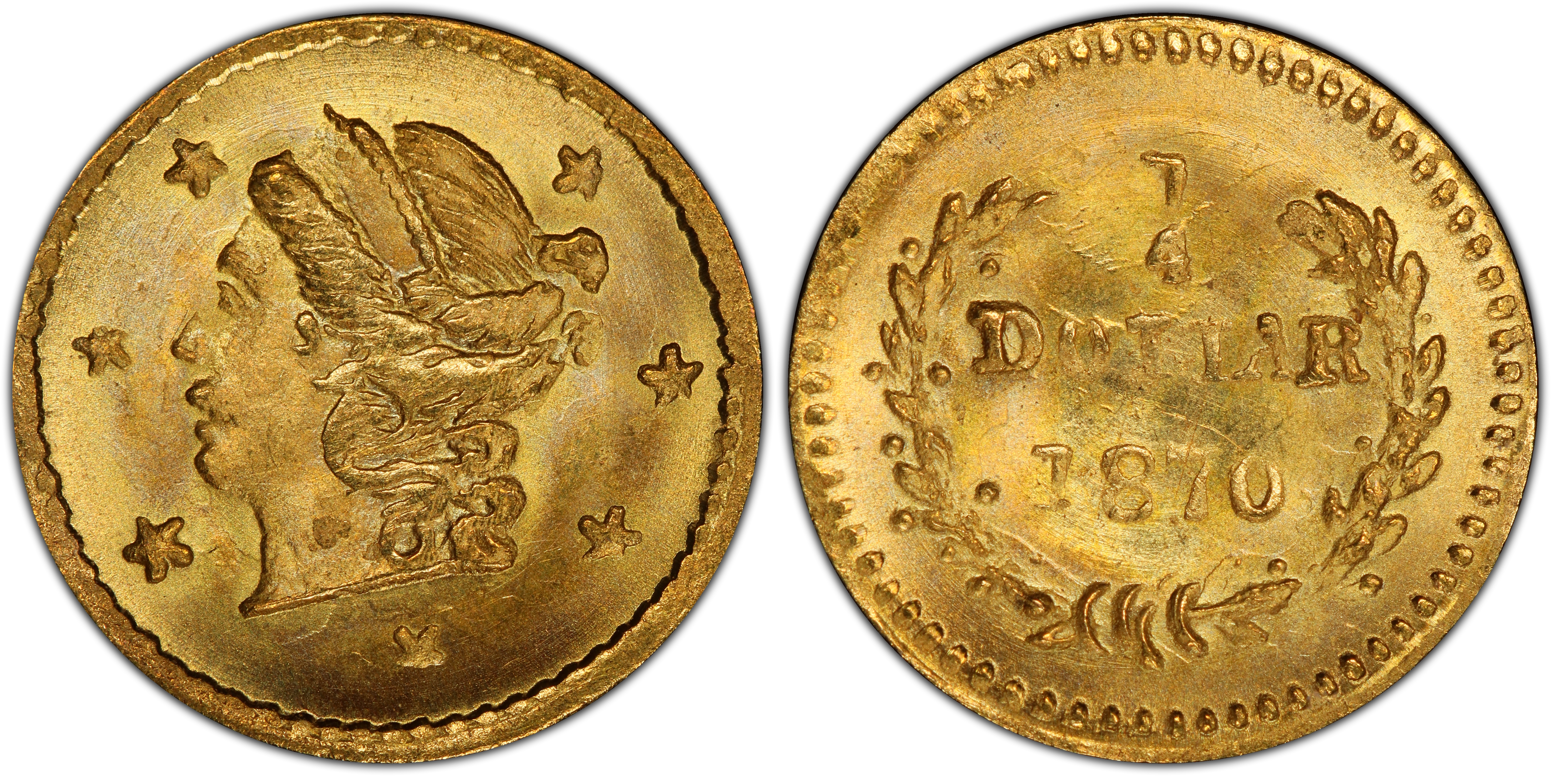
Obverse & Reverse
The 1870 G25C BG-808 is a product of the second period (1859-1882) of California Fractional Gold production, a fascinating and complex chapter in American numismatics. The initial California Gold Rush (beginning in 1848) created a booming economy on the West Coast, but the United States Mint was slow to provide adequate small-denomination coinage for daily commerce. Gold dust and tiny nuggets were impractical for small transactions, leading private jewelers and metallurgists, primarily in San Francisco, to begin striking their own miniature coins from native gold in 1852. These early 'Period One' issues were genuinely intended to alleviate the coin shortage. By 1870, however, the landscape had changed. The San Francisco Mint was in full operation, and the most acute phase of the coin shortage had passed. The production of fractional gold pieces transitioned from a commercial necessity to a cottage industry catering to a different market. These 'Period Two' pieces, often called 'jeweler's issues,' were primarily manufactured by French jewelers and their partners. They were thinner and contained less gold than their stated face value, making them profitable to produce and sell as souvenirs, keepsakes for tourists, and novelty items for local citizens. The BG-808, struck in 1870, fits squarely into this later period. It was not intended to be a primary medium of exchange but rather a memento of the Gold Rush era that was still very much a part of California's identity. These tiny gold pieces were affordable symbols of the state's immense mineral wealth and were popular as watch fobs, cufflink inserts, and good luck charms. The anonymous nature of the minter is typical for this period, as many small jewelers produced similar pieces without specific identifying marks.
Associated EventPost-Gold Rush California Economy
Reason For MintingPrimarily created as souvenirs and novelty items for tourists and locals, rather than to alleviate a major coin shortage as the earlier issues had.
Minter HistoryThe specific minter for BG-808 is unknown, as is common for many 'jeweler's issues' of the 1860s and 1870s. Production was often carried out by small, independent jewelers in San Francisco who possessed the skills for die-sinking and striking but did not operate as formal, named mints. Many of these craftsmen were of French origin.
Historical SignificanceThe BG-808 represents the evolution of California Fractional Gold from utilitarian currency to commercial souvenirs. It is a tangible link to the burgeoning tourism industry of late 19th-century California and the romanticism that had already begun to surround the Gold Rush. As a 'Period Two' issue, it tells a story of economic maturity and the commercialization of a historic event.
N/A
DenominationG25C (25 Cents)
Minting Period1870
Assayer/MinterUnknown private minter, likely a San Francisco jeweler.
Geographic OriginSan Francisco, California
Obverse DescriptionA head of Liberty facing left, with thirteen stars surrounding the portrait. The design is a miniature rendition of the motif used on contemporary federal gold coinage.
Obverse Inscription Reverse DescriptionThe denomination '1/4' is enclosed within a wreath of leaves and berries. The word 'DOLLAR' and the date '1870' appear below the wreath.
Reverse Inscription1/4 DOLLAR 1870
CompositionGold
Stated Fineness Actual FinenessVariable, but generally lower than federal coinage of the era, consistent with jeweler's issues.
Diameter9.80 mm
EdgePlain
Unknown
Survival Estimate76-150 (Per PCGS Population Report)
Rarity ScaleR-4
This variety appeals to collectors due to its affordability relative to earlier Period One issues, its classic Liberty Head design, and its status as a genuine artifact of the post-Gold Rush era. Its small size makes it a fascinating and intricate miniature.
Key VarietiesThe primary variety is the regular business strike. No known proof restrikes or patterns are associated with BG-808. Collectors of the series focus on the numerous die varieties (BG numbers) cataloged by Walter Breen and Ronald J. Gillio. There are no major sub-varieties of BG-808 itself, but the broader 1870 G25C category contains numerous other BG numbers with distinct design or die characteristics.
Authentication TipsGenuine pieces exhibit sharp, albeit sometimes uneven, strike details from hand-operated presses. The surfaces should have a natural, slightly satiny gold luster. Counterfeits are common and often appear soapy, with poorly defined details, incorrect weight, or a brassy, plated appearance. Many modern replicas exist, so authentication by a reputable third-party grading service like PCGS or NGC is highly recommended.
Shopping ConsiderationsA premium quality example for its grade will possess a sharp strike, especially on Liberty's hair details and the numerals of the date. Look for coins with clean, original surfaces that have not been harshly cleaned, polished, or used as jewelry. Luster is a key factor; a coin with attractive satiny or prooflike luster will command a significant premium. Avoid examples with scratches, rim bumps, or evidence of being mounted. Because they were often kept as souvenirs, many have survived in high grades, but finding a truly choice, mark-free specimen can be challenging.
A coin's grade is its condition, rated on a 1-70 scale. For rare coins, this is the most critical factor in determining value, as a tiny difference in preservation can mean a huge difference in price.
Relevant Grade TypesOriginal period issues were business strikes, many of which were sold as souvenirs and never circulated. Therefore, they are most commonly found in Mint State (MS, 60-70) grades. Circulated examples (1-58) exist but are less common. No true Proofs were struck during the original period of issue for this variety. Some examples may be designated 'Prooflike' (PL) by grading services if they exhibit mirrored fields from polished dies, but they are still considered business strikes.
Mint State CharacteristicsUncirculated examples of BG-808 are characterized by a soft, satiny luster. The strike is often somewhat soft on the highest points, such as the stars and Liberty's hair. Due to the hand-striking process, perfect centering is not always the norm. Small planchet flaws or striations are common and generally accepted for the type. The tiny size makes even minor contact marks appear significant, so clean surfaces are a major value driver.
Circulated Wear PatternsOn circulated examples, wear first appears on the high points of Liberty's hair, cheek, and the leaves in the wreath. On the reverse, the fraction '1/4' and the date will show initial flatness. In lower grades (VF and below), the stars on the obverse will begin to merge with the fields, and the finer details of the wreath will be lost.
Key Factors For ValueThe primary drivers of value for an 1870 BG-808 are grade and surface quality. A high-grade Mint State coin (e.g., MS-64 or higher) with original luster and minimal contact marks will sell for a substantial premium over a typical MS-62. Eye appeal is paramount; coins with a pleasing, original reddish-gold toning are highly sought after. A CAC sticker, indicating premium quality for the grade, adds significant value and liquidity to these small but desirable pieces.
PCGS Price Guide
| Grade | Price | Population |
|---|---|---|
| 20 | N/A | N/A |
| 55 | $190.00 | 2 |
| 55+ | $195.00 | N/A |
| 58 | $200.00 | 3 |
| 58+ | $210.00 | N/A |
| 60 | $220.00 | 3 |
| 61 | $230.00 | 4 |
| 62 | $275.00 | 25 |
| 62+ | $315.00 | N/A |
| 63 | $350.00 | 42 |
| 63+ | $375.00 | N/A |
| 64 | $425.00 | 75 |
| 64+ | $525.00 | 1 |
| 65 | $625.00 | 48 |
| 65+ | $700.00 | N/A |
| 66 | $875.00 | 20 |
| 66+ | $1,000.00 | N/A |
| 67 | $2,100.00 | 5 |
| 67+ | $3,250.00 | 2 |
| 68 | $5,250.00 | 1 |