1876 G25C BG-882 (Regular Strike)
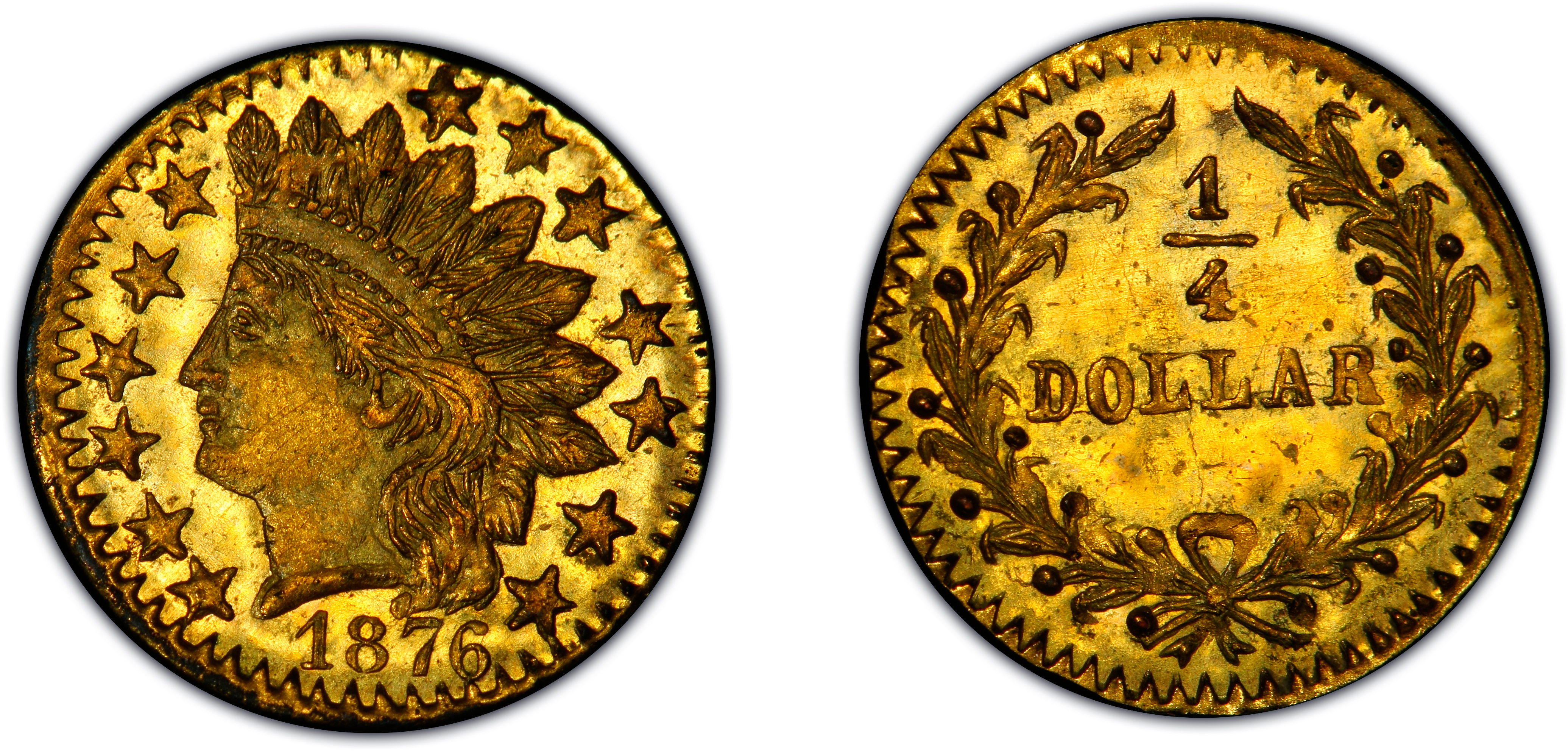
Obverse & Reverse
The 1876 BG-882 25 Cents is a quintessential example of a 'Period Two' California Fractional Gold piece. The series' origins trace back to the California Gold Rush of 1849, which created a massive and sudden influx of population and gold dust, but a severe shortage of circulating small-denomination coinage for daily commerce. To fill this void, private jewelers and metallurgists began striking their own quarter dollar, half dollar, and dollar coins starting in 1852. These initial 'Period One' (1852-1857) issues were generally of high gold content and were intended to, and did, circulate as a necessary medium of exchange. However, by the late 1850s, the newly established San Francisco Mint was producing sufficient quantities of federal silver and gold coins, alleviating the initial shortage. The nature of fractional gold production subsequently shifted. The BG-882, struck in 1876, belongs to the second epoch (1858-1882), often dubbed the 'Jeweler's Issues.' These pieces were not created out of commercial necessity but to satisfy a burgeoning market for souvenirs and keepsakes. As the allure of the Wild West and the Gold Rush captivated the nation, particularly during the Centennial celebrations of 1876, these miniature gold coins became popular tokens for tourists and collectors. Consequently, Period Two issues were often intentionally underweight and sometimes of lower fineness compared to their stated value, functioning more as tokens than true coinage. The Coinage Act of 1864 had made private coinage illegal, but enforcement was lax, allowing jewelers to continue production for decades. It wasn't until a Secret Service crackdown in 1883 that the manufacture of these fascinating pieces was finally halted. The BG-882 is a tangible link to this later, more commercial phase of private gold minting, representing a memento of the Gold Rush's enduring legacy rather than a tool of its frantic commerce.
Associated EventPost-Gold Rush California Commerce
Reason For MintingPrimarily struck as a souvenir or collectible item for the tourist trade, not for monetary circulation.
Minter HistoryThe specific maker of BG-882 is unknown, a common trait for many 'Period Two' issues. They were typically produced by various San Francisco-based jewelers and artisans who saw a commercial opportunity in selling miniature gold tokens to tourists and individuals back East who were fascinated by the California Gold Rush.
Historical SignificanceThis coin is historically significant not as a circulating medium, but as a cultural artifact representing the commercialization of the Gold Rush legend. It marks the transition of fractional gold from a necessary form of currency to a popular souvenir, reflecting a maturing California economy and a national nostalgia for the frontier era.
BG-882
Denomination25 Cents
Minting Period1876
Assayer/MinterUnknown Jeweler
Geographic OriginSan Francisco, California
Obverse DescriptionFeatures a classic Indian Head motif, facing left. The portrait is typically rendered in a simple style, surrounded by thirteen stars representing the original colonies.
Obverse InscriptionTypically no inscription is present on the obverse.
Reverse DescriptionThe central device is the denomination '1/4' and 'DOLLAR' contained within a wreath. The wreath is composed of two branches tied together at the bottom with a bow. A key diagnostic for this variety is the presence of die cracks; the reverse die was noted by Breen and Gillio as being 'shattered within wreath' on the die-mated BG-883, and faint, lengthy die cracks are visible on known examples of BG-882.
Reverse Inscription1/4 DOLLAR 1876
CompositionGold
Stated Fineness Actual FinenessVaries, but generally lower than monetary-issue gold, consistent with souvenir pieces.
EdgePlain
Extremely low, exact figure unknown.
Survival EstimateFewer than 10 known examples. Population reports from PCGS and NGC combined show a total of approximately 6-8 unique graded specimens.
Rarity ScaleR-7 (7-9 surviving examples)
The BG-882 is a highly coveted numismatic rarity, prized for its elusiveness. As an R-7 variety, its appeal lies in the challenge of acquisition and its status as a trophy coin for advanced specialists in the California Fractional Gold series. Its connection to the 1876 Centennial year adds a layer of historical interest.
Key VarietiesThe primary issue is the regular business strike. No known patterns, proofs, or restrikes were made for this specific variety. The key diagnostic is the die state of the reverse. Some references note that the reverse die used for BG-882 is the same as that used for BG-883 (an 1878/6 overdate), where the die is described as being 'shattered.' This provides a fascinating link between the two varieties.
Authentication TipsAuthenticity is paramount. Genuine pieces are die-struck, not cast. Look for sharp, albeit sometimes uneven, details. The primary diagnostic is the reverse: look for evidence of faint, long die cracks within the wreath, a tell-tale sign of the failing die state. The overall fabric, style of the Indian Head, and lettering should match known genuine examples illustrated in the Breen-Gillio reference. Be wary of modern replicas, which often have a soapy appearance, incorrect weight, or feature designs (like bears) never used on genuine fractional gold.
Shopping ConsiderationsFor a 'premium quality' BG-882, a potential buyer should prioritize a sharp strike, especially on the high points of the Indian Head's feathers and the details of the wreath. Original, uncleaned surfaces with some remaining luster are highly desirable. Given the handmade nature of these pieces, perfectly centered strikes are uncommon; a well-centered example commands a premium. Due to its immense rarity, any example, even one with minor planchet flaws or a slightly weak strike, is considered a major acquisition. Carefully inspect for evidence of tooling, harsh cleaning, or removal from jewelry, as many of these pieces were mounted.
A coin's grade is its condition, rated on a 1-70 scale. For rare coins, this is the most critical factor in determining value, as a tiny difference in preservation can mean a huge difference in price.
Relevant Grade TypesOriginal period issues were business strikes. As souvenir items not intended for heavy circulation, they are most often encountered in high circulated grades (AU) or, more typically, Mint State (MS, 60-70). The concept of a 'Proof' (PR/PF) striking is not applicable to this issue, as no such special collector versions were produced by the original minter. All known examples are considered Mint State.
Mint State CharacteristicsUncirculated examples of BG-882 are defined by their luster, which is typically semi-prooflike or satiny. The strike can be inconsistent; a fully struck-up example with sharp details on the headdress and wreath is the exception and highly valued. Due to the small size and minting process, minor planchet flaws or adjustment marks are not uncommon and may not significantly detract from the grade unless they are severe. Contact marks are the primary factor separating grades from MS-62 to MS-65; even small, light marks can have a large impact on such a tiny coin.
Circulated Wear PatternsAlthough most known examples are uncirculated, any wear would first appear on the highest points of the design. On the obverse, this includes the cheek and the tips of the feathers in the headdress. On the reverse, the high points of the bow and the leaves in the wreath would show the first signs of friction. In lower grades, the stars and the date would begin to lose their sharpness.
Key Factors For ValueGiven its R-7 rarity, the number one factor for value is simply existence and authenticity. Beyond that, grade is paramount. An example in MS-64 is worth substantially more than one in MS-62. Eye appeal is critical; a coin with smooth, lustrous, original surfaces will command a significant premium over a piece that is darkly toned, spotty, or has been cleaned. The presence of a CAC sticker, verifying premium quality for the grade, would add a very strong premium for an extreme rarity like this.
PCGS Price Guide
| Grade | Price | Population |
|---|---|---|
| 62 | $1,100.00 | 1 |
| 62+ | $1,150.00 | N/A |
| 63 | $1,250.00 | 6 |
| 63+ | $1,500.00 | N/A |
| 64 | $2,000.00 | 2 |
| 64+ | $2,500.00 | N/A |
| 65 | $4,250.00 | 4 |