1870 G25C BG-756, PL (Regular Strike)
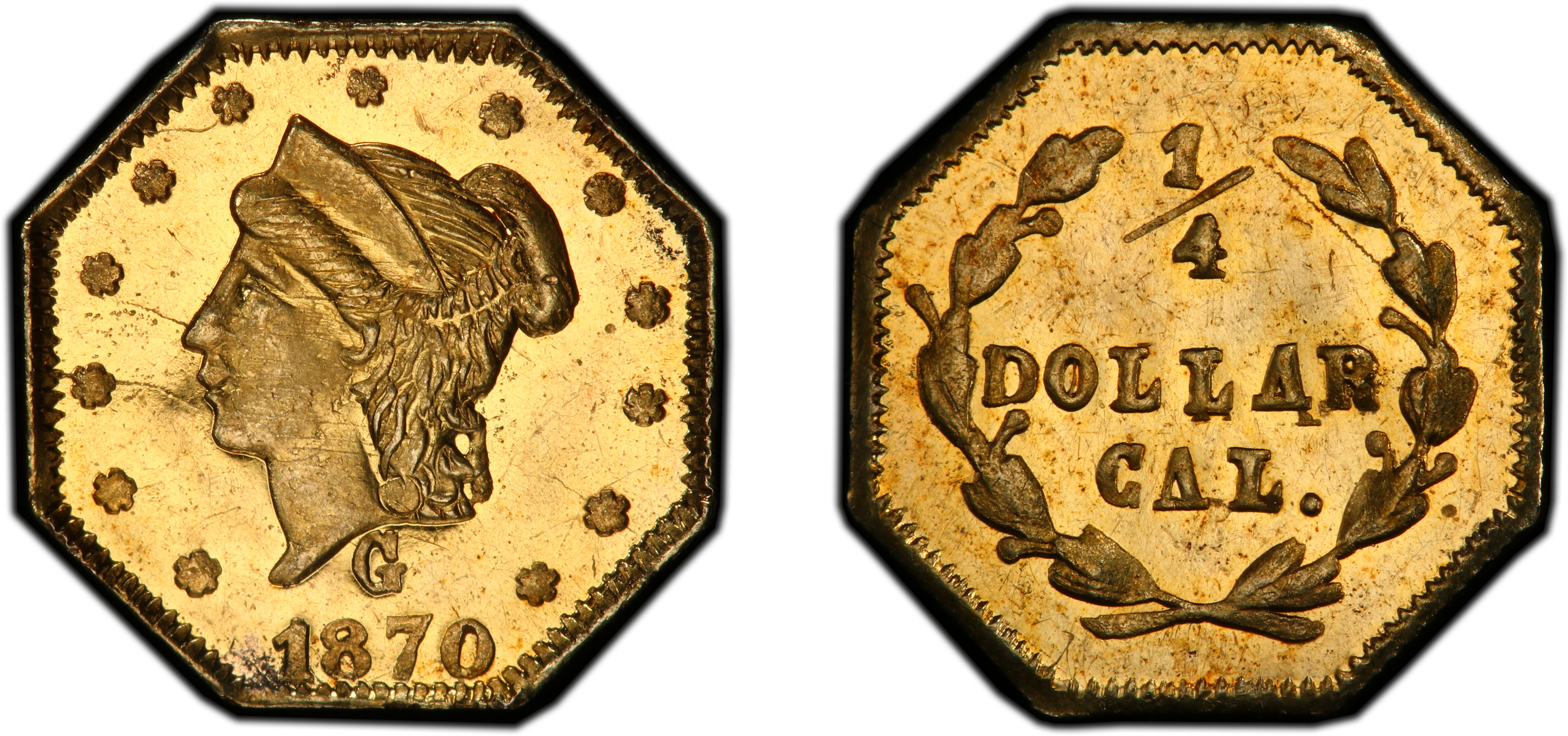
Obverse & Reverse
The 1870 G25C BG-756 is a quintessential example of a 'Period Two' California Fractional Gold piece. By 1870, the initial, urgent need for small denomination circulating currency that spurred the creation of 'Period One' (1852-1857) issues had largely subsided. The San Francisco Mint, operating since 1854, was producing sufficient federal coinage for daily commerce. Instead, the continued production of these miniature gold pieces shifted to a different market: tourism and collectibles. San Francisco was no longer just a rugged gold rush outpost but a burgeoning metropolis and a destination for travelers from the Eastern states and Europe. Jewelers and private minters, such as Robert B. Gray & Co., recognized the appeal of these tiny gold coins as keepsakes and souvenirs of the California adventure. Consequently, these 'jeweler's issues' were struck not with the intention of meeting a monetary need, but to be sold at a premium over their negligible intrinsic value. The Private Coinage Act of 1864 had made such private minting illegal, but the law was not strictly enforced by the Secret Service in California until 1883. This legal gray area allowed for a prolific output of hundreds of varieties throughout the 1860s and 1870s. The BG-756, like its contemporaries, was typically produced with less gold content than its stated face value would imply, a fact that was of little concern to a buyer seeking a memento. These pieces were often crudely struck by hand, leading to significant variation in strike quality. Their numismatic significance today lies not in their use as money, but as tangible artifacts of a transitional period in California's history, reflecting the commercialization of the Gold Rush legend itself.
Associated EventPost-Gold Rush California Tourism Boom
Reason For MintingTo be sold as souvenirs and keepsakes to tourists and collectors, capitalizing on the romanticism of the Gold Rush.
Minter HistoryRobert B. Gray & Co. was a San Francisco jewelry firm active in the production of California Fractional Gold during the 'Period Two' era. Around 1859-1860, the firm took over the business of Antoine Nouizillet, another prominent French jeweler and minter of fractional gold. Gray & Co. utilized some of Nouizillet's old dies but also created their own, often marked with a 'G'. They were a significant producer of these souvenir coins through the 1860s. In 1871, a year after this piece was struck, Gray sold his interests to the California Jewelry Co., which was run by the Levison Brothers.
Historical SignificanceThis coin is a historical marker of the evolution of the California Gold Rush legacy from a frantic economic reality into a commercialized and romanticized memory. It represents a period when private minters, operating in a legally ambiguous environment, catered to a burgeoning tourist trade rather than a commercial need for coinage.
BG-756
Denomination25 Cents
Minting Period1870
Assayer/MinterRobert B. Gray & Co.
Geographic OriginSan Francisco, California
Obverse DescriptionA crudely rendered Liberty Head facing left, with thirteen stars surrounding the portrait. The date '1870' appears below the bust truncation. The portrait style is a simplified imitation of contemporary federal gold coinage.
Obverse Inscription1870
Reverse DescriptionThe denomination '25 CENTS' is enclosed within a wreath of two branches tied with a bow at the bottom. The legend 'CALIFORNIA GOLD' is inscribed above the wreath, following the octagonal border. A small 'G' for the minter, Robert B. Gray & Co., may sometimes be visible, though it is often weak or absent on this variety.
Reverse InscriptionCALIFORNIA GOLD 25 CENTS
CompositionGold
Stated Fineness Actual FinenessVariable, but generally low for the period, often less than .500 fine. Period Two issues were notoriously underweight and debased.
EdgePlain
Unknown
Survival EstimateFewer than 15 known. Based on combined PCGS and NGC population reports (as of late 2025, approximately 7-10 coins graded across all conditions), with a few additional raw examples presumed to exist.
Rarity ScaleR-7 (4 to 12 known)
The BG-756 is highly sought after by specialists in California Fractional Gold due to its extreme rarity (R-7). Its appeal lies in its specific Breen-Gillio attribution, its octagonal shape, and as a representative of the later 'souvenir' period of this fascinating series.
Key VarietiesThe primary variety is the regular business strike as described (BG-756). No known patterns, restrikes, or special collector issues from the period of minting exist for this specific variety. The 'PL' (Prooflike) designation in the user's input refers to a characteristic of the surfaces on a regular strike, not a separate issue type.
Authentication TipsAuthentic examples are struck on thin planchets and often exhibit a weak or uneven strike, particularly on the stars or parts of the wreath. Look for characteristic die markers and compare to known genuine examples in auction archives. Counterfeits are common; many are cast fakes that will have a soapy, indistinct appearance and may have incorrect design details. Replicas made later often lack a denomination or are made of gilt base metal. The standard reference by Breen-Gillio is essential for authentication.
Shopping ConsiderationsFor a premium quality BG-756, a buyer should prioritize sharpness of strike, especially on the Liberty portrait and the date. Given the crude manufacturing process, a well-centered and fully struck example commands a significant premium. Look for original, undisturbed surfaces with some remaining luster; prooflike (PL) surfaces, as noted in the original query, are particularly desirable. Avoid examples that have been holed, bent, harshly cleaned, or show signs of tooling in the fields. Given the coin's rarity, even a details-graded coin (e.g., 'AU Details - Improperly Cleaned') can be a significant acquisition, but the price should reflect the impairment.
A coin's grade is its condition, rated on a 1-70 scale. For rare coins, this is the most critical factor in determining value, as a tiny difference in preservation can mean a huge difference in price.
Relevant Grade TypesOriginal issues of BG-756 were business strikes, technically intended for sale, not circulation, and are found in Circulated (1-58) and Mint State (MS, 60-70) grades. Given their status as souvenirs, many were preserved in high grade. No true Proofs were struck during the original minting period. The 'PL' or 'DPL' (Deep Prooflike) designation is an important qualifier for business strikes of this issue, indicating highly reflective, mirror-like surfaces that are prized by collectors.
Mint State CharacteristicsAn uncirculated (MS) BG-756 is defined by the absence of wear. Quality is then determined by the strike, surface preservation, and luster. Strikes are frequently weak, so a coin with sharp details on Liberty's hair and the leaves of the wreath is rare and desirable. Luster is typically satiny or, in exceptional cases, prooflike. Due to the softness of the gold and crude production, even Mint State examples will often have small planchet flaws, striations, or light contact marks.
Circulated Wear PatternsOn circulated examples, wear first appears on the high points of the design: Liberty's cheek, hair details, and the highest leaves and bow of the wreath on the reverse. As wear progresses, the stars on the obverse and the letters in the legends will become soft and begin to merge with the fields.
Key Factors For ValueFor the BG-756, rarity is the primary value driver. Beyond that, the key factors are grade and surface quality. An example with original, uncleaned surfaces and strong eye appeal will always be worth more than a dipped or cleaned coin of the same grade. A sharp strike is a major differentiating factor, as most are weakly struck. Finally, a Prooflike (PL) or Deep Prooflike (DPL) designation from a major grading service like PCGS or NGC will add a substantial premium, as will a CAC sticker indicating premium quality for the assigned grade.
PCGS Price Guide
| Grade | Price | Population |
|---|---|---|
| 63 | $2,250.00 | 1 |