1870 G25C BG-759, PL (Regular Strike)
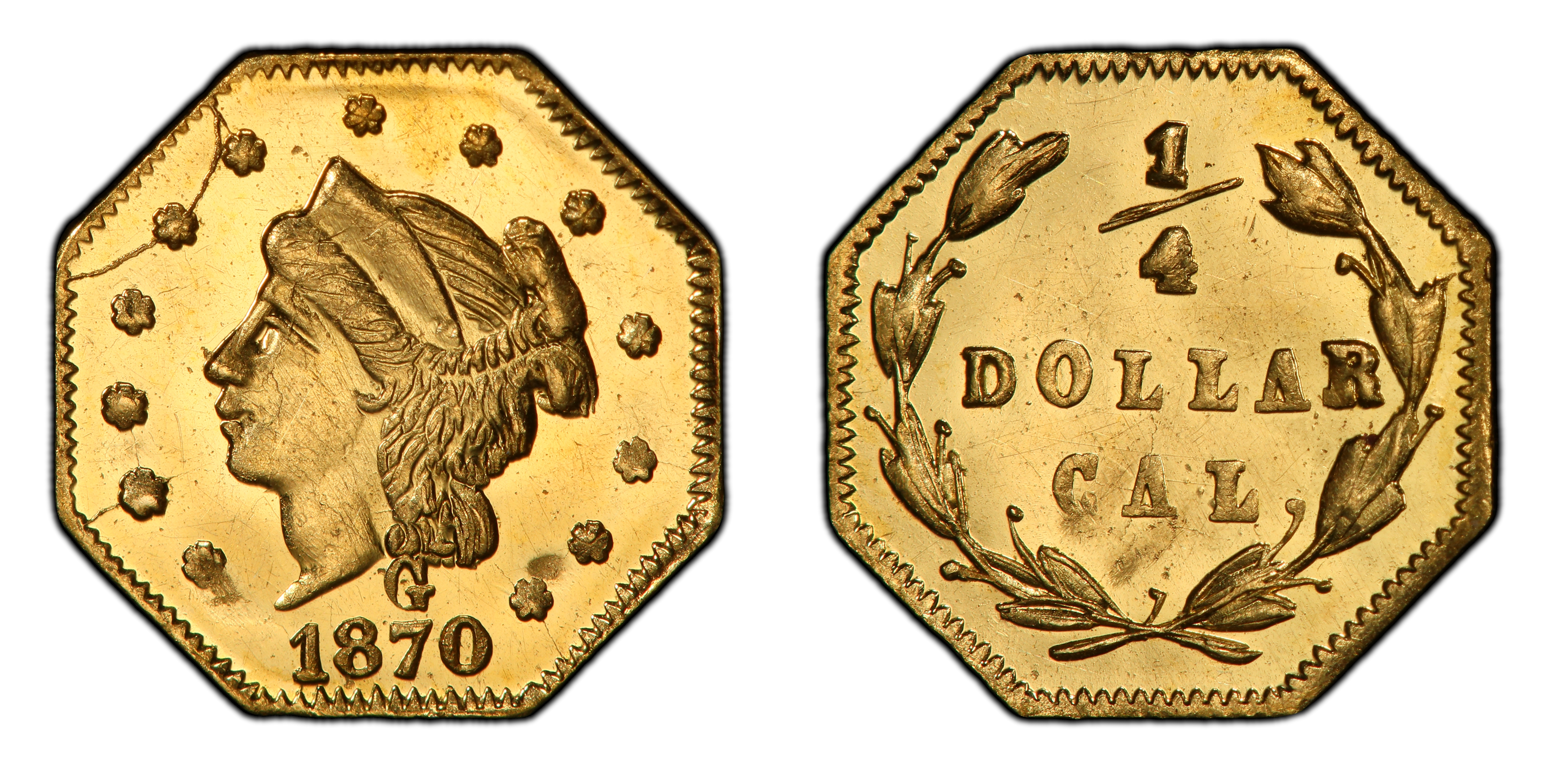
Obverse & Reverse
The 1870 BG-759 octagonal quarter dollar is a quintessential example of a 'Period Two' California Fractional Gold piece. By 1870, the chaotic, fever-pitch years of the initial Gold Rush had subsided, but California's economy, particularly in San Francisco, remained dynamic and distinct from the rest of the nation. The official San Francisco Mint, established in 1854, focused on larger gold and silver denominations, leaving a persistent and frustrating void in small change. While the acute coinage shortages of the early 1850s had eased, the lingering preference for hard money over paper currency on the West Coast, coupled with the impracticality of using tiny federal silver coins for daily transactions, sustained a niche market for privately issued gold substitutes. This era saw the rise of 'jeweler's issues,' so named because they were produced not by assay offices focused on bullion conversion, but by jewelers and metalsmiths who recognized the commercial demand. These pieces were technically illegal following the Private Coinage Act of 1864, but enforcement was lax in California. Robert B. Gray & Co., operating from their shop on Merchant Street, was a significant producer during this period. They, along with their contemporaries, created these miniature coins to facilitate everyday commerce—paying for a drink, a newspaper, or a streetcar ride. The BG-759 was struck not as a commemorative souvenir, but as a practical, albeit unofficial, tool for commerce. Its octagonal shape was a hallmark of these private issues, helping to distinguish them from round federal coinage. These coins circulated freely, accepted at face value by a populace accustomed to a wide variety of coinage. However, their low intrinsic gold value relative to their face value meant their acceptance was based more on convenience and convention than bullion content. The federal government's attention eventually turned to these private issues, and by the early 1880s, increased enforcement by the Secret Service brought the era of California Fractional Gold to a definitive close, cementing the status of surviving pieces like the BG-759 as treasured relics of a unique chapter in American monetary history.
Associated EventPost-Gold Rush Economic Expansion
Reason For MintingTo satisfy a persistent regional demand for small-denomination coinage for daily commercial transactions in a hard-money-based economy.
Minter HistoryRobert B. Gray & Co. was a prominent San Francisco jewelry and watchmaking firm active in the post-Gold Rush era. Located at 616 Merchant Street in 1870, Gray was a key figure in the production of 'Period Two' fractional gold. In the late 1850s, he reportedly purchased the business and equipment of another pioneer minter, Antoine Louis Nouzillet. Gray's operation was known for producing some of the heavier and more intrinsically valuable jeweler's issues of the period. His coins are typically identified by a 'G' mintmark, although this is not present on the BG-759 variety. He introduced dated obverses in 1870, using them with various stock reverses. In 1871, Robert B. Gray sold his interests to the California Jewelry Company, which continued to strike fractional gold pieces for a time, sometimes using his old dies.
Historical SignificanceThe BG-759 is historically significant as it represents the persistence of private coinage in the American West long after federal laws were enacted to prohibit it, demonstrating the unique economic conditions of post-Gold Rush California and the ingenuity of local merchants in solving a chronic shortage of small change.
N/A
Denomination25 Cents
Minting Period1870
Assayer/MinterRobert B. Gray & Co.
Geographic OriginSan Francisco, California
Obverse DescriptionA Liberty Head, facing left, with 'LIBERTY' inscribed on her coronet. Her hair is tied in a bun at the back. The portrait is surrounded by thirteen six-pointed stars, often appearing somewhat crude in their execution.
Obverse Inscription Reverse DescriptionA simple wreath composed of two branches tied with a bow at the bottom. The inscription '1/4 DOLLAR 1870' is located within the wreath, arranged in three lines.
Reverse Inscription1/4 DOLLAR 1870
CompositionGold
Stated Fineness Actual FinenessVariable, typically 14-21 karats for Period Two issues.
Weight0.25 grams
Diameter10.00 mm
EdgePlain
Unknown
Survival Estimate76-150 coins known (per R-4 rating)
Rarity ScaleR-4
This variety appeals to collectors due to its status as a tangible link to San Francisco's vibrant post-Gold Rush economy. Its octagonal shape, clear date, and affordability relative to rarer varieties make it a popular entry point into the complex and fascinating world of California Fractional Gold.
Key VarietiesThe primary variety is the regular business strike. While no major varieties, patterns, or official restrikes from the period are known for BG-759, collectors should be aware of contemporary counterfeits and modern replicas, which are common for the series. The 'PL' (Prooflike) and 'DMPL' (Deep Mirror Prooflike) designations are applied by grading services to business strikes with exceptionally reflective surfaces and are highly coveted.
Authentication TipsAuthentic BG-759 examples exhibit specific die characteristics. The stars on the obverse are often weakly defined and somewhat crude. On the reverse, the '1' in the date is typically sharp and well-defined, while the bow at the bottom of the wreath is often soft. The planchets are thin, and the strike can be uneven. Counterfeits are frequently overweight, have a soapy or cast-like texture, and may exhibit incorrect lettering fonts or star shapes. Comparison with high-resolution images of certified examples is essential.
Shopping ConsiderationsA premium quality BG-759 for its grade will possess a sharp, well-centered strike, especially on the Liberty portrait and the date. Look for examples with smooth, lustrous surfaces that are free from distracting marks, cleaning, or scratches. Original, uncleaned 'skin' with a slightly reddish-gold patina is highly desirable. Prooflike (PL) or Deep Mirror Prooflike (DMPL) examples command significant premiums due to their exceptional eye appeal and rarity. Avoid pieces that have been harshly cleaned, show evidence of tooling on the surfaces, or have been mounted in jewelry, which often results in rim damage or solder marks.
A coin's grade is its condition, rated on a 1-70 scale. For rare coins, this is the most critical factor in determining value, as a tiny difference in preservation can mean a huge difference in price.
Relevant Grade TypesOriginal 1870 BG-759 issues were business strikes intended for commerce, and they are found in Circulated (1-58) and Mint State (MS, 60-70) grades. No true Proofs were struck during the original minting period. The 'PL' (Prooflike) and 'DMPL' (Deep Mirror Prooflike) designations are not separate issues but rather desirable characteristics of early business strikes made with freshly polished dies.
Mint State CharacteristicsAn uncirculated BG-759 is defined by its luster. Higher-grade examples often exhibit a vibrant, satiny luster, with some showing prooflike or deep mirror prooflike fields from fresh dies. The strike is a key differentiator; many are softly struck on the stars or the wreath's details, so a sharply struck specimen is highly prized. Due to the softness of the gold and their use in commerce, even Mint State examples may show minor planchet flaws or small contact marks acquired from handling with other coins.
Circulated Wear PatternsWear first appears on the highest points of the design. On the obverse, look for flattening on Liberty's cheek, the hair above her eye, and the coronet. On the reverse, the highest points of the wreath's leaves and the bow will show initial friction and loss of detail. In lower grades (VF and below), the individual strands of hair will merge, and the smaller numerals in the date will begin to weaken.
Key Factors For ValueThe primary value drivers for an 1870 BG-759 are grade and surface quality. An example with original, undisturbed luster and minimal contact marks will always be worth more than a cleaned or scratched coin of the same grade. Strike quality is paramount; a coin with a full, sharp strike can command a significant premium over a weakly struck contemporary. Eye appeal, including attractive original toning and any prooflike reflectivity, plays a major role. Finally, certification by a top-tier grading service (PCGS or NGC), especially with a CAC sticker indicating premium quality for the grade, provides crucial validation and enhances market value.
PCGS Price Guide
| Grade | Price | Population |
|---|---|---|
| 63 | $725.00 | 1 |
| 63+ | $850.00 | N/A |
| 64 | $1,100.00 | N/A |
| 64+ | $1,400.00 | N/A |