1881 25C BG-799M, PL (Regular Strike)
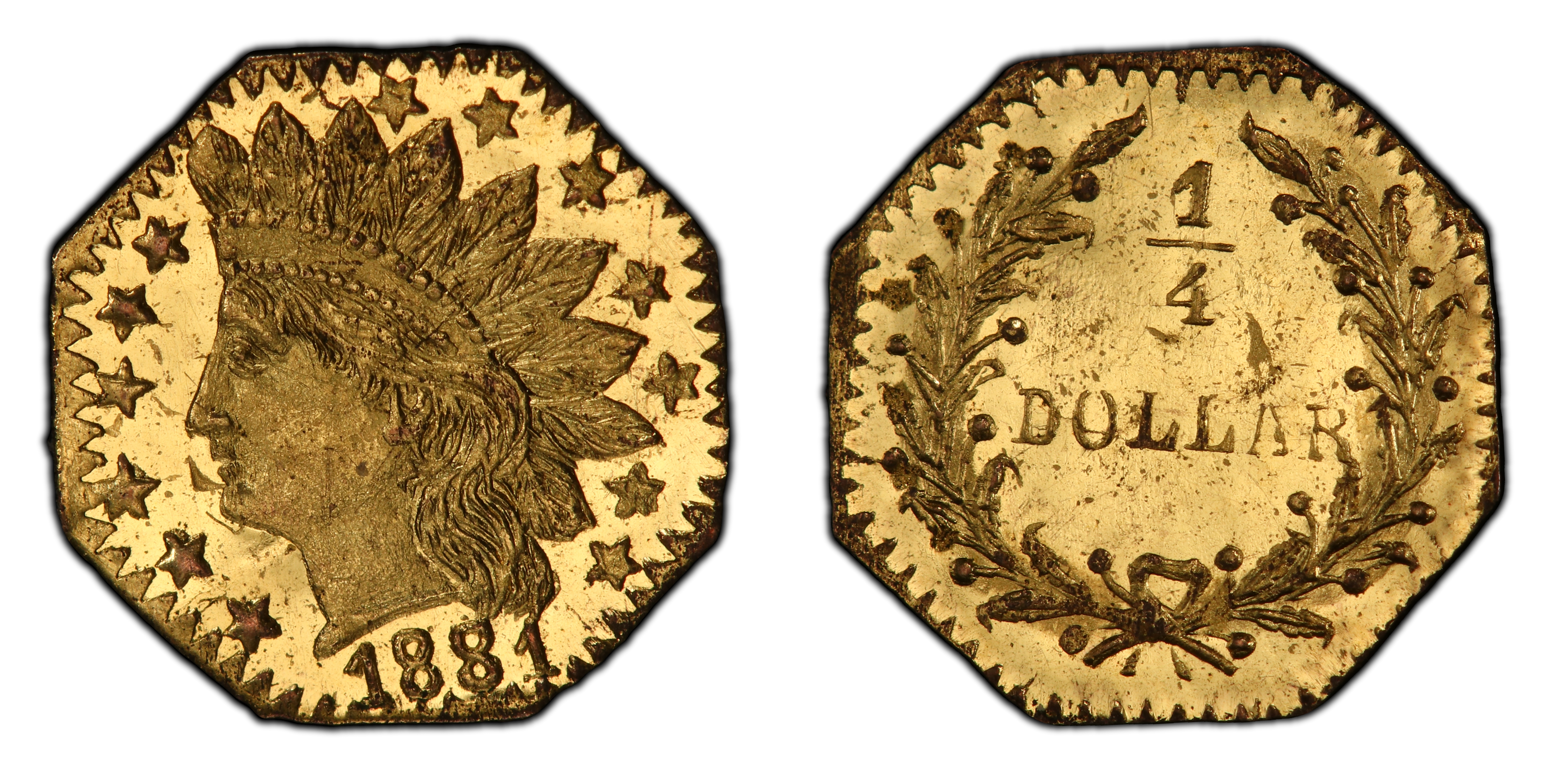
Obverse & Reverse
The 1881 25 Cents BG-799M represents the final evolution of a uniquely Californian numismatic tradition. Born from the acute shortage of small denomination coinage during the Gold Rush, the earliest fractional gold pieces of 1852-1856 ('Period One') served a vital, albeit unofficial, role in commerce. These were followed by 'Period Two' pieces (1856-1882), which emerged after federal legislation in 1864 criminalized private coinage intended for circulation. The manufacturers of Period Two coins, including this 1881 issue, cleverly circumvented the law by slightly altering the designs, often omitting the word 'DOLLAR' or 'D.' and denominating them as '1/4 ARM' or simply '1/4'. Consequently, these later pieces were not intended to circulate as money in the traditional sense but were marketed as souvenirs, keepsakes, and jewelry items for tourists and locals nostalgic for the Gold Rush era. By 1881, the wild days of the '49ers were a distant memory, but the allure of gold remained potent. San Francisco was a bustling metropolis, and a cottage industry of jewelers and novelty makers produced these miniature gold tokens to satisfy a thriving tourist trade. They were often sold in sets or mounted into pins, cufflinks, and other adornments. The technical production of these pieces had become quite refined, with standardized Liberty head and wreath motifs, often struck with a precision and sometimes proof-like finish that belied their unofficial status. The BG-799M, specifically, is a product of this late period, a testament to the enduring legacy of the Gold Rush and the clever entrepreneurship that adapted to changing legal landscapes. Its existence speaks to a market that valued the symbolism of California gold as much as its intrinsic worth, serving as a tangible memento of a transformative era in American history.
Associated EventPost-Gold Rush California Economic Development & Tourism
Reason For MintingPrimarily created as a souvenir or jewelry item for the tourist trade, not for general circulation.
Minter HistoryThe specific minter for BG-799M is unknown, a common trait for many Period Two California Fractional Gold pieces. The production was likely carried out by one of several San Francisco-based jewelers or private minting concerns that specialized in creating these gold tokens for the robust souvenir market. These manufacturers operated in a legal gray area and thus rarely, if ever, placed their own identifying marks on their products. Their business model was based on creating attractive, miniature gold pieces that evoked the spirit of the Gold Rush without explicitly violating federal laws against private currency.
Historical SignificanceThis coin is significant not as a circulating medium but as a cultural artifact representing the commercialization of the Gold Rush legacy. It marks the final phase of private gold minting in California, demonstrating how the industry adapted from producing functional coinage to creating souvenir tokens in response to federal legislation. It is a tangible link to the late Victorian-era tourism that became a major part of San Francisco's economy.
N/A
Denomination25 Cents
Minting Period1881
Assayer/MinterUnknown, likely a jeweler or private manufacturer
Geographic OriginSan Francisco, California
Obverse DescriptionA well-defined Liberty Head facing left, with 13 stars surrounding the portrait. The date '1881' is positioned below the truncation of the neck. This particular variety is known for its sharp, well-executed details.
Obverse Inscription[13 stars surrounding portrait] 1881
Reverse DescriptionThe denomination '1/4' is enclosed within a wreath of two olive branches tied together with a bow at the bottom. The legend 'CALIFORNIA GOLD' appears above the wreath, arching along the upper rim.
Reverse InscriptionCALIFORNIA GOLD 1/4
CompositionGold
Stated Fineness Actual FinenessTypically ranges from .500 to .800 fine (12k to 19k gold), though not standardized.
Diameter9.70 mm
EdgePlain
Unknown
Survival Estimate50-100
Rarity ScaleR-5
The BG-799M is highly prized by specialists for its status as a late-date, 'last year of issue' piece from the classic period. Its appeal is enhanced by its often sharp strike and the frequent presence of proof-like (PL) surfaces, making it visually stunning for its type. It represents the culmination of the fractional gold tradition, offering a high-quality example of the jeweler's art.
Key VarietiesThis is a single, specific die marriage (BG-799M). No major varieties from the original minting period are known. Unlike some earlier issues, there are no known contemporary patterns or later restrikes associated with this specific Breen-Gillio number. The primary distinction among examples is the quality of the strike and the degree to which they exhibit proof-like surfaces.
Authentication TipsAuthentic examples will show crisp, well-defined details, especially in Liberty's hair and the leaves of the wreath. The planchet should be thin and well-made, consistent with other Period Two pieces. Be wary of modern replicas, which often have a soapy, indistinct appearance, incorrect weight or diameter, or a brassy color. The diagnostic for BG-799M is the alignment of the final A in CALIFORNIA over the space between the T and the I of UNITED, and a specific die crack that can sometimes be seen. Always compare against high-resolution images of certified examples.
Shopping ConsiderationsWhen acquiring an 1881 BG-799M, seek out an example with a bold strike and minimal distracting marks. A 'premium quality' piece will have sharp details on the highest points, such as the hair curls around Liberty's face and the individual leaves in the wreath. Given its propensity for proof-like surfaces, a coin with deep, reflective fields (designated 'PL' by grading services) commands a significant premium. Look for original, undisturbed luster and avoid examples that have been harshly cleaned, polished, or show evidence of being removed from jewelry, such as solder marks or rim damage. Eye appeal is paramount for this issue.
A coin's grade is its condition, rated on a 1-70 scale. For rare coins, this is the most critical factor in determining value, as a tiny difference in preservation can mean a huge difference in price.
Relevant Grade TypesOriginal 1881 issues were business strikes, though many were struck with care on polished planchets, resulting in proof-like (PL) surfaces. They are found in both Circulated (AU-50 to AU-58, as they saw little actual use) and Mint State (MS, 60-70) grades. No true Proofs in the modern sense were struck during the original period of issue for this variety. The PL designation is a modifier for a Mint State grade (e.g., MS-64 PL) and is not a separate grade type; it indicates a coin with mirror-like fields distinct from the frosted devices, a highly desirable characteristic for this issue.
Mint State CharacteristicsAn uncirculated BG-799M is defined by its luster and lack of wear. Luster is typically bright and flashy, often with a semi-proof-like or fully proof-like character in the fields. The strike is usually sharp, though minor weakness on the centermost hair details or the bow on the reverse can be seen. Due to their status as keepsakes, contact marks can be minimal but are often present from handling or storage with other pieces. The finest examples have deeply reflective fields and a strong cameo contrast on the devices.
Circulated Wear PatternsWhile most examples are uncirculated, those that show light handling or friction will exhibit wear first on the highest points. For the obverse, this includes the hair above Liberty's eye and ear, and her cheekbone. On the reverse, the highest points of the leaves in the wreath and the knot of the bow will show the first signs of rub. In circulated grades, the proof-like fields will be the first to be interrupted by friction and hairlines.
Key Factors For ValueThe primary value driver for this coin is its grade, with a steep premium for Gem (MS-65 and above) condition. The presence of a Proof-Like (PL) or Deep Proof-Like (DPL/DMPL) designation from a major grading service can dramatically increase value. Surface quality is critical; an example with clean, mark-free fields and original 'skin' will always be prized over one that is cleaned, hairlined, or has distracting carbon spots. Exceptional eye appeal, created by a strong strike, vibrant luster, and sometimes light, attractive toning, is what sets the most valuable examples apart. A CAC sticker for this issue is a strong endorsement of quality and typically adds a significant premium.
PCGS Price Guide
| Grade | Price | Population |
|---|---|---|
| 63 | $450.00 | 2 |
| 63+ | $500.00 | N/A |
| 64 | $600.00 | N/A |
| 64+ | $675.00 | N/A |
| 65 | $850.00 | 1 |
| 65+ | $1,050.00 | N/A |
| 66 | $1,400.00 | 1 |
| 66+ | $1,750.00 | N/A |
| 67 | $2,500.00 | N/A |