1873 G25C BG-872, PL (Regular Strike)
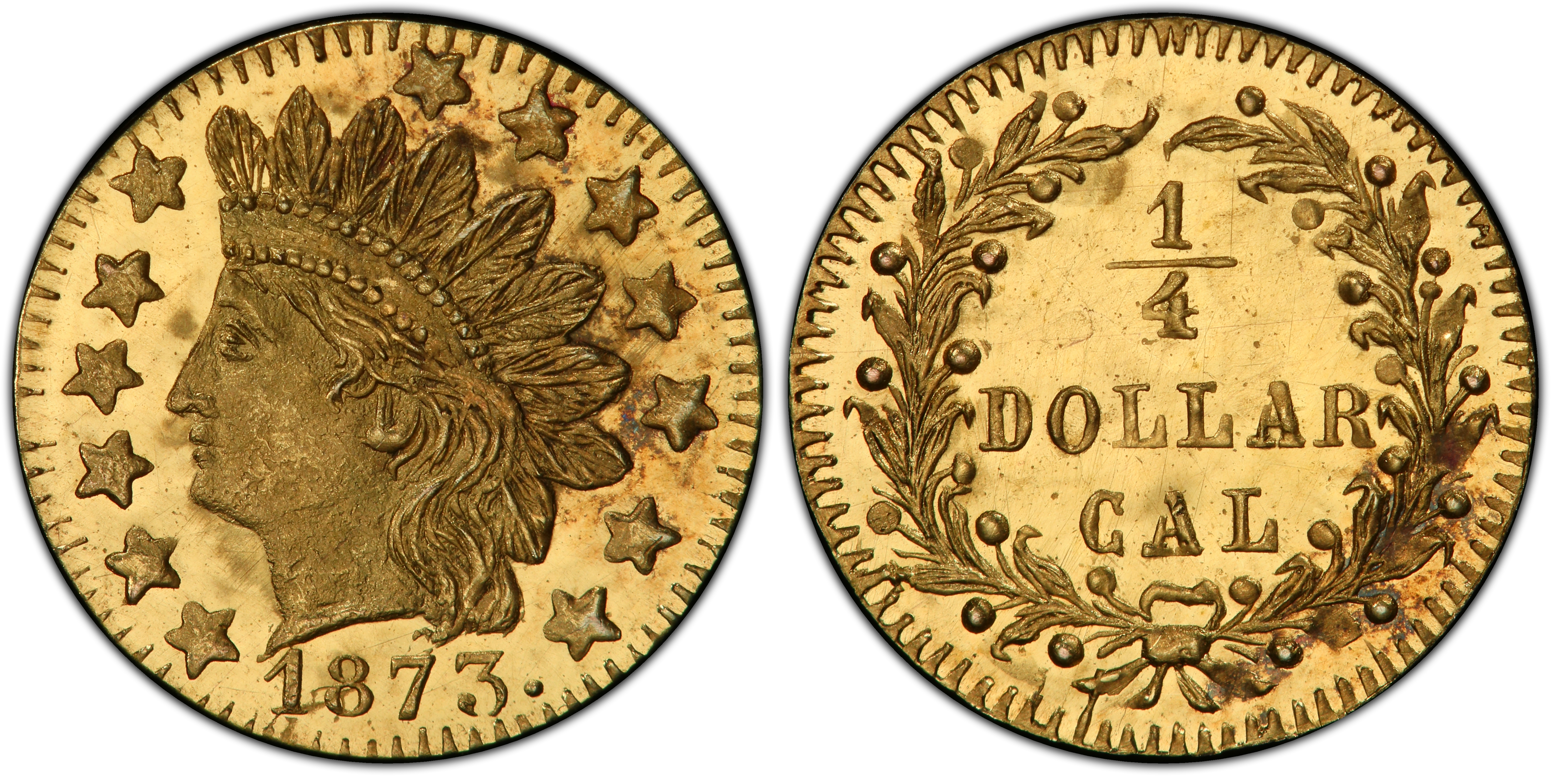
Obverse & Reverse
The 1873 G25C BG-872 is a product of a fascinating and lengthy period in California's numismatic history, long after the initial Gold Rush fervor had subsided. By the 1870s, the economic landscape of the West Coast had matured. The large-denomination private gold coins of the '49ers were a distant memory, but a localized need for small change persisted, particularly in areas still reliant on gold dust for transactions. While the U.S. Mint in San Francisco produced standard federal coinage, the smallest gold coin was the dollar, which was a significant sum for minor daily purchases. Silver coins were often scarce or hoarded. This created a commercial niche for privately manufactured, small-denomination gold tokens, colloquially known as California Fractional Gold. These pieces, in quarter dollar, half dollar, and dollar sizes, were not legal tender but were widely accepted as a convenient medium of exchange. They were lightweight, often containing gold value significantly less than their face value, and served as souvenirs or 'keepsakes' as much as they did circulating currency. The manufacturer of the BG-872 variety is attributed to the California Jewelry Company of San Francisco, a firm known for producing a variety of such pieces during this era. These tokens were struck with designs that mimicked federal coinage, such as the Indian Head motif, to inspire public confidence. Their production was a purely commercial enterprise, meeting a practical need while also profiting from the public's continued fascination with gold. The era of fractional gold came to a close with the passage of the Act of 1883, which explicitly forbade the private minting of coins, rendering these charming and historically significant pieces obsolete.
Associated EventPost-Gold Rush Economic Period
Reason For MintingTo satisfy a commercial need for small denomination coinage for daily transactions in California and to be sold as souvenirs.
Minter HistoryThe BG-872 is attributed to the California Jewelry Company, one of several San Francisco-based private firms that manufactured fractional gold tokens from the 1850s through the early 1880s. These companies operated more like jewelers or medalists than official mints. They produced a wide array of tokens with varying designs and qualities, often using planchets of inconsistent weight and fineness. Their primary business was not coinage, but they capitalized on the local demand for small change and the tourist trade, stamping out these miniature gold pieces until federal legislation halted their activities.
Historical SignificanceThe BG-872 represents the final, longest-lasting phase of private currency production in California. Unlike the earlier, full-weight territorial coins, these fractional pieces illustrate a shift from a bullion-based economy to one where convenience and token-value were paramount. They are a tangible link to the everyday economic life of post-Gold Rush California and a testament to the unregulated and entrepreneurial spirit of the era.
N/A
Denomination25 Cents
Minting Period1873
Assayer/MinterCalifornia Jewelry Company (Attributed)
Geographic OriginSan Francisco, California
Obverse DescriptionA stylized head of Liberty facing left, wearing a feathered headdress. The headdress is adorned with 13 stars along its band. The portrait is often described as an 'Indian Head' type.
Obverse Inscription1873
Reverse DescriptionThe denomination '1/4' is enclosed within a continuous wreath of leaves and berries. The word 'DOLLAR' appears below the wreath. A small mintmark 'G' is typically visible below the wreath, representing the initial of the manufacturer.
Reverse Inscription1/4 DOLLAR
CompositionGold
Stated Fineness Actual FinenessVaries, but typically between .500 and .750 fine.
Weight0.24 grams
Diameter9.50 mm
EdgePlain
Unknown
Survival Estimate500-750
Rarity ScaleR-4
This variety appeals to collectors for its classic 'Indian Head' design, its historical connection to post-Gold Rush San Francisco, and its relative affordability compared to earlier territorial issues. The 'PL' (Proof-Like) designation indicates an early strike from fresh dies, giving it a desirable mirrored finish that is highly sought after.
Key VarietiesThe primary variety is the BG-872 as described. Within this catalog number, coins can be found with varying degrees of strike quality and surface characteristics. The most significant 'variety' for collectors is the surface designation: 'Regular Strike' refers to a standard business strike, while 'PL' (Proof-Like) or 'DMPL' (Deep Mirror Proof-Like) designations are given by grading services to specimens struck from highly polished dies, which command a significant premium. There are no known official restrikes or patterns from later periods.
Authentication TipsAuthentic pieces have a sharp, well-defined strike, especially on the stars of the headdress and the details of the wreath. The 'G' mintmark should be clear and properly formed. Counterfeits are common and often have a mushy or soapy appearance, incorrect weight, or a brassy color. Many fakes are cast rather than struck, showing pitting or a seam on the edge. Compare the specific die markers, such as the exact position of the date digits relative to the bust, with known genuine examples.
Shopping ConsiderationsFor a premium quality example, look for a coin designated 'PL' or 'DMPL' with deep, clear mirrors and minimal frost on the devices. A sharp strike is paramount; check for full details on all 13 obverse stars and the individual leaves on the reverse. Avoid examples with excessive bag marks, as the mirrored fields are very susceptible to scratches and abrasions. Original, uncleaned surfaces with a hint of reddish-gold toning are highly desirable. Be wary of coins that have been harshly cleaned or polished, as this destroys the delicate original surfaces and significantly reduces value.
A coin's grade is its condition, rated on a 1-70 scale. For rare coins, this is the most critical factor in determining value, as a tiny difference in preservation can mean a huge difference in price.
Relevant Grade TypesOriginal period issues were business strikes intended for circulation or sale as souvenirs, and they are found in Circulated (AU-58 and below) and Mint State (MS, 60-70) grades. No true Proofs were struck during the original period. The 'PL' (Proof-Like) and 'DMPL' (Deep Mirror Proof-Like) designations are applied to business strikes that were struck using freshly polished dies, creating a mirrored surface. These are not a separate issue but rather an early state of the die's life and are highly prized by collectors.
Mint State CharacteristicsA high-grade Mint State BG-872 will exhibit bright, flashy luster. On PL examples, the fields will be highly reflective and mirror-like. The strike can be inconsistent across the series, but choice examples will show sharp detail in the feathers and the stars on the headdress. Due to the small size and handling in bulk, even uncirculated specimens often show tiny ticks and contact marks. A clean, mark-free field is the primary driver of high MS grades (MS-64 and above).
Circulated Wear PatternsThe first signs of wear appear on the high points of Liberty's cheek, the feathers in the headdress, and the upper leaves of the wreath on the reverse. On more heavily worn examples, the stars will begin to merge, and the fine details of the wreath will become flat. The date and inscriptions remain legible until lower grades.
Key Factors For ValueFor the BG-872, the single most important factor beyond the numerical grade is the surface designation. A coin graded MS-63 DMPL will be worth many times more than a regular MS-63. Beyond that, eye appeal is critical. Collectors pay significant premiums for sharply struck coins with clean, mirrored fields and original, attractive coloration. A CAC sticker, indicating a premium quality coin for the grade, adds a substantial premium, especially for PL and DMPL specimens.
PCGS Price Guide
| Grade | Price | Population |
|---|---|---|
| 64 | $950.00 | 1 |
| 64+ | $1,200.00 | N/A |
| 65 | $2,000.00 | N/A |
| 65+ | $3,500.00 | 1 |