1869 G25C BG-827, PL (Regular Strike)
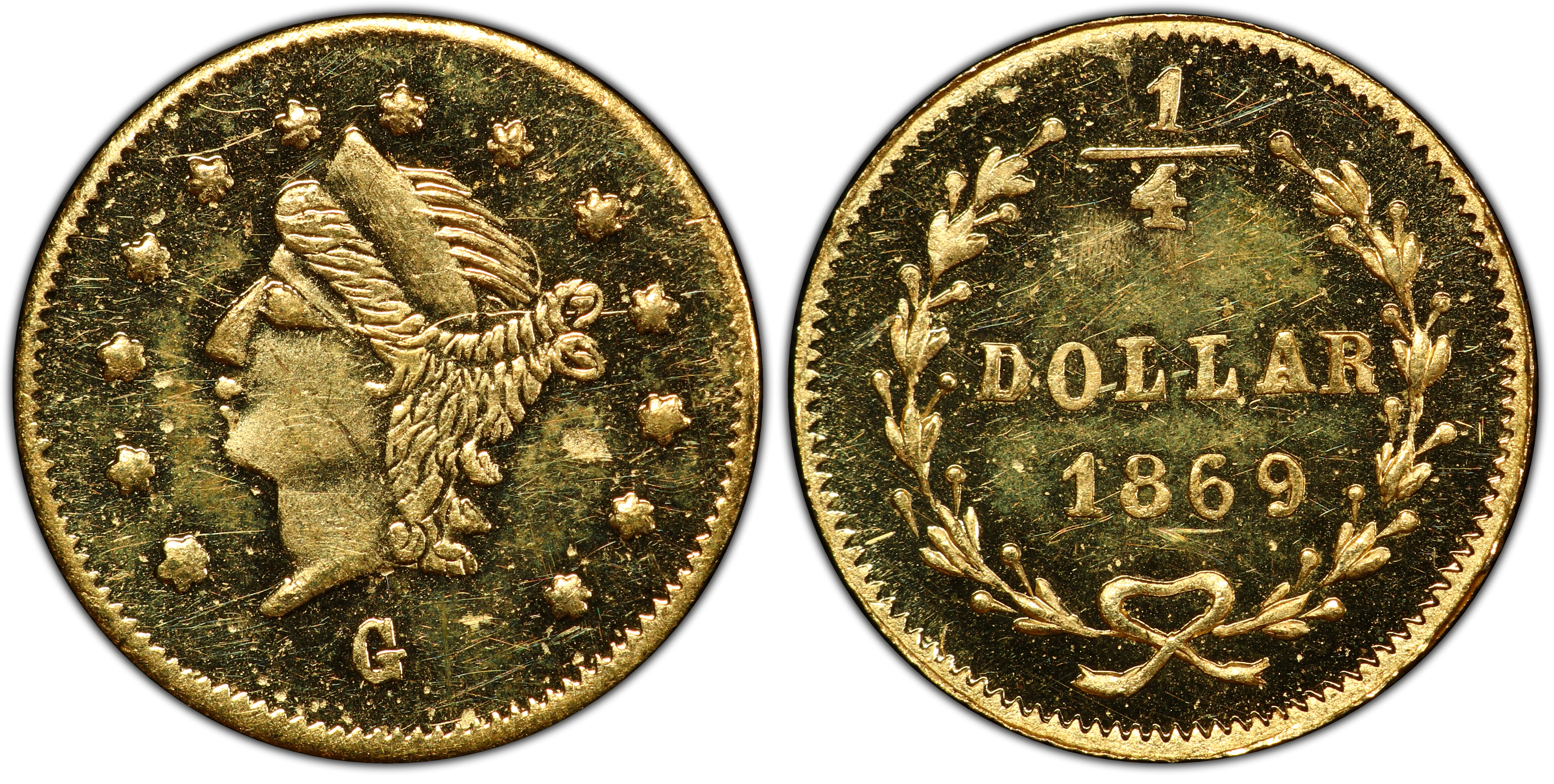
Obverse & Reverse
The 1869 Gaime, Guillemot & Co. 25 Cent piece, cataloged as Breen-Gillio 827 (BG-827), emerged from the second major phase of California Fractional Gold production, often termed 'Period Two' (1858-1882). Unlike the earlier 'Period One' issues which were struck to alleviate a critical shortage of small change during the Gold Rush, these later pieces served a different purpose. By the late 1860s, the U.S. Mint in San Francisco was producing ample federal coinage. Period Two fractionals were primarily created as souvenirs and jewelry items, catering to a burgeoning tourist trade and local demand for keepsakes that evoked the romance of the Gold Rush. Gaime, Guillemot & Co., located at 620 Merchant Street in San Francisco, was a prominent firm of manufacturing jewelers, not a private mint in the traditional sense. They, along with other jewelers, capitalized on a legal loophole. While the Act of June 8, 1864, prohibited private coinage, it was interpreted by some as only applying to denominations explicitly minted by the federal government ($1, $2.50, etc.). By creating unconventional denominations like Quarter Dollars and Half Dollars, often omitting the word 'DOLLAR' or abbreviating it to 'DOL' or simply 'D', these manufacturers argued they were not counterfeiting but producing tokens. The BG-827 is a classic example of this era's output: struck with professional dies and exhibiting fine workmanship, yet intended for the novelty market. These pieces were often mounted into rings, cufflinks, and brooches. Their composition was native California gold, but their intrinsic value was substantially less than their face value, a common trait for Period Two issues. The survival of high-grade, unmounted examples is a testament to their immediate adoption as collectibles and souvenirs rather than as circulating currency. Today, they are appreciated not as emergency money but as historical artifacts that reflect California's evolving economy and its mythologizing of the Gold Rush era.
Associated EventPost-Gold Rush Economic Expansion & Souvenir Trade
Reason For MintingPrimarily created to be sold as souvenirs and used in jewelry, capitalizing on the romantic appeal of the California Gold Rush.
Minter HistoryGaime, Guillemot & Company was a San Francisco-based firm of manufacturing jewelers active in the post-Gold Rush era. Located at 620 Merchant Street, they were not a private mint focused on circulating coinage but rather artisans who produced a wide array of gold items, including the popular 'California Fractional Gold' tokens. Their production was part of a larger trend among jewelers of the time who recognized the commercial appeal of small gold 'coins' as keepsakes for tourists and locals. The firm is known for its high-quality die work and consistent craftsmanship, with their pieces being among the more skillfully executed of the Period Two issues. They produced several different varieties of fractional gold tokens in both round and octagonal formats.
Historical SignificanceThe BG-827 is significant as a quintessential example of 'Period Two' California Fractional Gold, illustrating the shift from creating coinage for commerce to producing tokens for the souvenir and jewelry market. It represents the legal and commercial ingenuity of San Francisco jewelers in navigating federal private coinage laws and capitalizing on the enduring legacy of the Gold Rush. The coin's existence highlights a distinct chapter in American numismatics where the function of private gold issues had fundamentally changed.
N/A
DenominationG25C (Gold 25 Cents)
Minting Period1869
Assayer/MinterGaime, Guillemot & Company
Geographic OriginSan Francisco, California
Obverse DescriptionA beaded border encircles a Liberty Head design, facing left. The portrait is that of an Indian princess, featuring a feathered headdress. Thirteen stars surround the portrait, seven to the left and six to the right.
Obverse Inscription[None, only stars and portrait]
Reverse DescriptionA beaded border surrounds a wreath composed of two olive branches tied at the bottom with a ribbon. The denomination '1/4' and the word 'DOLLAR' are centrally located within the wreath. The date '1869' is positioned below the wreath, just above the lower border.
Reverse Inscription1/4 DOLLAR 1869
CompositionGold
Stated Fineness Actual FinenessTypically ranges from .500 to .750 fine for Period Two issues.
Weight0.25 grams
Diameter10.00 mm
EdgePlain
5,000-10,000
Survival Estimate200-300
Rarity ScaleR-5
The BG-827 is highly popular with collectors due to its classic 'Indian Head' design, clear date and denomination, and its status as a relatively common and accessible entry point into the complex series of California Fractional Gold. Its connection to a known San Francisco jeweler adds to its historical appeal. The 'PL' designation (Prooflike) adds significant appeal, indicating an early strike from fresh, polished dies.
Key VarietiesThe primary variety is the BG-827 as described. No major contemporary varieties are noted, but collectors should be aware of modern replicas and fantasy pieces which are not from the original period. There are no known special collector issues, patterns, or restrikes from the original dies. The 'PL' (Prooflike) designator is not a variety but a descriptor of surface quality found on a small minority of the surviving population, representing early strikes.
Authentication TipsAuthentic examples have sharp, well-defined details, particularly in the feathers of the headdress and the leaves of the wreath. The numerals in the date are crisply punched and properly aligned. Many counterfeits are cast, exhibiting a porous or soft texture under magnification. Compare the weight and diameter to known specifications; authentic pieces are tiny and lightweight. The style of the engraving, particularly the shape of the Liberty head and the font used for the reverse text, is a key diagnostic that should be matched against known genuine examples.
Shopping ConsiderationsFor a premium quality example, seek out a specimen with Prooflike (PL) or Deep Mirror Prooflike (DMPL) surfaces, indicating an early, sharp strike from polished dies. A well-struck coin will show full detail on the feathers and the wreath's bow. Original, uncleaned surfaces with a hint of reddish-gold toning are highly desirable. Carefully inspect the rims and fields for evidence of having been previously mounted in jewelry, which is a very common impairment for this series. Look for minute scratches, solder marks, or rim filing. A specimen free from jewelry mounting, cleaning, or scratches commands a significant premium. A CAC sticker is particularly valuable for this series, confirming both the grade and the originality of the surfaces.
A coin's grade is its condition, rated on a 1-70 scale. For rare coins, this is the most critical factor in determining value, as a tiny difference in preservation can mean a huge difference in price.
Relevant Grade TypesOriginal period issues were business strikes, although primarily intended for the souvenir market rather than active circulation. They are found in Circulated (1-58) and, more commonly, Mint State (MS, 60-70) grades. No true Proofs were struck during the original period of issue. The 'PL' or 'DMPL' designations are applied to business strikes with mirrored fields, which are highly sought after but are not technically Proof coins. Any piece described as a 'Proof' is either a modern creation or a misattribution of a Prooflike business strike.
Mint State CharacteristicsIn uncirculated (MS) condition, the BG-827 should exhibit bright, vibrant luster. High-quality examples, particularly those designated Prooflike (PL), will have mirrored fields and sometimes frosted devices. The strike is typically sharp on this issue, but weakness can sometimes be seen on the highest points of the feathers or the center of the wreath. Due to their handling as souvenirs, even Mint State coins can have small, detracting contact marks; a 'clean' coin with minimal marks is prized.
Circulated Wear PatternsFor circulated examples, wear first appears on the high points of the design: the cheek and feathers of the Indian princess on the obverse, and the bow and highest leaves of the wreath on the reverse. In lower grades (VF and below), the smaller details of the feathers will begin to merge, and the individual leaves in the wreath will become less distinct. The stars on the obverse and the date on the reverse are relatively protected and are among the last elements to show significant wear.
Key Factors For ValueThe primary value drivers for the BG-827 are grade and surface quality. A high-grade Mint State coin (e.g., MS64 or MS65) is worth many multiples of a circulated or lower-grade uncirculated example. The presence of a PL or DMPL designation adds a substantial premium. Crucially, any evidence of having been used in jewelry—such as rim damage, tooling, or surface smoothing—drastically reduces the value. Therefore, 'problem-free' coins with original, attractive surfaces and a sharp strike command the highest prices. Certification by a major grading service (PCGS or NGC) is standard, and a CAC sticker provides an additional layer of confirmation regarding quality for the grade.
PCGS Price Guide
| Grade | Price | Population |
|---|---|---|
| 64 | $1,850.00 | 1 |