1880/76 G25C BG-885 (Regular Strike)
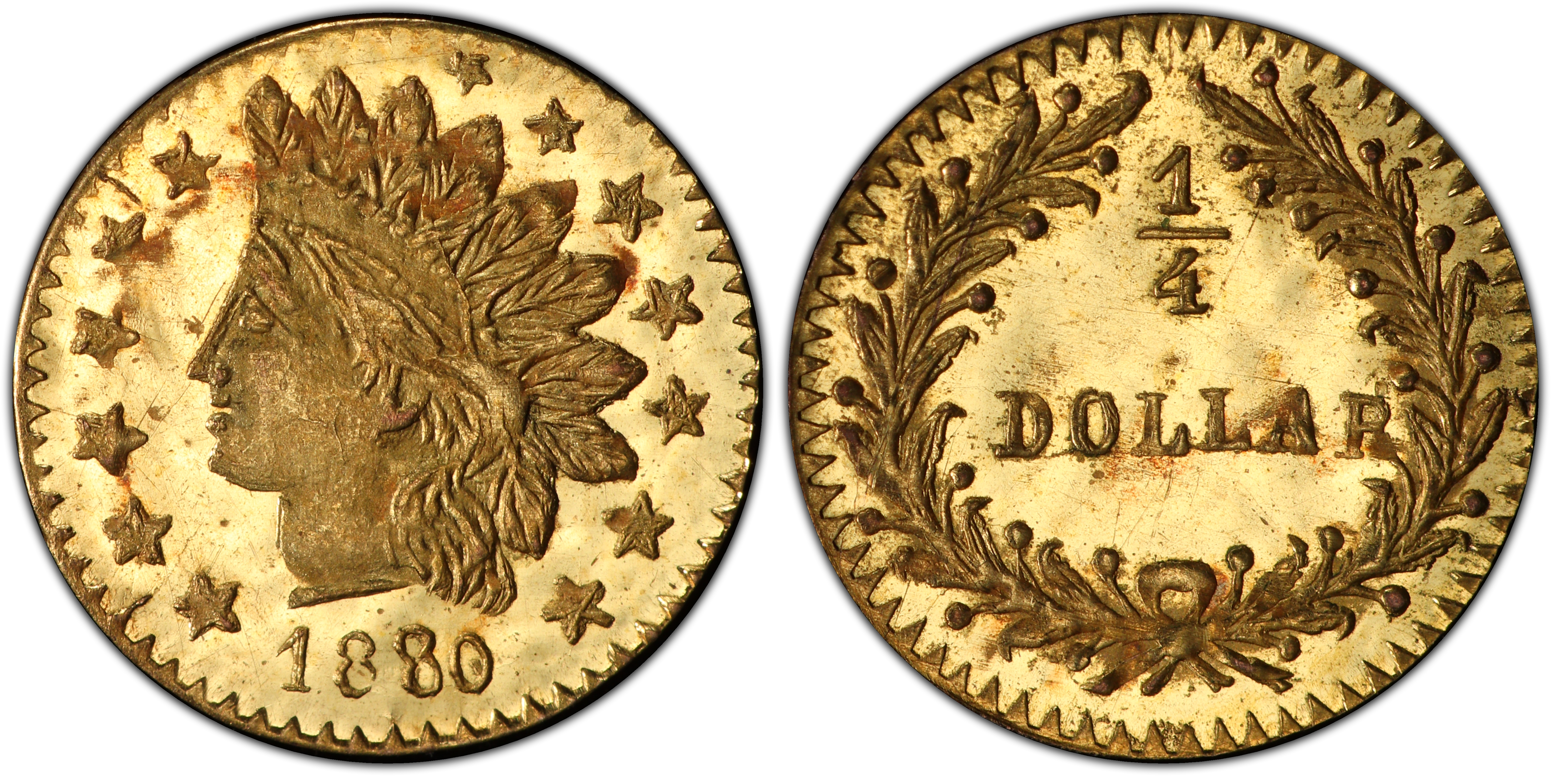
Obverse & Reverse
The 1880/76 BG-885 25 Cents is a quintessential example of what numismatists classify as 'Period Two' California Fractional Gold, also known as the 'Suppressed Jewelers' Issues' (1858-1882). Unlike the 'Period One' issues, which were struck with the earnest, if economically flawed, intent of alleviating a severe shortage of small change during the initial Gold Rush, these later pieces served a different purpose. By the 1870s and early 1880s, the San Francisco Mint was in full operation, and the acute need for private coinage had subsided. Instead, these miniature gold pieces were primarily manufactured by anonymous San Francisco jewelers as souvenirs and curiosities. They were popular items for tourists and locals to send back East in letters, tangible and affordable mementos of the romanticized California Gold Rush. Despite their denominational markings, their gold content was far below their face value, rendering them fiduciary tokens rather than true circulating currency. This discrepancy, and their resemblance to official U.S. coinage, eventually attracted the attention of the U.S. Secret Service. Chief James J. Brooks deemed them a risk for fraud, leading to a crackdown that effectively suppressed their production by 1883. The BG-885 is notable for its dramatic 1880/76 overdate, a feature likely born of frugality, where an older 1876 die was repurposed by punching the new date over it. This variety, with its Indian Head motif—a popular design for the era—encapsulates the final, commercially-driven phase of this fascinating numismatic chapter before federal authority ended the private minting of gold coinage in the United States.
Associated EventCalifornia Gold Rush (Later Souvenir Period)
Reason For MintingPrimarily created as a commercial souvenir and collectible rather than to fill a circulating coinage void.
Minter HistoryThe minter of BG-885 is unknown, which is characteristic of the 'Period Two' issues. These coins were produced by a variety of jewelers and artisans operating in San Francisco who did not typically apply identifiable mintmarks. Their work was clandestine to a degree, especially as federal scrutiny increased, and their primary business was jewelry and novelty items, not official coinage. Their production methods often involved hand presses or the simple 'hammer method,' resulting in inconsistent strike quality.
Historical SignificanceThe BG-885 is significant not as a circulating coin but as a historical artifact representing the commercialization of the Gold Rush legacy. It is a product of an era when the event itself had become a source of tourism and nostalgia. The prominent overdate provides insight into the pragmatic and cost-saving measures of its private manufacturers. Its eventual suppression marks a key moment in the federal government's consolidation of control over the nation's currency, ending the long and colorful tradition of private and territorial gold.
BG-885
Denomination25 Cents
Minting Period1880
Assayer/MinterUnknown Private Minter
Geographic OriginSan Francisco, California
Obverse DescriptionFeatures a right-facing Indian Head design, adorned with a feathered headdress. The portrait is surrounded by thirteen stars, representing the original colonies. The prominent 1880/76 overdate is located below the bust.
Obverse Inscription1880/76
Reverse DescriptionA simple wreath composed of two branches tied together with a bow at the bottom. The denomination '25 CENTS' is inscribed within the wreath. A distinctive feature of this variety is the style of the wreath and the font used for the denomination.
Reverse Inscription25 CENTS
CompositionGold
Stated Fineness Actual FinenessVariable, but generally low for the period, often between 14 to 22 karats.
Diameter9.50 mm
EdgePlain
Unknown
Survival Estimate76-150 coins (Consistent with R-3 to R-4 ratings)
Rarity ScaleR-3 (Scarce) to R-4 (Very Scarce), depending on the source.
The BG-885 is highly sought after due to its dramatic and easily visible 1880/76 overdate, a feature that appeals to error and variety collectors. As an Indian Head type from the popular California Fractional Gold series, it attracts a broad base of collectors. The existence of high-grade, prooflike examples adds another layer of desirability.
Key Varieties1. **Regular Strike:** The standard issue, intended as a souvenir. 2. **Prooflike (PL):** Struck from highly polished dies, resulting in mirror-like fields. These are scarcer than regular strikes and command a significant premium. 3. **Deep Prooflike (DPL):** Exhibits deeper, more profound reflectivity than standard PL examples. These are very rare and highly prized. 4. **Rotated Dies:** Some examples are known with significant die rotations, which can add to their appeal and value as an error.
Authentication TipsThe primary diagnostic is the clear 1880/76 overdate. Under magnification, remnants of the underlying '76' should be visible within the digits of '80'. Walter Breen described it as the '80 appearing almost as script to artfully include the lines of the previously appearing 76.' Genuine examples from this period are typically very thin and lightweight. Counterfeits are often thicker, have incorrect weight, soapy details, and may feature incorrect design elements or legends. Be wary of any pieces with a coppery core visible or that lack the precise die characteristics of known genuine examples.
Shopping ConsiderationsA premium quality example for its grade will exhibit a sharp, well-defined strike, especially on the feathers of the headdress and the details within the wreath. Luster is a key factor; look for original, vibrant surfaces rather than dull or cleaned ones. Prooflike (PL) and Deep Prooflike (DPL) specimens are the most desirable and should have clean, reflective fields with minimal distracting marks. For any example, check carefully for hidden problems like tooling in the fields to remove marks, re-engraving of details, or evidence of having been mounted in jewelry (solder marks, rim damage). Eye appeal is paramount; coins with a pleasing, original reddish-gold hue are preferred over those that are unnaturally bright or discolored.
A coin's grade is its condition, rated on a 1-70 scale. For rare coins, this is the most critical factor in determining value, as a tiny difference in preservation can mean a huge difference in price.
Relevant Grade TypesAll original period BG-885 issues were business strikes, although many were produced with special care as souvenirs. They are found in Circulated (1-58) and, more commonly, Mint State (MS, 60-70) grades. No true Proofs were struck during the original period. However, special collector strikes known as Prooflike (PL) and Deep Prooflike (DPL) were produced from polished dies and are recognized by grading services. These are distinct from regular business strikes and are highly desirable.
Mint State CharacteristicsUncirculated examples are defined by their luster. A typical MS example has a soft, satiny gold luster. Higher quality examples, particularly those designated PL or DPL, will have deeply mirrored fields contrasting with frosted devices. Strike can be inconsistent across the series, but a well-struck BG-885 will show clear details in the headdress feathers and the wreath's bow. Due to the softness of the gold and their history as souvenirs, even Mint State coins often show tiny handling marks or 'flyspecks' in the fields.
Circulated Wear PatternsOn this tiny design, wear first appears on the highest points: the cheekbone of the Indian Head and the upper feathers of the headdress. On the reverse, the highest points of the bow and the leaves in the wreath will show flatness first. In lower grades (VF and below), the date and stars will begin to lose their sharpness and merge with the fields.
Key Factors For ValueThe primary value driver is the grade and surface quality. A high-grade Mint State coin is worth significantly more than a circulated one. The presence of a Prooflike (PL) or Deep Prooflike (DPL) designation dramatically increases value. Surface preservation is critical; examples with clean, original, mark-free surfaces command strong premiums. The sharpness of the overdate and the overall strike quality are also key. Finally, a CAC sticker, indicating a premium quality coin for its assigned grade, adds a significant premium for this and other California Fractional Gold issues.
PCGS Price Guide
| Grade | Price | Population |
|---|---|---|
| 55 | $235.00 | 3 |
| 55+ | $235.00 | N/A |
| 58 | $240.00 | 4 |
| 58+ | $245.00 | N/A |
| 60 | $250.00 | 3 |
| 61 | $275.00 | 5 |
| 62 | $350.00 | 39 |
| 62+ | $400.00 | N/A |
| 63 | $550.00 | 55 |
| 63+ | $600.00 | N/A |
| 64 | $675.00 | 72 |
| 64+ | $725.00 | N/A |
| 65 | $875.00 | 18 |
| 65+ | $1,150.00 | N/A |
| 66 | $1,650.00 | 4 |
| 67 | N/A | N/A |