1873 G25C BG-872 (Regular Strike)
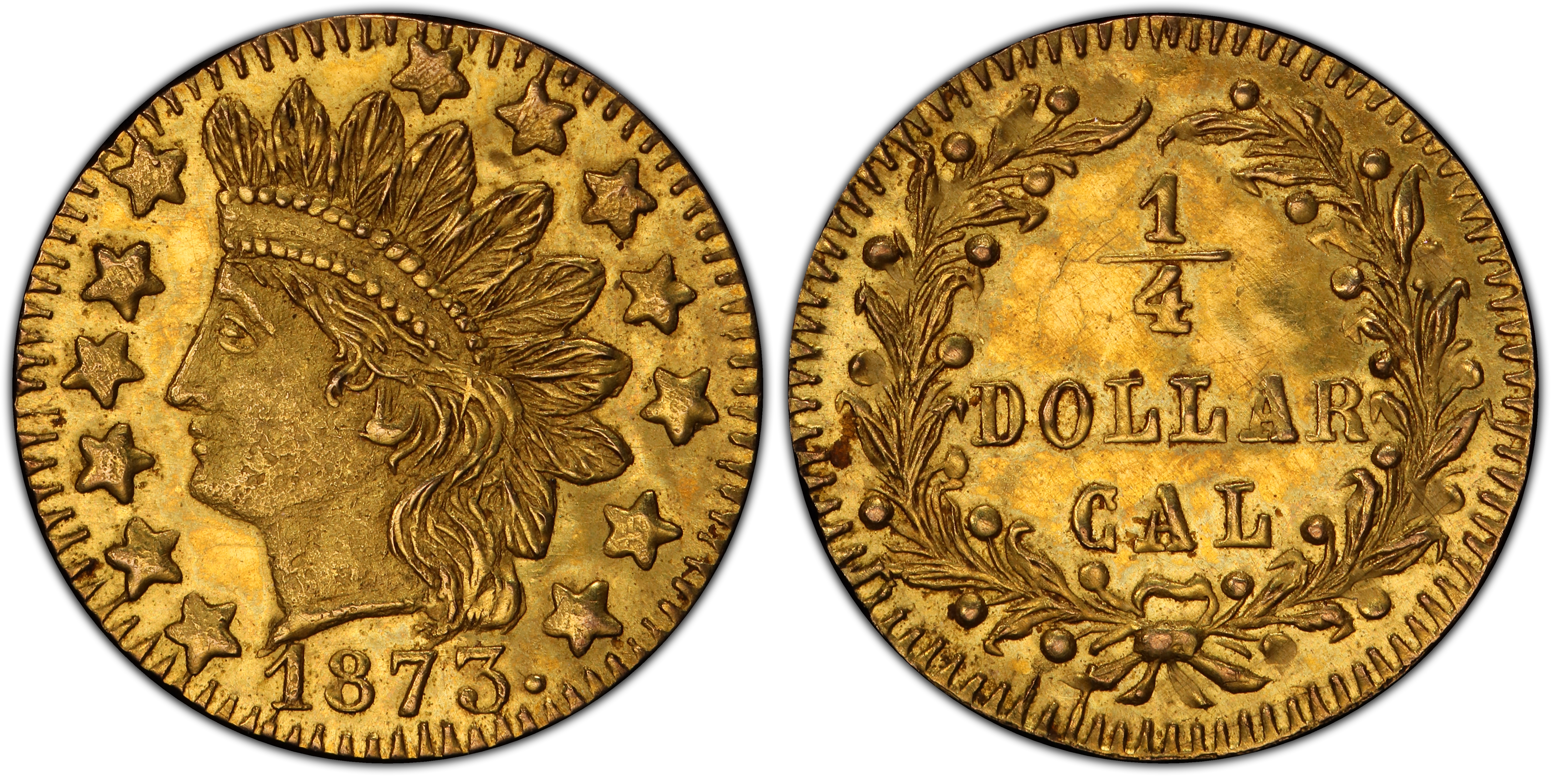
Obverse & Reverse
The 1873 G25C BG-872 is a product of the latter period of California Fractional Gold production, a fascinating chapter in American numismatics born from necessity and entrepreneurial spirit. By 1873, the main California Gold Rush had long since subsided, but its economic legacy endured. California's economy was still heavily reliant on gold dust and large-denomination federal coins, creating a chronic shortage of small change for everyday transactions. While the San Francisco Mint produced federal silver coinage, it was often hoarded or exported, perpetuating the problem. Into this void stepped jewelers and private minters who began producing tiny, fractional-denomination gold coins in the early 1850s. These pieces, often called 'charms' or 'tokens' to circumvent federal laws against private coinage, served as a practical substitute currency. The BG-872 variety falls into the 'Period Two' (1858-1882) classification of fractional gold, a time when production was more commercialized and the legal status of the pieces was increasingly ambiguous. These later-period coins were often machine-struck with greater precision than their Period One predecessors. They were marketed as souvenirs and keepsakes of California, though they undoubtedly saw some circulation in localized areas. The designs frequently mimicked federal coinage, with the Indian Head motif of the BG-872 being a clear nod to the popular U.S. Indian Head cent. By the 1870s, increased federal coinage production and the passage of the Act of June 8, 1864, which explicitly forbade private coinage, began to curtail the industry. Production dwindled, and by 1882, the era of California Fractional Gold came to a close, leaving behind a legacy of beautiful, miniature coins that tell the story of California's unique economic development.
Associated EventPost-California Gold Rush Economic Development
Reason For MintingTo alleviate a chronic shortage of small-denomination coinage for daily commerce in California and to serve as popular souvenirs.
Minter HistoryWhile definitive attribution is difficult for many fractional gold pieces, the BG-872 is stylistically and metallurgically linked to the firm of Frontier, Deviercy & Co. of San Francisco. This company was a prominent jeweler and manufacturer of 'California Gold Dollars' and other souvenir items. They utilized more advanced striking technologies than the earliest 'smiths, resulting in coins of generally higher quality and more uniform appearance. Their business model focused on creating attractive, desirable keepsakes for locals and tourists, capitalizing on the romanticism of the Gold Rush, while also producing pieces that could function as currency in a pinch.
Historical SignificanceThe BG-872, like all California Fractional Gold, represents a fascinating response to a localized economic need and a legal gray area in U.S. monetary history. It is a tangible artifact from a time when private enterprise directly addressed failures in the federal currency system. As a Period Two issue, it also illustrates the evolution of the series from a purely utilitarian currency to a more commercially produced souvenir item, reflecting California's changing economy and its growing self-awareness as a destination.
N/A
Denomination25 Cents (Quarter Dollar)
Minting Period1873
Assayer/MinterAttributed to Frontier, Deviercy & Co., San Francisco, California
Geographic OriginSan Francisco, California
Obverse DescriptionA stylized head of Liberty facing left, wearing a feathered headdress. The portrait is often described as an 'Indian Head'. A circle of 13 stars surrounds the portrait.
Obverse Inscription[No Inscription]
Reverse DescriptionThe denomination '1/4' is prominently displayed in the center, enclosed within a wreath of leaves and berries. The date '1873' is positioned at the top, just inside the wreath. The inscription 'CALIFORNIA GOLD' encircles the wreath below.
Reverse Inscription1873 CALIFORNIA GOLD 1/4
CompositionGold
Stated Fineness Actual FinenessVaries, but typically between .500 and .750 fine (12-18 karat gold).
Weight0.25 grams
Diameter9.50 mm
EdgePlain
Unknown
Survival Estimate200-300
Rarity ScaleR-5
The BG-872 is highly popular with collectors due to its classic 'Indian Head' design, which mimics federal coinage, and its status as a genuine artifact of post-Gold Rush California. It is a relatively affordable and available entry point into the complex world of Period Two fractional gold, offering a tangible connection to this unique numismatic era.
Key VarietiesThe primary issue is the business strike intended for circulation or as a souvenir. There are no known major varieties from the original minting period for BG-872. No known period proofs, patterns, or official restrikes exist. Collectors should be aware of modern replicas, which are not considered numismatic varieties.
Authentication TipsAuthentic BG-872 examples have a specific 'feel' due to their low-gold-content alloy. Look for sharp, well-defined details in the feathers and the wreath, which are often mushy on counterfeits. The style of the numerals in the date and fraction is a key diagnostic; compare any potential purchase to high-resolution images of certified examples. The coin's weight should be very close to 0.25 grams. Many forgeries are cast, showing pitting or a soapy texture, whereas genuine pieces are struck and exhibit die flow lines and sharp rims.
Shopping ConsiderationsA premium quality BG-872 will exhibit a sharp strike, particularly on the highest points of the feathers and the bow of the wreath. Original, uncleaned surfaces with some remaining luster command significant premiums. The typical color is a slightly brassy or reddish-gold due to the alloy. Avoid examples that are heavily cleaned, polished, or have been mounted in jewelry, which is a common fate for these small pieces. Look for any evidence of tooling in the fields or repairs on the rim. A coin with smooth, problem-free surfaces and good eye appeal is always more desirable, even in a slightly lower grade.
A coin's grade is its condition, rated on a 1-70 scale. For rare coins, this is the most critical factor in determining value, as a tiny difference in preservation can mean a huge difference in price.
Relevant Grade TypesOriginal period issues were business strikes intended for circulation or sale as souvenirs and are found in Circulated (1-58) and Mint State (MS, 60-70) grades. No Proof (PR/PF) examples were struck during the original period of issue, and there are no known later-date presentation strikings or restrikes. Any piece described as a 'Proof' is almost certainly a modern copy or fantasy piece.
Mint State CharacteristicsUncirculated examples of BG-872 typically feature a soft, satiny luster rather than a hard, frosty one. The strike can be variable; a well-struck coin will show full detail in the headdress feathers and the leaves of the wreath. Due to the small size and handling, even Mint State coins can show tiny planchet flaws or light contact marks. The fields are not always perfectly flat and may show some slight die polishing lines.
Circulated Wear PatternsWear first appears on the high points of the design. On the obverse, check the cheek of the Indian Head and the tips of the feathers. On the reverse, the highest points of the wreath's leaves and the numeral '4' in the fraction will show the first signs of friction. In lower grades (VF and below), the individual feathers will begin to merge, and the legend CALIFORNIA GOLD will become weak.
Key Factors For ValueSurface preservation is paramount. An example with original, undisturbed luster and minimal marks will always be worth more than a heavily cleaned or polished coin of the same grade. Strike quality is a major driver of value; collectors pay a premium for sharply detailed examples. Eye appeal, including attractive original toning or a pleasing gold color, significantly enhances value. For this series, third-party certification (PCGS, NGC) is crucial for authentication and liquidity, and a CAC sticker indicates premium quality for the assigned grade and brings a substantial price increase.
PCGS Price Guide
| Grade | Price | Population |
|---|---|---|
| 58 | $300.00 | 2 |
| 58+ | $315.00 | N/A |
| 60 | $335.00 | N/A |
| 61 | $350.00 | 3 |
| 62 | $375.00 | 5 |
| 62+ | $425.00 | N/A |
| 63 | $550.00 | 8 |
| 63+ | $600.00 | N/A |
| 64 | $900.00 | 21 |
| 64+ | $1,050.00 | N/A |
| 65 | $1,850.00 | 3 |
| 66 | N/A | N/A |