1872 G50C BG-940 (Regular Strike)
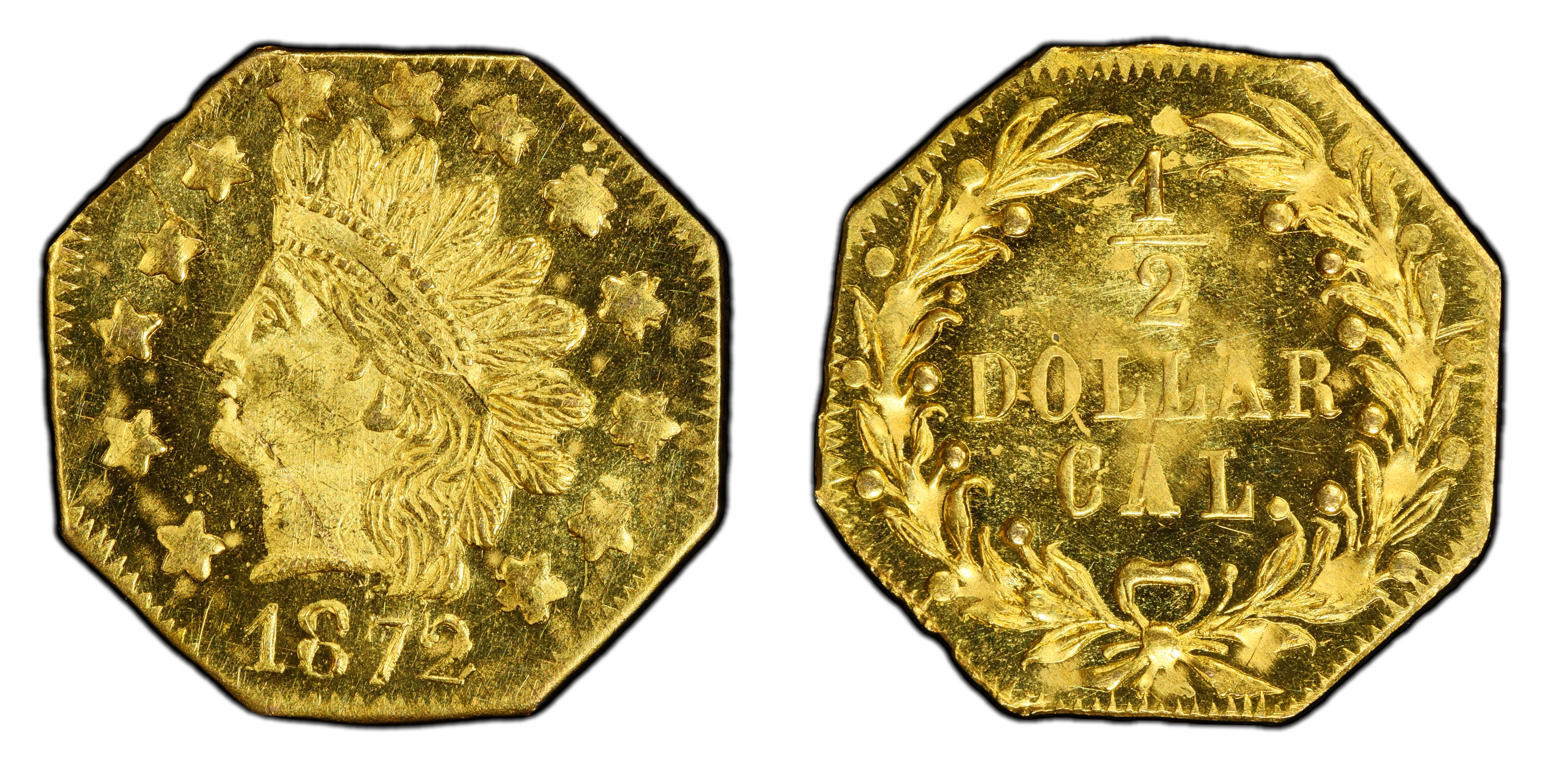
Obverse & Reverse
The 1872 BG-940 Fifty Cent piece is a quintessential example of a 'Period Two' California Fractional Gold coin, a series born from the unique economic conditions of the American West. The initial California Gold Rush, beginning in 1849, drew hundreds of thousands of prospectors and merchants to the isolated territory. This massive and sudden influx of population, combined with a reliance on raw gold dust for transactions, created a chaotic monetary environment and a severe shortage of small-denomination coinage for everyday purchases. To fill this void, private jewelers and metallurgists, primarily in San Francisco, began striking their own coins in 25 cent, 50 cent, and one-dollar denominations starting in 1852. These initial 'Period One' (1852-1857) issues were utilitarian, intended to and did circulate as a practical medium of exchange, albeit often with a gold content slightly below their face value. By the 1860s and 1870s, the monetary landscape of California had matured. The establishment of the San Francisco Mint in 1854 had alleviated the most pressing coinage shortages, and the use of private gold for circulation dwindled. However, the allure of the Gold Rush and the romance of the West had captured the nation's imagination. San Francisco's jewelers, recognizing a new market, transitioned from producing coins for commerce to creating miniature gold pieces as souvenirs and keepsakes. The BG-940 falls squarely into this 'Period Two' (1858-1882) category, often termed 'jeweler's issues.' These pieces were not intended for circulation but were sold to tourists, sent back East as mementos, or incorporated into jewelry. As such, their designs, while echoing Federal coinage like the Indian Head cent, were often more stylized. The Coinage Act of 1864 officially prohibited private coinage, but the law was not strictly enforced against these small, popular tokens until the Secret Service cracked down in the early 1880s, bringing the era of California Fractional Gold to a close. The BG-940 is a tangible link to this later, more commercial phase of the private gold story, representing a fascinating intersection of numismatics, economics, and tourism in 19th-century America.
Associated EventCalifornia Gold Rush Aftermath
Reason For MintingPrimarily created as a souvenir or keepsake for the tourist trade, capitalizing on the romanticism of the Gold Rush.
Minter HistoryThe specific minter of BG-940 is unknown, a common trait for many Period Two issues. These coins were produced by a variety of San Francisco jewelers and artisans who struck them using hand-operated presses. Unlike the more systematically organized private mints of the early 1850s, these later producers were often small-scale operations. Prominent makers of similar 'Indian Head' types during this period included figures like Robert B. Gray, but a definitive attribution for this specific die pairing has not been established. These jewelers were skilled metallurgists who created their own dies and planchets, resulting in a wide array of distinctive varieties.
Historical SignificanceThe BG-940 represents the evolution of private gold coinage from a necessary medium of exchange to a popular collectible and souvenir. It highlights the lasting cultural and economic impact of the Gold Rush, demonstrating how its legacy was commodified for a national audience. As a 'jeweler's issue,' it is a testament to the lax enforcement of federal anti-counterfeiting laws of the era and the continued demand for tangible, golden reminders of the Wild West.
BG-940
Denomination50 Cents
Minting Period1872
Assayer/MinterUnknown
Geographic OriginSan Francisco, California
Obverse DescriptionFeatures a stylized bust of an Indian princess facing left, wearing a feathered headdress. The portrait is encircled by 13 six-pointed stars, representing the original colonies.
Obverse Inscription1872
Reverse DescriptionA wreath composed of two branches tied together with a bow at the bottom. The wreath encircles the denomination.
Reverse Inscription1/2 DOLLAR
CompositionGold
Stated Fineness Actual FinenessVariable; Period Two issues are known to range from 14 to 22 karats (.583 to .917 fine).
EdgePlain
Unknown
Survival Estimate76-200 (The R-4 rating on the Breen-Gillio scale corresponds to this range of known examples.)
Rarity ScaleR-4
The BG-940 is sought after for its connection to the California Gold Rush, its octagonal shape, and its classic Indian Head design. As a dated, denominated gold piece from a fascinating period of U.S. history, it appeals to collectors of territorial gold, tokens, and 19th-century Americana. Its relatively affordable price compared to Period One issues makes it an accessible entry point into the series.
Key VarietiesNo major, recognized varieties or restrikes of the BG-940 die marriage are known to exist. The primary 'variety' is the coin itself within the broader series of over 500 different California Fractional Gold issues cataloged by Breen and Gillio. Collecting focuses on acquiring different BG numbers rather than die states of a single variety.
Authentication TipsAuthentic Period Two pieces like the BG-940 will almost always carry a denomination (e.g., '1/2 DOLLAR' or '50 CENTS'). Be wary of pieces that say 'CALIFORNIA GOLD' without a denomination, or those featuring a bear on the reverse, as these are hallmarks of later, non-contemporary tokens or replicas. Genuine examples often have a slightly crude, hand-struck appearance with imperfect centering and strike softness. The luster should be original and not the bright, brassy look of modern gold plating. Familiarity with the specific die characteristics, when viewable on certified examples, is the best defense.
Shopping ConsiderationsA premium quality example of BG-940 will exhibit a sharp strike for the type, particularly on the details of the headdress and the individual leaves of the wreath. Look for clean, original surfaces with minimal distracting marks; the small size of these coins makes any imperfection highly noticeable. Luster is a key value driver; coins with a bright, semi-prooflike or frosty luster command significant premiums. Avoid examples that have been harshly cleaned, polished, or show evidence of being mounted in jewelry (solder marks, rim damage). Eye appeal is paramount, and coins with a pleasing, uniform reddish-gold toning are highly desirable.
A coin's grade is its condition, rated on a 1-70 scale. For rare coins, this is the most critical factor in determining value, as a tiny difference in preservation can mean a huge difference in price.
Relevant Grade TypesOriginal BG-940 issues were business strikes. Since they were primarily intended as souvenirs, many were saved in high grades. They are found in both Circulated (AU-58 and below, though scarce) and Mint State (MS, 60-70) grades. No official Proofs were struck during the original period of issue, though some sharply struck, high-quality specimens exhibit prooflike surfaces and are designated 'PL' by grading services.
Mint State CharacteristicsUncirculated examples of BG-940 are defined by their luster and lack of wear. Luster is typically satiny or semi-prooflike. The strike is often uneven, with some softness on the stars or parts of the wreath being common and acceptable. High-grade Mint State examples should be free of significant contact marks, though tiny planchet flaws or strike-throughs (debris on the die during striking) are not uncommon given the rudimentary minting process. The overall eye appeal, combining luster, strike, and surface preservation, is critical in determining the grade from MS-62 to the gem levels of MS-65 and above.
Circulated Wear PatternsWear first appears on the highest points of the design. On the obverse, this includes the cheekbone of the Indian princess and the upper feathers of the headdress. On the reverse, the highest points of the wreath's bow and the upper leaves are the first areas to show friction and loss of detail. On lower-grade circulated examples, the stars will begin to lose their sharpness and the legends will appear soft.
Key Factors For ValueFor the BG-940, value is driven by several key factors. Grade is paramount, with Gem Mint State (MS-65 or higher) examples being exceptionally rare and valuable. Surface quality is next; an example with original, undisturbed luster and skin will always be worth more than a cleaned or polished coin of the same grade. Strike sharpness contributes significantly to eye appeal, and well-struck pieces are prized. Finally, certification by a top-tier service (PCGS or NGC) is essential for market acceptance, and a CAC sticker signifying premium quality for the grade can add a substantial premium.
PCGS Price Guide
| Grade | Price | Population |
|---|---|---|
| 55 | $210.00 | 2 |
| 55+ | $215.00 | N/A |
| 58 | $220.00 | 3 |
| 58+ | $250.00 | N/A |
| 60 | $300.00 | 1 |
| 61 | $340.00 | 3 |
| 62 | $375.00 | 17 |
| 62+ | $400.00 | N/A |
| 63 | $475.00 | 23 |
| 63+ | $550.00 | N/A |
| 64 | $700.00 | 30 |
| 64+ | $850.00 | N/A |
| 65 | $1,100.00 | 11 |
| 65+ | $1,750.00 | 1 |
| 66 | $2,500.00 | 1 |
| 66+ | $3,000.00 | N/A |
| 67 | $3,500.00 | N/A |
| 67+ | $4,000.00 | N/A |
| 68 | $5,000.00 | N/A |