1872 G25C BG-814 (Regular Strike)
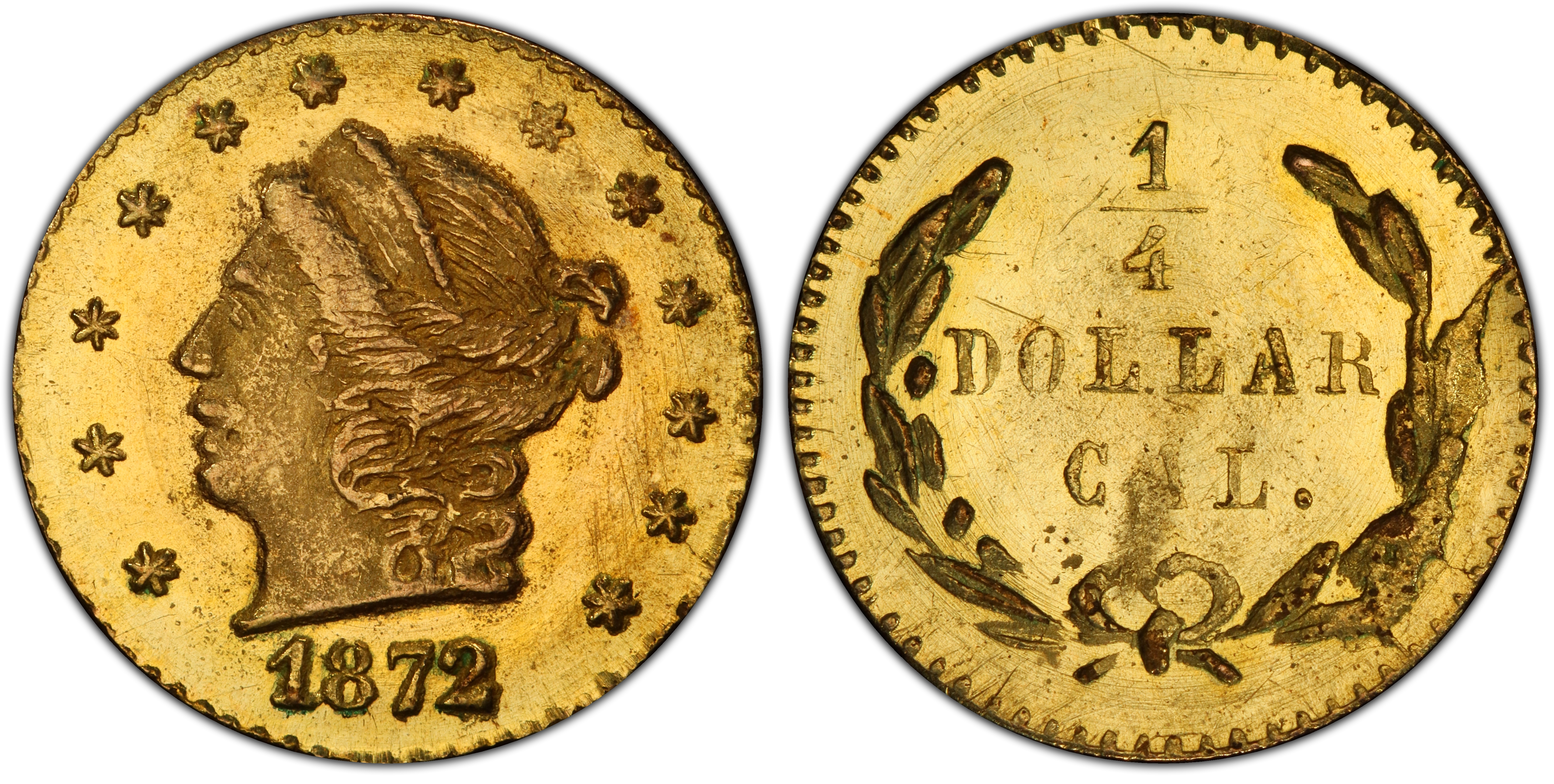
Obverse & Reverse
The 1872 G25C BG-814 is a quintessential example of a 'Period Two' California Fractional Gold piece. By 1872, the socio-economic landscape of California had evolved dramatically from the chaotic, early days of the Gold Rush. The initial, desperate shortage of small-denomination coinage that spurred the creation of 'Period One' (1852-1857) fractionals had been largely resolved by the output of the San Francisco Mint, which opened in 1854. Consequently, the reason for minting private gold coinage shifted. The BG-814 was not struck to satisfy a need in daily commerce but was instead created as a novelty item, a souvenir, and for use in jewelry. The minters, Frontier & Bellemere, were listed in San Francisco directories as 'Manufacturing Jewelers and Diamond-setters' at 706 Montgomery St. Their business was not that of a private mint in the territorial sense, but of artisans catering to a market that romanticized the Gold Rush. These tiny gold pieces were popular keepsakes for tourists and locals alike, tangible mementos of California's golden identity. The Coinage Act of 1864 had prohibited private coinage, but enforcement was lax, particularly for pieces that were clearly not intended to seriously compete with federal money due to their minuscule size and intrinsic value. These 'jeweler's issues' often contained less gold than their Period One predecessors and were produced with varying quality. The BG-814, however, is a product of skilled jewelers, displaying a relatively sharp strike for the type. Its extreme rarity today suggests a very small original production, likely made as a special order or as part of a small batch. These pieces never truly circulated in a traditional sense; their journey was one from the jeweler's shop to a velvet-lined box or a piece of custom jewelry, preserving them from the wear that characterizes true circulating coinage.
Associated EventPost-Gold Rush California Commerce
Reason For MintingPrimarily struck as a souvenir and for use in jewelry rather than to alleviate a commercial coin shortage.
Minter HistoryFrontier & Bellemere were established manufacturing jewelers and lapidaries located at 706 Montgomery Street in San Francisco during the 1870s. Their business focused on cutting precious stones, setting diamonds, and creating custom jewelry. Like other jewelers of the era, they entered the business of producing California Fractional Gold pieces to cater to the robust market for souvenirs and novelties that recalled the height of the Gold Rush. Their output was part of the 'Period Two' series, characterized by production for the tourist and jewelry trade rather than for circulation. They are known for several varieties of fractional gold, including the popular Washington Head types.
Historical SignificanceThe BG-814 represents the transition of California Fractional Gold from a necessary medium of exchange to a nostalgic souvenir. It is a physical artifact of how the Gold Rush was memorialized and commercialized in the decades following the initial boom, reflecting the skilled craftsmanship of San Francisco's jewelers.
BG-814
Denomination25 Cents
Minting Period1872
Assayer/MinterFrontier & Bellemere
Geographic OriginSan Francisco, California
Obverse DescriptionA classic Liberty Head portrait facing left, with hair tied in a bun at the back. The portrait is surrounded by 13 six-pointed stars arranged in a circle near the denticled rim. The date, 1872, is positioned below the bust.
Obverse Inscription1872
Reverse DescriptionThe denomination '1/4 DOLLAR' is displayed across two lines within a wreath. The wreath is composed of two olive branches tied together with a bow at the bottom. A key diagnostic for this variety is a prominent, severe die break that connects the wreath to the rim on the right side.
Reverse Inscription1/4 DOLLAR
CompositionGold
Stated Fineness Actual FinenessVariable, typical for Period Two issues (often .500 to .800 fine)
Weight0.25 grams
Diameter9.80 mm
EdgePlain
Extremely low, likely fewer than 500
Survival EstimateFewer than 15 known specimens
Rarity ScaleHigh R-6 (possibly R-7)
The BG-814 is a highly coveted numismatic rarity, prized for its connection to the famous California Gold Rush era, its attractive Liberty Head design, and its extreme scarcity. Being a 'Period Two' issue from a known jeweler adds to its charm as a historical souvenir. Its rarity places it in the cabinet of the advanced fractional gold specialist.
Key VarietiesNo major varieties, restrikes, or patterns are widely known for the BG-814 in numismatic literature. The defining characteristic of the variety is the specific die pairing and its associated diagnostics, such as the reverse die break. All known examples are considered original business strikes from the period.
Authentication TipsThe primary diagnostic for authenticating a genuine BG-814 is a severe die break on the reverse, joining the wreath to the right rim. Genuine examples will exhibit sharp, albeit miniature, details consistent with jeweler-produced dies of the 1870s. Look for a 'medallic alignment' (obverse and reverse aligned at 180 degrees). Counterfeits are rampant in this series; fakes are often crude, have incorrect details (such as a bear on the reverse, which is never found on genuine period issues), a soapy or cast-like texture, incorrect weight, and are often made of brass or low-karat gold plating. All suspected examples should be authenticated by a major third-party grading service.
Shopping ConsiderationsFor a coin of this rarity, any example is a significant acquisition. A 'premium quality' specimen would be one that is well-centered and sharply struck, with minimal marks. Luster is a key value component; look for examples with original, satiny fields. The color is often described as a 'rich green and orange-gold,' and pieces with this attractive, original skin command a premium. Avoid examples that have been harshly cleaned, show evidence of tooling, or have been mounted in jewelry, as this significantly impairs value. Given the rarity, even a problem-free AU (About Uncirculated) example is a major prize.
A coin's grade is its condition, rated on a 1-70 scale. For rare coins, this is the most critical factor in determining value, as a tiny difference in preservation can mean a huge difference in price.
Relevant Grade TypesOriginal period issues were business strikes intended for the souvenir and jewelry trade, not for circulation. They are found in Circulated (AU-50 to 58) and, more commonly for this rare issue, Mint State (MS, 60-70) grades. The term 'circulated' for these pieces often refers to minor handling rather than extensive public use. No Proofs were struck during the original period of issue, and there are no known later-date Proof restrikes.
Mint State CharacteristicsUncirculated examples of BG-814 typically exhibit a soft, satiny luster. The strike can be uneven, which is common for privately produced issues made with less advanced equipment than the U.S. Mint. A well-struck example will show clear details in Liberty's hair and the leaves of the wreath. Due to the softness of the gold and their small size, even Mint State examples may show minor handling marks or planchet imperfections. The characteristic die break on the reverse should be sharp and clear.
Circulated Wear PatternsOn handled or 'circulated' examples, wear first appears as a slight flattening on the highest points of the design. This includes Liberty's cheekbone, the hair above her ear, and the coronet. On the reverse, the high points of the wreath's leaves and the bow of the ribbon will show the first signs of friction. In lower grades (e.g., AU-50), a general softness will be evident across the entire design, and luster will be subdued in the fields.
Key Factors For ValueGiven its rarity, the primary value driver is simply authenticity and the absence of problems. Beyond that, value is determined by surface preservation and eye appeal. An example with minimal contact marks, original undisturbed luster, and attractive reddish-gold or greenish-gold toning is highly desirable. Strike quality is also critical; a coin with a full, sharp strike on both the central devices and the peripheral stars will command a significant premium over a weakly struck counterpart. Certification by PCGS or NGC is essential for market acceptance, and a CAC sticker would denote premium quality for the assigned grade.
PCGS Price Guide
| Grade | Price | Population |
|---|---|---|
| 50 | $250.00 | 1 |
| 50+ | $250.00 | N/A |
| 53 | $275.00 | 1 |
| 53+ | $285.00 | N/A |
| 55 | $310.00 | 2 |
| 55+ | $325.00 | N/A |
| 58 | $400.00 | 3 |
| 58+ | $425.00 | N/A |
| 60 | $450.00 | N/A |
| 61 | $475.00 | 2 |
| 62 | $525.00 | 5 |
| 62+ | $550.00 | N/A |
| 63 | $600.00 | 6 |
| 63+ | $750.00 | N/A |
| 64 | $1,050.00 | 2 |
| 64+ | $1,250.00 | N/A |
| 65 | $2,000.00 | 4 |
| 66 | N/A | N/A |