1872/1 G25C BG-870, PL (Regular Strike)
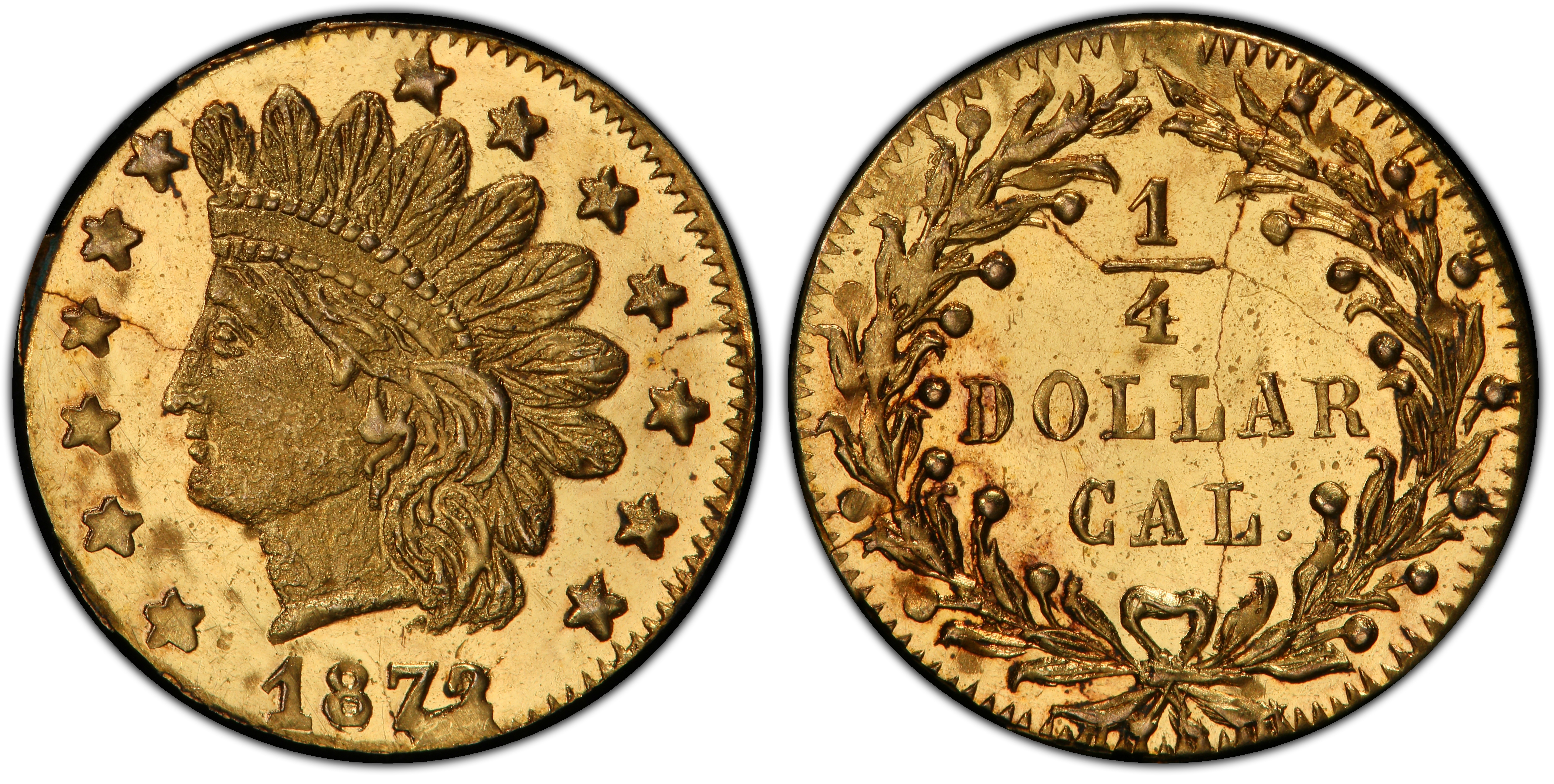
Obverse & Reverse
The 1872/1 G25C BG-870 is a quintessential example of a 'Period Two' California Fractional Gold piece. By the 1870s, the initial, desperate need for small denomination coinage that characterized the Gold Rush's peak had subsided, thanks to the robust output of the official San Francisco Mint, which opened in 1854. The purpose of these tiny gold coins had fundamentally shifted from utilitarian commerce to novelty and souvenir sales. San Francisco was becoming a major tourist destination, and visitors from the East Coast and Europe were eager for keepsakes of the romanticized 'Wild West' and its gold fields. Jewelers and private minters, many of whom were skilled European artisans who had immigrated during the rush, astutely filled this market demand. Gaetano F. Lanza was one such figure, a die-sinker and jeweler operating in the city. Unlike the earlier 'Period One' issues (1852-1857), which were generally of honest weight and intended to alleviate the critical shortage of small change, these later 'jeweler's issues' were intentionally and significantly underweight. Their intrinsic value was a fraction of their face value, a fact that was of little concern to a buyer seeking a memento rather than a monetary instrument. The production of these pieces existed in a legal gray area. The Coinage Act of 1864 had prohibited private coinage, but enforcement by the Secret Service was inconsistent and not fully pursued in California until 1883. To navigate this, minters often used older dates or, in this case, created overdates like the 1872/1 by re-punching a prior year's die, possibly to extend its usable life or to create an immediate sense of history. These pieces were typically struck with a screw press, allowing for sharper details than the earlier hammered coinage, and were often sold with prooflike or mirror-like surfaces to enhance their appeal. The BG-870, with its clear overdate, stands as a tangible link to this fascinating era of numismatic history, representing the transition from necessity-driven private coinage to commercial souvenir production.
Associated EventPost-Gold Rush California Tourism & Commerce
Reason For MintingPrimarily created as souvenirs and keepsakes for tourists and locals in San Francisco, not for general circulation.
Minter HistoryGaetano F. Lanza was an Italian-born die-sinker and jeweler who was active in San Francisco during the latter period of fractional gold production. He is credited with producing a variety of Indian Head and Liberty Head designs in the early 1870s. Lanza's work is characteristic of the 'jeweler's issues' of the era, marked by delicate craftsmanship but produced on thin, underweight planchets intended for the souvenir market rather than for monetary circulation. His operations were part of a cottage industry of private minters who capitalized on the romantic appeal of the Gold Rush long after its zenith, navigating the ambiguous legal status of private coinage prior to the federal crackdown in 1883.
Historical SignificanceThis coin is significant as a prime example of a 'Period Two' jeweler's issue, illustrating the shift in private gold coinage from a practical necessity to a souvenir commodity. The 1872/1 overdate provides direct physical evidence of the production methods of these private minters, who often repurposed dies to save on costs or create novelties.
BG-870
Denomination25 Cents
Minting Period1872
Assayer/MinterGaetano F. Lanza
Geographic OriginSan Francisco, California
Obverse DescriptionA stylized head of Liberty facing left, adorned with a Native American-style feathered headdress. The portrait is surrounded by thirteen stars, representing the original colonies. The most prominent diagnostic is the date below the bust, which shows a clear '2' punched over a '1' in the '1872', a result of an 1871 die being repurposed.
Obverse Inscription1872/1
Reverse DescriptionThe reverse features the denomination '1/4 DOLLAR' enclosed within a delicate, continuous wreath composed of leaves and berries, tied with a bow at the bottom.
Reverse Inscription1/4 DOLLAR
CompositionGold
Stated Fineness Actual FinenessApproximately .500 to .600 fine (12-14 karat), typical for underweight Period Two issues.
Weight0.24 grams
Diameter9.80 mm
EdgePlain
Unknown
Survival Estimate100-150
Rarity ScaleR-3
The BG-870 is highly sought after due to the clear and collectible 1872/1 overdate, which offers a unique story and a visible production anomaly. Its connection to a specific San Francisco jeweler, Gaetano F. Lanza, and its status as a quintessential 'Period Two' souvenir piece add to its historical appeal. The Indian Head motif is also very popular among collectors.
Key VarietiesThe primary variety is the 1872/1 overdate itself. No major sub-varieties from the original minting period are widely recognized. There are no known special collector issues, patterns, or official restrikes associated with this specific BG number.
Authentication TipsAuthentication requires careful examination. Genuine examples exhibit a specific die state and a sharp, albeit sometimes shallow, strike from a screw press. The overdate is the key diagnostic; look for the clear remnants of the underlying '1' beneath the '2'. Counterfeits often have incorrect details, a mushy or cast appearance, and may be made of brass or have incorrect weight and fineness. Many fakes lack a denomination or feature a bear on the reverse, which is not found on genuine Period Two denominated issues.
Shopping ConsiderationsA premium quality example for its grade will display sharp details, particularly in the feathers of the headdress and the lettering. Given the 'PL' (Prooflike) designation, look for coins with bright, reflective fields, as this greatly enhances eye appeal. The visibility of the overdate is paramount; a bold and unmistakable '2 over 1' commands a significant premium. Common problems include cleaning, which dulls the fragile surfaces, and jewelry mounting or removal, which can leave solder marks or rim damage. Given their small size and thinness, these coins are prone to minor planchet flaws or weak strikes at the periphery; a well-centered, fully-struck example is a prize.
A coin's grade is its condition, rated on a 1-70 scale. For rare coins, this is the most critical factor in determining value, as a tiny difference in preservation can mean a huge difference in price.
Relevant Grade TypesOriginal period issues of BG-870 were business strikes, often with prooflike surfaces, intended for sale as souvenirs. They are found in both Circulated (1-58) and, more commonly, Mint State (MS, 60-70) grades due to their non-circulating purpose. No true Proofs were struck during the original period of issue, and there are no known later-date Proof restrikes for this specific variety.
Mint State CharacteristicsUncirculated examples are defined by their luster. High-grade BG-870s often exhibit flashy, prooflike (PL) or deep mirror prooflike (DMPL) fields. Strike quality can vary, but a sharp strike will show clear definition in the individual feathers and the details of the wreath. Due to the softness of the low-karat gold and minimal handling, contact marks are often small but can be distracting in the open fields; a coin with clean, reflective fields is highly desirable.
Circulated Wear PatternsFor the few examples that saw handling, wear first appears on the high points of the design: the cheek and the details of the feathers on the obverse, and the highest leaves and the bow of the wreath on the reverse. In lower grades (VF and below), the fine details of the feathers will merge and the legends will begin to soften.
Key Factors For ValueThe primary value drivers for the BG-870 are the grade and the quality of the surfaces. A high Mint State grade (MS-63 or better) with a PL or DMPL designation commands a substantial premium. The strength and clarity of the 1872/1 overdate are critical; a bold overdate is more valuable than a faint one. Original, uncleaned surfaces with attractive reddish-gold toning add significant eye appeal and value. A CAC sticker for this issue confirms premium quality for the grade and typically results in a higher market price.
PCGS Price Guide
| Grade | Price | Population |
|---|---|---|
| 62 | N/A | N/A |
| 64 | N/A | N/A |
| 65 | $1,350.00 | 2 |
| 66 | N/A | N/A |
| 67 | N/A | N/A |