1874 G25C BG-875 (Regular Strike)
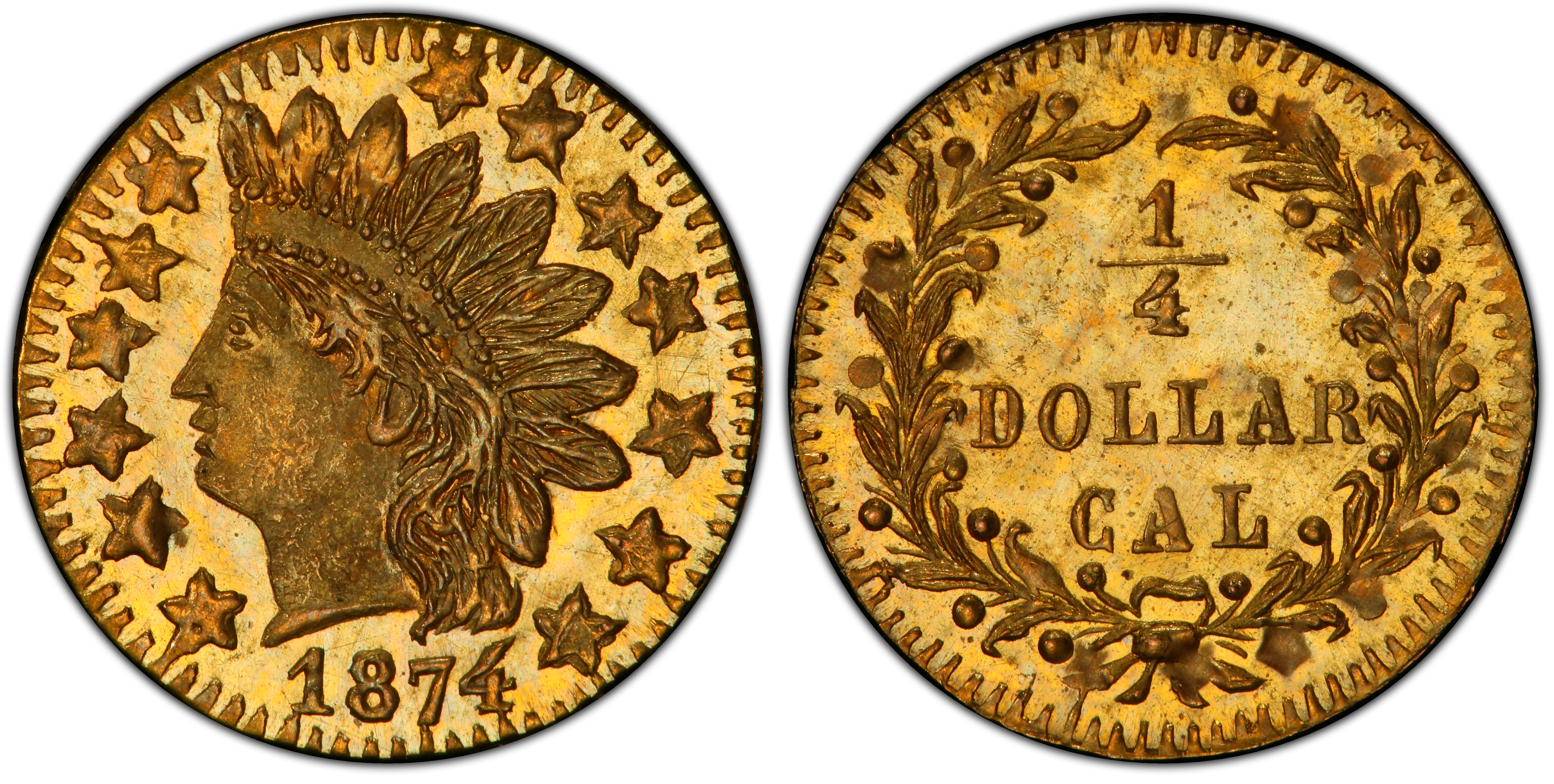
Obverse & Reverse
The 1874 G25C BG-875 is a product of 'Period Two' (1859-1882) of California Fractional Gold production. Unlike the earlier 'Period One' issues (1852-1857) which were struck out of a genuine need for small-denomination circulating currency during the height of the Gold Rush, the Period Two pieces were created in a different economic climate. By the 1870s, the United States Mint in San Francisco was in full operation, producing ample federal coinage and alleviating the initial shortage. Consequently, the impetus for creating fractional gold shifted from commerce to souvenir and novelty. Jewelers, primarily in San Francisco, recognized a burgeoning tourist market and a nostalgic desire for keepsakes from the romanticized Gold Rush era. These small gold pieces, often lighter and of a lower fineness than their stated value would imply, were perfect for this trade. The BG-875, with its classic Indian Head design, was a popular motif, emulating federal coinage to lend an air of legitimacy and appeal. These pieces were not intended to, and largely did not, circulate as money. Instead, they were sold as mementos, charms for bracelets, or small gifts. The private and often anonymous nature of their manufacture means the exact minters are lost to history, but their craftsmanship reflects the jewelers' skills. The Coinage Act of 1864 had made private coinage illegal, but the law was not strictly enforced against these small, low-value 'tokens' until 1883, allowing for a prolific period of production that catered to a post-Gold Rush California looking to capitalize on its own recent history.
Associated EventCalifornia Gold Rush Aftermath & Tourism
Reason For MintingPrimarily created as souvenirs and keepsakes for a growing tourist trade in California, rather than for circulation as currency.
Minter HistoryThe specific minter for BG-875 is unknown, a common trait for Period Two fractional gold. These pieces were generally produced by various jewelers and metalworkers in San Francisco who capitalized on the demand for Gold Rush souvenirs. Unlike earlier territorial minters who prominently marked their work (e.g., Moffat & Co.), these later producers often remained anonymous to avoid potential legal issues and because the pieces were sold as novelties, not as competitors to federal coinage.
Historical SignificanceThe BG-875 is significant not as a coin of commerce, but as a tangible artifact of California's transition from the chaotic Gold Rush to a more established economy with a burgeoning tourism industry. It represents the commercialization of the Gold Rush legend itself, where the idea of California gold became as valuable as the metal's monetary worth. Numismatically, it is an important part of the extensive and complex California Fractional Gold series, which tells the story of the region's economic evolution.
N/A
Denomination25 Cents
Minting Period1874
Assayer/MinterUnknown private minter, often attributed to jewelers in San Francisco. No specific mint mark is present.
Geographic OriginSan Francisco, California
Obverse DescriptionThe obverse features a left-facing bust of a female figure representing Liberty, wearing a Native American-style feathered headdress. The portrait is surrounded by 13 stars, representing the original colonies.
Obverse InscriptionNo inscription.
Reverse DescriptionThe reverse features the denomination '1/4' and the word 'DOLLAR' within a wreath of leaves and berries, tied with a bow at the bottom. The date '1874' is located below the bow.
Reverse Inscription1/4 DOLLAR 1874
CompositionGold
Stated Fineness Actual FinenessVaries, but Period Two issues are typically of a lower fineness than Period One issues, often ranging from 14 to 22 carats.
Weight0.25 grams
Diameter9.80 mm
EdgePlain
Unknown
Survival EstimateFewer than 200
Rarity ScaleHigh R-4
This coin appeals to collectors for its connection to the California Gold Rush era, its miniature size, and the challenge of collecting the numerous Breen-Gillio (BG) varieties. The Indian Head motif is classic and widely popular. As a dated 'Period Two' issue, it is more affordable than its 'Period One' circulating counterparts, making it an accessible entry point into the series.
Key VarietiesThe primary reference is the Breen-Gillio catalog, where this coin is designated BG-875. Within the broader 1874 25C series, there are numerous other BG numbers corresponding to different dies, shapes (round vs. octagonal), and design details (e.g., Liberty heads, Indian heads). No special collector restrikes are known for this specific variety from the original period of manufacture, but collectors must be aware of a vast number of modern, unofficial replicas, often gold-plated, which have no numismatic value.
Authentication TipsAuthentic BG-875 specimens have a characteristic strike style that is often sharp in some areas and weak in others due to the hand-hammering process. The details of the wreath and the digits of the date are key diagnostic points. Counterfeits and modern replicas are extremely common. Many fakes are gold-plated base metal and can sometimes be identified by an unnatural color or exposed core. Others are underweight. A key red flag is the presence of a bear on the design, which never appeared on genuine fractional gold from this period. Comparison with high-resolution images of certified examples is essential. Professional authentication by services like PCGS or NGC, which attribute by BG number, is highly recommended.
Shopping ConsiderationsA premium quality BG-875 for its grade will exhibit a sharp strike on the high points of the Indian's headdress and the details of the wreath. Look for original, undisturbed luster, which can range from satiny to semi-prooflike. The surfaces of these tiny coins are prone to handling marks, so examples with clean fields command a premium. Avoid pieces that have been harshly cleaned, which will appear unnaturally bright and show hairlines under magnification. Many were used as jewelry, so check carefully for signs of mounting, removal, or tooling in the fields or around the rim. A coin with attractive, original reddish-gold toning is highly desirable.
A coin's grade is its condition, rated on a 1-70 scale. For rare coins, this is the most critical factor in determining value, as a tiny difference in preservation can mean a huge difference in price.
Relevant Grade TypesOriginal period issues were business strikes. Since Period Two fractionals were primarily souvenirs, many survive in high grades. They are found in both Circulated (1-58) and, more commonly, Mint State (MS, 60-70) grades. No true Proofs were struck during the original manufacturing period for this variety. Any piece described as a 'Proof' is likely a later-date replica or a business strike with exceptionally reflective, Prooflike (PL) surfaces.
Mint State CharacteristicsIn uncirculated (MS) condition, the BG-875 typically displays a soft, satiny luster. The strike can be inconsistent; a fully struck example with sharp details on the feathers and the wreath's bow is rare and desirable. Planchet quality can vary, with minor original flaws or laminations sometimes present. Due to their tiny size and handling over the years, even Mint State examples may show small ticks or marks; a coin with exceptionally clean surfaces is a prize.
Circulated Wear PatternsWear first appears on the highest points: the cheek and the feathers of the headdress on the obverse, and the bow and highest leaves of the wreath on the reverse. On lower-grade circulated examples, the stars on the obverse and the digits of the date on the reverse will begin to lose their sharpness and merge with the fields.
Key Factors For ValueThe primary drivers of value are grade and surface quality. An example with original, uncleaned surfaces and strong eye appeal will always be worth more than a dipped or cleaned coin of the same grade. Strike quality is crucial; a sharply struck coin can command a significant premium over a weakly struck counterpart. The presence of a CAC sticker, indicating premium quality for the grade, adds a notable premium for this series, as it gives buyers confidence in the originality of the surfaces and the strength of the strike.
PCGS Price Guide
| Grade | Price | Population |
|---|---|---|
| 55 | $225.00 | 2 |
| 55+ | $235.00 | N/A |
| 58 | $260.00 | N/A |
| 58+ | $265.00 | N/A |
| 60 | $275.00 | N/A |
| 61 | $300.00 | 3 |
| 62 | $350.00 | 7 |
| 62+ | $425.00 | N/A |
| 63 | $525.00 | 24 |
| 63+ | $575.00 | N/A |
| 64 | $650.00 | 36 |
| 64+ | $850.00 | N/A |
| 65 | $1,250.00 | 7 |
| 65+ | $1,575.00 | N/A |
| 66 | $2,250.00 | 2 |