1864 G50C BG-1016A (Regular Strike)
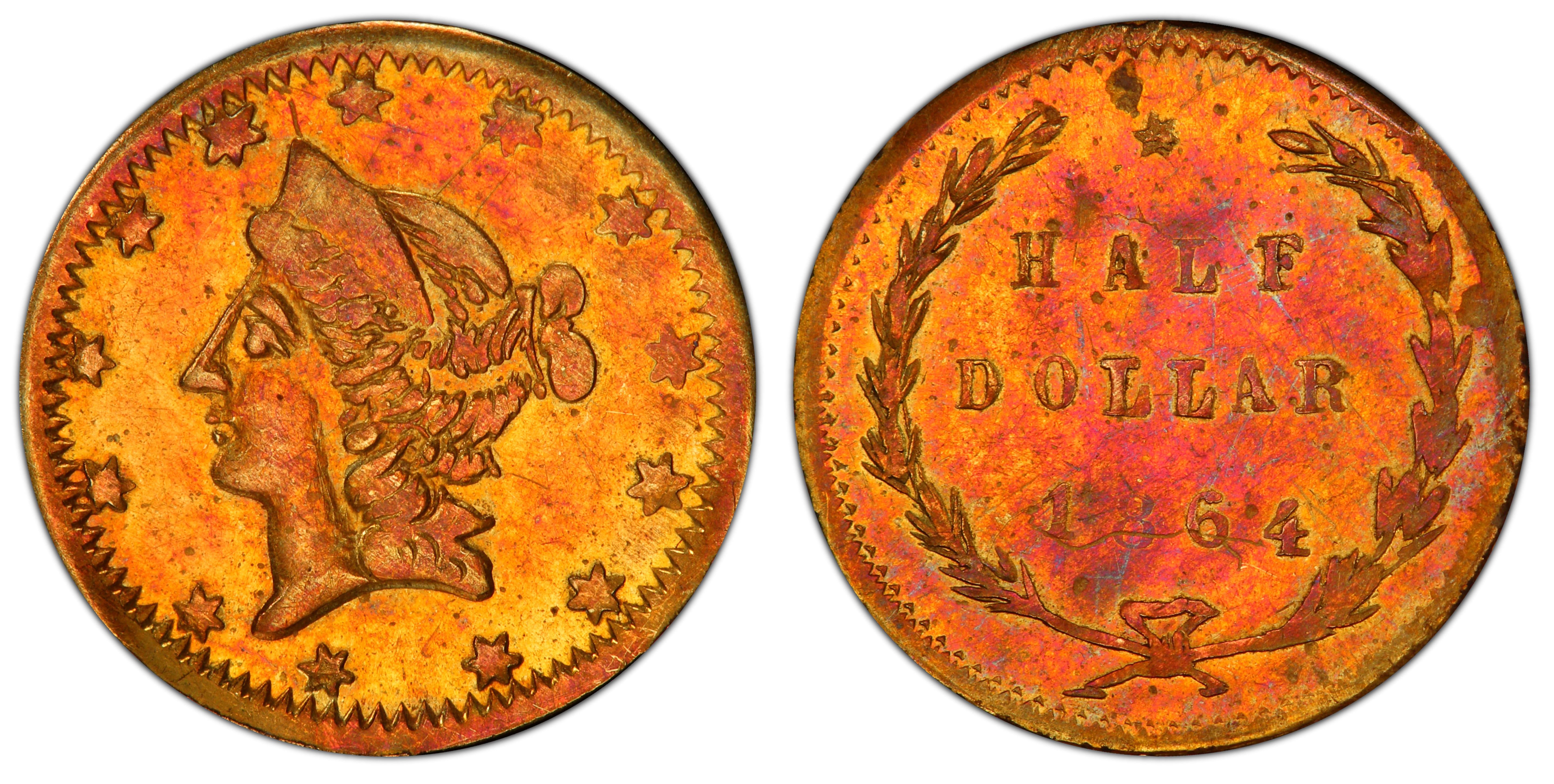
Obverse & Reverse
The 1864 G50C BG-1016A is an artifact from the second phase, or 'Period Two' (1859-1882), of California Fractional Gold production. This era is distinct from the earlier 'Period One' (1852-1856) issues, which were minted out of a genuine necessity to alleviate a severe shortage of small-denomination coinage during the initial frenzy of the Gold Rush. By the 1860s, the economic landscape of California had matured. The San Francisco Mint, opened in 1854, was producing sufficient federal coinage to meet the day-to-day needs of commerce. The impetus for private minters to produce fractional gold shifted from utility to novelty. These small-denomination gold pieces, including the BG-1016A, were primarily created as souvenirs and keepsakes. Jewelers in San Francisco, like Robert B. Gray & Co., catered to a growing tourist trade and a populace still enamored with the romanticism of the Gold Rush. These pieces were mementos that could be easily mailed back East or worn as jewelry. The passage of the Coinage Act of April 22, 1864, technically outlawed the private issuance of coinage. However, enforcement by the Secret Service was lax and not fully realized until the early 1880s. This legal gray area allowed jewelers to continue producing their denominated 'coins' for several years. The BG-1016A, struck in the very year the Act was passed, represents a transition point. It was made using dies from a previous assayer, likely featuring a backdated obverse, a common practice to circumvent legal scrutiny. Despite their token or souvenir status, these pieces were struck in gold, albeit often of a lower fineness and weight than their stated face value would imply. The extreme rarity of the BG-1016A today suggests a very limited original production, intended for a niche market rather than widespread circulation, solidifying its status as a prized numismatic collectible rather than a functional piece of currency.
Associated EventCalifornia Gold Rush (Later Period)
Reason For MintingPrimarily struck as a souvenir or keepsake for tourists and locals during a period when the initial shortage of small change had subsided.
Minter HistoryRobert B. Gray & Co. was a San Francisco-based jeweler and one of the key private minters during 'Period Two' of California Fractional Gold production. Gray took over the operations of the earlier firm of Nouizillet & Routhier, acquiring some of their dies. His coins are often identifiable by a 'G' mintmark, although the BG-1016A variety does not feature this. Gray's business operated in the legal ambiguity following the Coinage Act of 1864, producing denominated gold pieces largely for the souvenir trade. Like his contemporaries, he adapted to a market that valued Gold Rush memorabilia over functional currency. In 1871, Robert B. Gray sold his interests to the California Jewelry Co., marking the end of his direct involvement in the fractional gold series.
Historical SignificanceThe BG-1016A is significant as a representative of 'Period Two' California Fractional Gold, illustrating the shift from utilitarian private coinage to commercial souvenir production. Its 1864 date places it at a crucial legal crossroads for private minting in the United States, and its immense rarity makes it a key variety for advanced specialists of the series.
Not Applicable
Denomination50 Cents
Minting Period1864
Assayer/MinterRobert B. Gray & Co.
Geographic OriginSan Francisco, California
Obverse DescriptionThe obverse features a classic Liberty Head portrait facing left. The hair is tied in a bun at the back. Thirteen stars encircle the portrait along the rim.
Obverse InscriptionLIBERTY (on coronet)
Reverse DescriptionThe reverse displays the denomination '50 CENTS' within a beaded circle. The date '1864' is positioned below the denomination, also within the circle. The legend 'CALIFORNIA GOLD' encircles the design along the outer rim.
Reverse InscriptionCALIFORNIA GOLD 50 CENTS 1864
CompositionGold
Stated Fineness Actual FinenessPeriod Two issues generally ranged from 14 to 22 carats; the specific fineness for this variety is not documented but was likely less than the .900 standard of federal coinage.
EdgePlain
Extremely low, exact figure unknown.
Survival EstimateFewer than 5 known examples.
Rarity ScaleR-8 (Very Rare)
This coin's appeal lies in its extreme rarity (R-8). As one of the rarest and most challenging varieties in the entire California Fractional Gold series, it is a landmark acquisition for the most advanced collectors. Its status as a 'Period Two' issue struck in the pivotal year of 1864 adds significant historical interest.
Key VarietiesThe BG-1016A is a distinct die marriage and a key variety in itself. There are no major sub-varieties from the original minting period. No known special collector issues, such as proofs or restrikes, were made for this specific variety.
Authentication TipsAuthentication is critical. Genuine BG-1016A pieces will exhibit specific die characteristics known to specialists. Look for sharp, well-defined details consistent with known examples, as many contemporary counterfeits are crude. Genuine pieces are denominated '50 CENTS'; many fakes or charms from a later period lack a denomination or use phrases like 'CAL GOLD CHARM'. The fabric of the planchet is also key; authentic pieces were struck on thin gold planchets, and some counterfeits are plated or have an incorrect metallic feel. Third-party certification by PCGS or NGC is highly recommended for any transaction involving this rarity.
Shopping ConsiderationsFor a coin of this rarity, any example is a major prize. A 'premium quality' specimen would be one that is well-struck for the issue, with minimal marks and attractive original surfaces. While many fractional gold pieces are weakly struck, the BG-1016A is known to come with a relatively bold strike on the portrait. Check for impairments such as bending, evidence of jewelry mounting, or harsh cleaning, which would significantly impact value. Given the minuscule population, a buyer's primary consideration will be availability. Any opportunity to acquire a certified, problem-free example should be considered significant.
A coin's grade is its condition, rated on a 1-70 scale. For rare coins, this is the most critical factor in determining value, as a tiny difference in preservation can mean a huge difference in price.
Relevant Grade TypesOriginal examples of BG-1016A were business strikes, though they were intended as souvenirs and saw little to no circulation. They are found in Circulated (AU-58 and below) and, more typically, Mint State (MS, 60-70) grades. No Proof (PR/PF) examples were struck during the original period of issue, and no later-date Proof restrikes are known to exist.
Mint State CharacteristicsAn uncirculated BG-1016A is defined by its preserved luster and lack of wear. Unlike some other fractional issues, known examples are often well-struck, particularly on the portrait of Liberty. Luster is typically satiny and can be vibrant. Due to the softness of the gold and the production methods, small planchet flaws or contact marks from handling are common, even on high-grade specimens. The fields may show die polishing lines.
Circulated Wear PatternsOn the rare occasion an example shows wear, it would first appear on the highest points: the cheek and hair details of Liberty on the obverse, and the numerals of the denomination '50' on the reverse. In lower grades, the delicate stars and letters in the legends would begin to soften and merge with the fields.
Key Factors For ValueWith a population of fewer than five pieces, rarity is the paramount driver of value. Beyond that, the grade is the most significant factor. An MS-63 example is considerably more valuable than an AU-58. Surface quality is critical; collectors will pay a substantial premium for a coin with clean, original surfaces and minimal distracting marks. Eye appeal, including any attractive reddish-gold toning, enhances value. A CAC sticker on an already certified coin provides an additional layer of verification for quality and commands a strong premium in the market for this elite rarity.
PCGS Price Guide
| Grade | Price | Population |
|---|---|---|
| 58 | $1,600.00 | 1 |
| 58+ | $1,850.00 | N/A |
| 60 | $2,100.00 | N/A |
| 61 | $2,650.00 | 1 |
| 62 | $3,500.00 | 1 |
| 62+ | $4,000.00 | N/A |
| 63 | $5,000.00 | 1 |