1871 G25C BG-862 (Regular Strike)
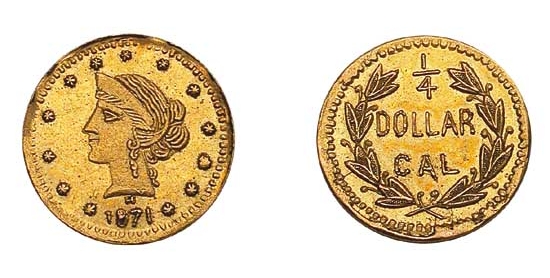
Obverse & Reverse
The 1871 BG-862 25 Cent piece is a quintessential example of a 'Period Two' California Fractional Gold coin, a series born from the unique economic conditions of post-Gold Rush California. The initial wave of fractional gold, struck from 1852-1857, was a direct response to a severe shortage of small-denomination coinage for daily transactions. These early pieces, while privately issued, were generally of good weight and fineness and served a genuine monetary purpose. However, by the time the BG-862 was created, the landscape had changed dramatically. The San Francisco Mint, opened in 1854, was producing ample federal coinage, obviating the need for private issues in commerce. Furthermore, the Coinage Act of 1864 explicitly outlawed private minting, casting a legal shadow over such enterprises. Despite this, San Francisco jewelers like Robert B. Gray & Co. continued to produce these miniature gold coins, which now served a different purpose. They were no longer primarily for circulation but were instead popular as souvenirs, keepsakes, and jewelry items, eagerly purchased by locals and tourists captivated by the romance of the Gold Rush. These 'Jeweler's Issues,' as they are known, were intentionally struck with a gold content significantly below their face value, making them profitable tokens rather than true coins. Their production was an open secret, largely ignored by federal authorities until the early 1880s when the Secret Service, concerned about potential for fraud, finally suppressed their manufacture. The year 1871 is particularly significant in the history of this piece's minter; it was the year Robert B. Gray sold his business to the California Jewelry Co., marking the end of an era for one of the period's most prolific producers. The BG-862 is thus a tangible artifact from this final year of the Gray firm's numismatic activities, representing a fascinating transition from utilitarian coinage to commercial souvenir.
Associated EventCalifornia Gold Rush Aftermath
Reason For MintingPrimarily created as a commercial souvenir and novelty item for the jewelry trade, not to alleviate a coin shortage.
Minter HistoryRobert B. Gray & Co. was a prominent San Francisco-based manufacturing jeweler. Around 1859, Gray purchased the business and equipment of Antoine Nouizillet, one of the primary minters of 'Period One' fractional gold. Gray continued to use some of Nouizillet's dies before creating his own, which are identifiable by a small 'G' hallmark, though BG-862 is an anonymous issue attributed to his firm. The company produced a wide variety of fractional gold pieces until 1871, when Gray sold his interests to the California Jewelry Company (successors to the Levison Brothers). Gray's issues are noted for often being of slightly better weight and quality than some other competing 'Jeweler's Issues' of the era.
Historical SignificanceThe BG-862 is a relic of the 'Jeweler's Issue' period of fractional gold, representing the commercialization of the Gold Rush legacy. It stands as evidence of a legally ambiguous but popular practice of private minting that persisted long after its original economic justification had vanished, serving as a memento of one of California's most defining eras.
N/A
Denomination25 Cents
Minting Period1871
Assayer/MinterRobert B. Gray & Co.
Geographic OriginSan Francisco, California
Obverse DescriptionA small, classic Liberty Head facing left, reminiscent of the design on the U.S. Gold Dollar. The head is flanked by thirteen stars, representing the original colonies. The date '1871' is below the bust truncation.
Obverse Inscription1871
Reverse DescriptionThe denomination '1/4 DOLLAR' is enclosed within a simple wreath composed of two branches tied together with a bow at the bottom. The legend 'CAL.' for California is inscribed above the wreath, just inside the beaded border.
Reverse InscriptionCAL. 1/4 DOLLAR
CompositionGold
Stated Fineness Actual FinenessVariable, but significantly less than the 90% standard of federal coinage; fineness for Period Two issues could range from 14 to 22 karats.
Weight0.24 grams
Diameter9.60 mm
EdgePlain
Unknown
Survival EstimateFewer than 30 known.
Rarity ScaleHigh R-6
This variety is highly sought after due to its significant rarity (High R-6) and its connection to the well-documented jeweler Robert B. Gray & Co. As a 'Period Two' issue, it is a key component for specialists assembling comprehensive sets of fractional gold by minter and Breen-Gillio (BG) number.
Key VarietiesThe primary variety is the regular strike as described. No proof strikings, patterns, or official restrikes are known to exist for BG-862. The entire series of Period Two fractional gold is rife with minor die variations, but BG-862 is a distinct marriage of obverse and reverse dies. Collectors should be aware of contemporary counterfeits and modern replicas, which are common for the series but typically crude and often made of brass or are gold-plated.
Authentication TipsAuthentic examples are struck in gold, not plated. The strike is often somewhat uneven due to the hand-hammering process. The details of the wreath and lettering on the reverse can be a key diagnostic; compare them to high-resolution images of certified examples. The style of the Liberty head and the placement of the stars are specific to this die. Counterfeits often have a soapy, cast-like appearance, incorrect weight, or lettering/design details that do not match the known authentic examples. The fabric and luster should be consistent with 19th-century private minting techniques.
Shopping ConsiderationsFor a premium quality example, seek a coin with a sharp, well-centered strike, as many were produced hastily and can be off-center or weak in areas. Original, uncleaned surfaces with some remaining luster command a significant premium. Look for a warm, reddish-gold or greenish-gold toning that is characteristic of unadulterated native California gold alloy. Avoid examples that have been used as jewelry, which often show signs of being mounted, soldered, heavily polished, or holed. Even minor rim bumps can significantly detract from the value of these tiny, delicate pieces. Certification by a major grading service (PCGS or NGC) is highly recommended for this series to ensure authenticity and accurate grading.
A coin's grade is its condition, rated on a 1-70 scale. For rare coins, this is the most critical factor in determining value, as a tiny difference in preservation can mean a huge difference in price.
Relevant Grade TypesAll original examples of BG-862 were struck as business strikes, intended for sale as novelties rather than circulation. They are found in Circulated grades (About Good-3 to About Uncirculated-58) and, more commonly for this souvenir-type issue, in Mint State (MS-60 to MS-70). No Proof (PR/PF) examples were struck during the original period of issue, and no later-date official restrikes are known.
Mint State CharacteristicsUncirculated examples often exhibit a soft, satiny luster rather than a hard, frosty one. The strike can be inconsistent; a coin with fully struck hair details on Liberty and a complete wreath on the reverse is highly desirable. Due to the hand-hammering process, planchets may not be perfectly flat. Small, as-made planchet flaws or minor die cracks are not uncommon and are generally accepted by specialists. The surfaces are very susceptible to tiny contact marks due to the softness of the gold.
Circulated Wear PatternsOn circulated examples, wear first appears on the highest points: Liberty's cheek, the hair just above the ear, and the coronet. On the reverse, the high points of the wreath's leaves and the bow will show initial flatness. In lower grades (VF and below), the stars on the obverse and the letters in the inscriptions will begin to lose their sharpness and merge with the fields.
Key Factors For ValueRarity is paramount for BG-862. Beyond its inherent rarity, the primary value drivers are grade and surface quality. An example with original, undisturbed luster and minimal contact marks will sell for multiples of a cleaned or polished piece. Strike quality is a major consideration; a bold, complete strike is rare and highly prized. Eye appeal, including attractive original toning, adds a premium. For this series, a CAC sticker is a significant value-enhancer, confirming premium quality for the assigned grade.
PCGS Price Guide
| Grade | Price | Population |
|---|---|---|
| 61 | $700.00 | 1 |
| 62 | $850.00 | 2 |
| 62+ | $1,000.00 | N/A |
| 63 | $1,650.00 | 1 |
| 63+ | $1,800.00 | N/A |
| 64 | $2,450.00 | 4 |
| 64+ | $2,750.00 | N/A |
| 65 | $3,250.00 | N/A |
| 65+ | $3,600.00 | N/A |
| 66 | $4,250.00 | 2 |