1874 G50C BG-930 (Regular Strike)
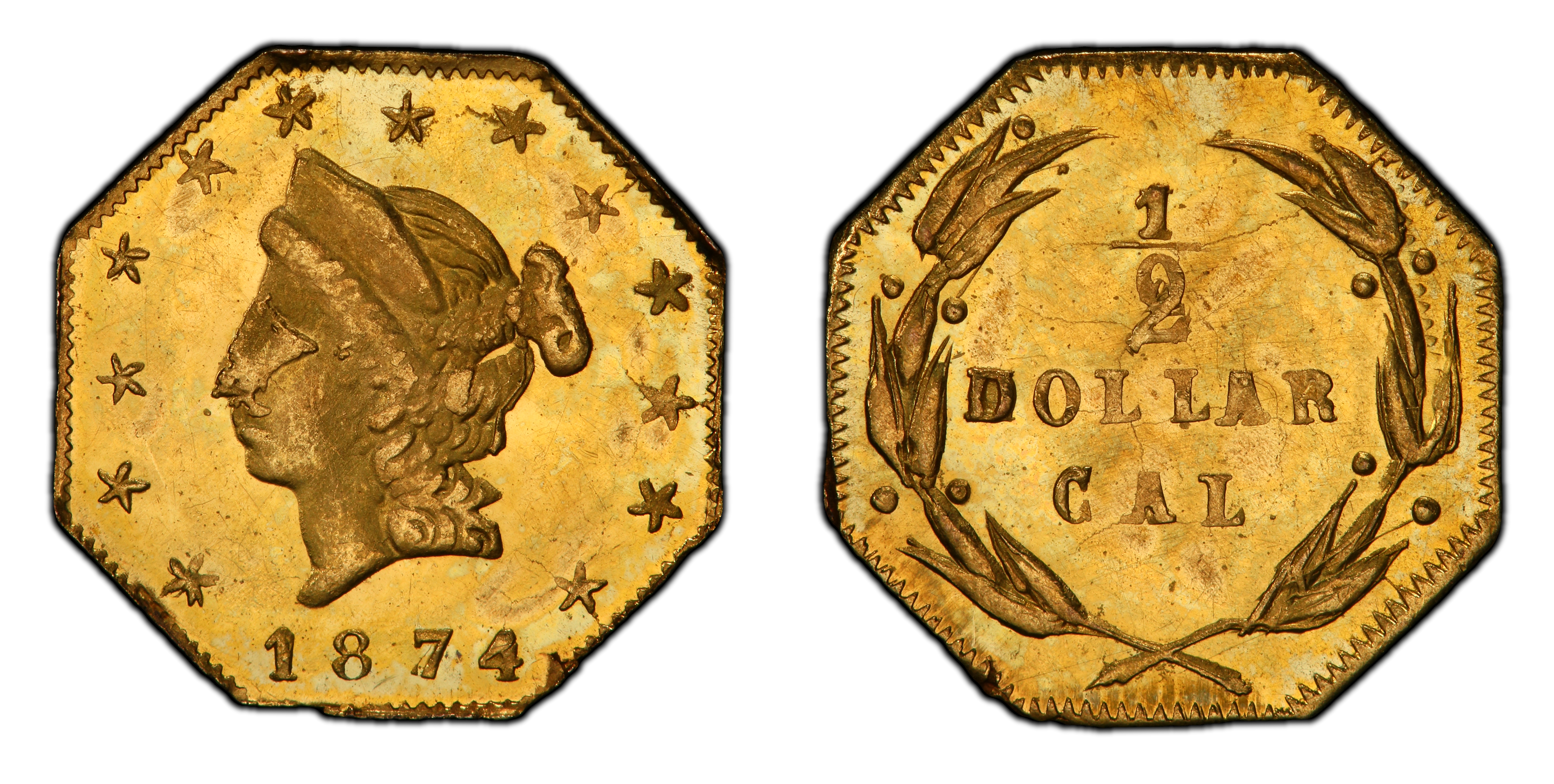
Obverse & Reverse
The 1874 G50C BG-930 is a product of the second great wave of California Fractional Gold production, often termed 'Period Two' (1859-1882) by numismatic historians like Walter Breen and Ronald Gillio. Unlike the 'Period One' issues, which were struck out of genuine necessity to alleviate a critical shortage of small change during the initial Gold Rush boom, the pieces from this later era served a different purpose. By the 1870s, the San Francisco Mint was in full operation, supplying the region with ample federal coinage. The raison d'être for fractional gold had shifted from commerce to commemoration. These small gold pieces were now primarily manufactured by jewelers and private minters in San Francisco as souvenirs, keepsakes, and novelty items for tourists and locals captivated by the romance of the Gold Rush. They were tangible, affordable mementos of California's golden identity. The Private Coinage Act of 1864 had officially outlawed private minting, but the law was not aggressively enforced against these small-denomination pieces until 1883. This legal gray area allowed for a prolific output of varied designs throughout the 1870s. The BG-930 variety, with its traditional Liberty Head motif, harkened back to the designs of federal gold coinage, lending it a sense of legitimacy and appeal, even though it was not intended for circulation. These 'jeweler's issues' were often underweight and of inconsistent fineness compared to their Period One predecessors, as their value was derived from their novelty rather than their intrinsic metal content. The crude manufacturing techniques, often involving hand-cut dies and manual presses, resulted in pieces with characteristic softness of detail and frequent die imperfections, hallmarks of the BG-930 and its contemporaries. Today, these pieces are not just collected as coins but as historical artifacts that chart the evolution of California's economy and culture from a frontier society struggling with a lack of specie to a burgeoning state trading on its own legend.
Associated EventCalifornia Gold Rush (Later Souvenir Period)
Reason For MintingPrimarily created as a souvenir or keepsake for the tourist trade, not to fill a commercial need for circulating coinage.
Minter HistoryThe minter for the BG-930 die marriage is unknown. Like many 'Period Two' California Fractional Gold pieces, it was likely produced by one of the numerous jewelers operating in San Francisco during the 1870s. These artisans often created their own dies and struck pieces on demand, leaving no identifying marks or records, hence their classification as 'Anonymous' in numismatic literature.
Historical SignificanceThis coin is significant not as a circulating medium of exchange, but as a representation of the commercialization of the Gold Rush legend. It marks the transition of fractional gold from a necessary component of frontier commerce to a nostalgic souvenir, reflecting California's maturation and its marketing of its own history to a wider audience.
N/A
Denomination50 Cents
Minting Period1874
Assayer/MinterAnonymous
Geographic OriginSan Francisco, California
Obverse DescriptionA rendition of the Liberty Head, facing left, with hair tied in a bun. The portrait is encircled by 13 six-pointed stars. The date, 1874, is positioned below the truncation of the neck. The overall style is a crude imitation of the federal gold coinage of the era.
Obverse Inscription1874
Reverse DescriptionThe denomination '50 CENTS' is displayed across two lines in the center, enclosed within a wreath. The wreath is composed of two branches tied together at the bottom with a bow. The design is simple and utilitarian.
Reverse Inscription50 CENTS
CompositionGold
Stated Fineness Actual FinenessVariable, but generally lower than the .900 standard of federal coinage; fineness for Period Two issues could range from 14 to 22 karats.
Weight0.75 grams
Diameter9.60 mm
EdgePlain
Unknown
Survival Estimate31-75
Rarity ScaleR-5
The BG-930 is sought after as a representative example of the popular and historically rich California Fractional Gold series. Its appeal lies in its connection to the Gold Rush era, its affordability relative to Period One issues, and the challenge of collecting the numerous die varieties. The octagonal shape and classic Liberty Head design make it a visually appealing piece.
Key VarietiesThe primary variety is the regular business strike. No proof strikings, patterns, or official restrikes from the original period are known for this specific BG number. Collectors should be aware of the broader category of modern replicas and fantasy pieces which are not part of the Breen-Gillio catalog and have no numismatic value.
Authentication TipsAuthentic BG-930 specimens are struck on solid gold planchets, not plated. They exhibit a characteristic soft strike, especially on the high points of Liberty's hair and the wreath. The lettering and stars are often imperfectly formed due to the crude die engraving. Weight and diameter should conform to the known specifications (approx. 0.75g and 9.6mm). Suspect pieces are often overly sharp, have a soapy or cast-like surface texture, or feature incorrect design details (e.g., a bear on the reverse, which is a fantasy element on period pieces). Third-party certification by PCGS or NGC is highly recommended for authentication.
Shopping ConsiderationsA premium quality example for its grade will exhibit minimal contact marks and retain some original mint luster, which is often satiny rather than deeply prooflike. Given that this variety is known to be 'crudely produced' with 'normal flatness on the portrait,' a well-struck example with more detail than average in Liberty's hair would command a significant premium. Avoid coins that have been harshly cleaned, which strips the original surface and imparts a dull or hairlined appearance. Also, be wary of ex-jewelry pieces that may show signs of mounting, tooling, or repair, especially around the edges. Eye appeal is paramount; a coin with attractive, original reddish-gold toning is far more desirable than a brighter but less original specimen.
A coin's grade is its condition, rated on a 1-70 scale. For rare coins, this is the most critical factor in determining value, as a tiny difference in preservation can mean a huge difference in price.
Relevant Grade TypesOriginal period issues were business strikes intended to be sold as souvenirs, not for circulation. They are found in Circulated (1-58) and, more commonly, Mint State (MS, 60-70) grades. No Proofs (PR/PF) were struck during the original period for this variety. Any piece described as a 'Proof' is likely a modern fantasy issue or a misattribution of a prooflike business strike.
Mint State CharacteristicsUncirculated examples of BG-930 are defined by their luster and lack of wear. However, quality varies significantly due to crude production. A typical Mint State coin will exhibit a distinct flatness on the high points of Liberty's hair and cheek. The luster is typically soft and satiny. Contact marks from handling with other pieces are common, but large, distracting marks will lower the grade. A sharp strike for the variety is a key determinant of quality and is rare.
Circulated Wear PatternsOn circulated examples, wear first appears on the highest points of the design. For the obverse, this includes Liberty's cheek, the hair above her eye and ear, and the tips of the stars. On the reverse, the high points of the wreath's leaves and the bow will show initial friction and smoothing. In lower grades (VF and below), the finer details of the hair and wreath become indistinct, and the legends start to weaken.
Key Factors For ValueThe primary driver of value is the grade, or state of preservation. Within a grade, sharpness of the strike is critical; a well-struck BG-930 with clear details in the central devices is far more valuable than a typically soft or flatly struck example. Surface quality is key: coins with clean, original surfaces and attractive luster command strong premiums. Conversely, coins that have been cleaned, polished, or damaged (e.g., from jewelry use) are heavily discounted. Certification by a top-tier service like PCGS or NGC is essential for market acceptance and value realization. A CAC sticker for this issue would indicate premium quality for the grade and add a significant price premium.
PCGS Price Guide
| Grade | Price | Population |
|---|---|---|
| 45 | $190.00 | 1 |
| 45+ | $195.00 | N/A |
| 50 | $200.00 | 1 |
| 50+ | $210.00 | N/A |
| 53 | $215.00 | N/A |
| 53+ | $220.00 | N/A |
| 55 | $225.00 | 2 |
| 55+ | $245.00 | N/A |
| 58 | $275.00 | 7 |
| 58+ | $285.00 | N/A |
| 60 | $310.00 | 3 |
| 61 | $330.00 | 5 |
| 62 | $450.00 | 10 |
| 62+ | $500.00 | N/A |
| 63 | $600.00 | 8 |
| 63+ | $725.00 | N/A |
| 64 | $1,650.00 | 9 |
| 64+ | $1,850.00 | N/A |
| 65 | $2,250.00 | 1 |
| 66 | N/A | N/A |