1866 25C BG-804 (Regular Strike)
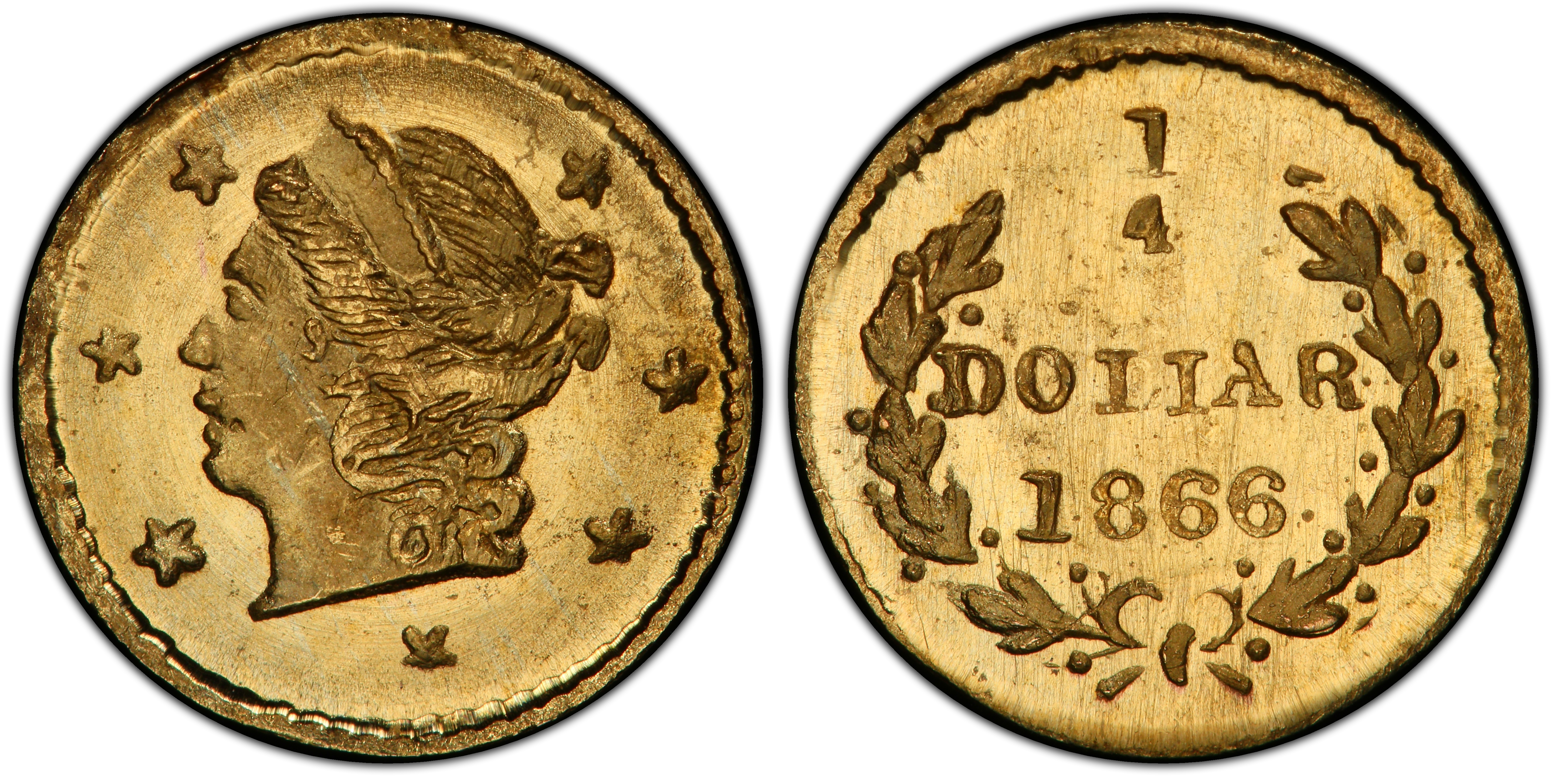
Obverse & Reverse
The 1866 BG-804 25 Cent piece emerged during the second phase of California Fractional Gold production, a period numismatically distinct from the initial frenzy of the Gold Rush. The first period (1852-1857) was born of a genuine and severe shortage of small denomination coinage for daily commerce. Miners with pouches of gold dust found it impractical to purchase a drink or a loaf of bread, and these tiny, privately minted gold quarters and halves, despite being significantly underweight for their stated value, filled a crucial economic niche. However, by the mid-1860s, the economic landscape of California had matured. The U.S. Mint in San Francisco was in full operation, and government-issued coinage was more readily available, reducing the commercial necessity for private issues. Concurrently, the Coinage Act of April 22, 1864, explicitly outlawed private coinage. Despite this federal legislation, the law was not strictly enforced in California by the Secret Service until 1883. This created a nearly two-decade window where local jewelers and metalworkers continued to strike 'fractional gold.' Their motivation, however, had shifted. These 'Period Two' pieces, including the BG-804, were produced less as circulating currency and more as souvenirs and keepsakes. They catered to a burgeoning tourist trade and a local population proud of its Gold Rush heritage. These pieces were charming mementos of California's unique economic history. The makers were typically anonymous jewelers in San Francisco who could produce them profitably due to their low gold content and high novelty value. While they may have occasionally passed as change, their primary role was that of a collectible, a tangible link to the romanticism of the golden state, making them a fascinating example of a currency transitioning into a commemorative token.
Associated EventPost-Gold Rush Economic Development in California
Reason For MintingPrimarily struck to serve the souvenir and gift market, capitalizing on the romanticism of the California Gold Rush era.
Minter HistoryThe specific minter of BG-804 is unknown, which is characteristic for most 'Period Two' California Fractional Gold. These pieces were generally not the product of large, organized assay offices like their territorial predecessors, but rather were crafted by numerous independent jewelers and artisans operating primarily in San Francisco. These craftsmen used standardized design elements, such as the Liberty Head motif, but often employed their own distinct dies, leading to the vast number of varieties cataloged today. Their business model relied on the public's appetite for gold souvenirs rather than a need for circulating money.
Historical SignificanceThe BG-804 is significant as a prime example of a 'Period Two' California Fractional Gold piece, illustrating the evolution of private coinage from a commercial necessity to a souvenir commodity. It represents a final, semi-tolerated chapter of private minting in the United States before federal laws were fully enforced, closing the book on this uniquely American numismatic field.
BG-804
Denomination25C
Minting Period1866
Assayer/MinterUnknown
Geographic OriginSan Francisco, California
Obverse DescriptionA head of Liberty facing left, her hair is tied in a bun with a few loose curls at the bottom. She wears a coronet or diadem inscribed with the word LIBERTY, though it is often illegible due to the coin's small size and strike quality. The portrait is encircled by 13 six-pointed stars.
Obverse InscriptionLIBERTY (on coronet)
Reverse DescriptionThe denomination '25 CENTS' is enclosed within a wreath of two olive branches tied with a bow at the bottom. Above the denomination and inside the wreath is the date '1866'. The legend 'CALIFORNIA GOLD' appears along the upper periphery, outside the wreath.
Reverse InscriptionCALIFORNIA GOLD / 1866 / 25 CENTS
CompositionGold
Stated Fineness Actual FinenessVaries, but typically between .500 and .750 fine.
Weight0.25 grams
Diameter9.70 mm
EdgePlain
Unknown
Survival Estimate76-200
Rarity ScaleR-4
BG-804 is sought after by specialists for its status as a widely recognized and attributable 'Period Two' variety. Its appeal lies in its affordability relative to rarer issues, its classic Liberty Head design, and its direct connection to the romantic souvenir trade of 1860s San Francisco. It serves as an excellent entry point into the complex world of California small denomination gold.
Key VarietiesThe primary issue is the business strike intended for souvenir sales. No original proof strikings are known. While Breen-Gillio identifies BG-804 as a singular die marriage, collectors should be aware of minor die states, including the presence of die cracks or polishing marks which can add to a specimen's interest. No major, contemporaneously produced varieties are noted. Later facsimiles and copies from the 20th century exist and are unlisted in Breen-Gillio; these are considered non-numismatic replicas.
Authentication TipsGenuine BG-804 pieces will have a specific die alignment and sharpness profile. Compare any prospective purchase with high-resolution images from major grading services. A key diagnostic is the positioning of the date relative to the wreath. Fakes often have incorrect letter or number punches, a soapy or cast-like appearance, and incorrect luster. Critically, genuine pieces must have a denomination ('25 CENTS'); replicas made as jewelry often feature a bear on the reverse and lack a denomination, which is an immediate red flag.
Shopping ConsiderationsA premium quality BG-804 will exhibit a sharp strike, particularly on the stars of the obverse and the lettering on the reverse. Many examples are weakly struck, especially in the center. Look for specimens with pleasing, original surfaces and a minimum of distracting contact marks. Luster is a key value determinant; examples with semi-prooflike or prooflike fields command significant premiums. Attractive, stable toning, often seen as a subtle reddish-gold or greenish-gold hue, is highly desirable and evidence of originality. Avoid pieces that have been harshly cleaned, which strips the original patina, or those mounted in jewelry, which often results in rim damage or solder marks.
A coin's grade is its condition, rated on a 1-70 scale. For rare coins, this is the most critical factor in determining value, as a tiny difference in preservation can mean a huge difference in price.
Relevant Grade TypesAll original examples of BG-804 are business strikes, created for souvenir purposes rather than circulation, though some may have seen minor handling. They are found in Circulated (1-58) grades, but are much more common in Mint State (MS, 60-70). No true Proofs (PR/PF) were struck during the original period of issue. The term 'Prooflike' (PL) is often applied to high-grade business strikes that have deeply mirrored fields from being struck with polished dies, a desirable characteristic for this issue.
Mint State CharacteristicsIn uncirculated grades, the quality of a BG-804 is defined by luster, strike, and surface preservation. Luster can range from a soft, satiny texture to a highly reflective, prooflike finish. The strike is often weak on Liberty's hair and coronet, and on the bow of the reverse wreath; well-struck examples are scarce and prized. Due to the softness of the gold alloy, even high-grade specimens will typically show small handling marks or 'flyspecks.' A truly choice MS example will have vibrant luster, a reasonably sharp strike for the issue, and minimal, non-distracting marks.
Circulated Wear PatternsFor the few examples that show wear, it will first appear on the highest points of the design. On the obverse, check for flatness on Liberty's cheek, the hair above her eye, and the coronet. On the reverse, the high points of the wreath's leaves and the bow will show initial rubbing. In lower grades (VF and below), the stars on the obverse and the legends will begin to lose their sharpness and merge towards the fields.
Key Factors For ValueThe primary drivers of value for a BG-804 are grade and eye appeal. A high numerical grade (e.g., MS-65 vs. MS-63) creates a substantial price difference. Surface quality is paramount; an example with original, undisturbed luster and attractive toning will always be worth more than a brilliant but harshly cleaned coin of the same grade. Strike sharpness is a major consideration, with collectors paying a premium for a fully detailed portrait and wreath. Finally, certification by a top-tier grading service (PCGS or NGC) is essential for market acceptance, and a CAC sticker signifying premium quality for the grade adds a further, significant premium.
PCGS Price Guide
| Grade | Price | Population |
|---|---|---|
| 53 | $180.00 | 1 |
| 53+ | $180.00 | N/A |
| 55 | $185.00 | 1 |
| 55+ | $185.00 | N/A |
| 58 | $200.00 | 1 |
| 58+ | $215.00 | N/A |
| 60 | $230.00 | N/A |
| 61 | $250.00 | 4 |
| 62 | $285.00 | 18 |
| 62+ | $315.00 | N/A |
| 63 | $385.00 | 18 |
| 63+ | $425.00 | 1 |
| 64 | $460.00 | 33 |
| 64+ | $500.00 | N/A |
| 65 | $625.00 | 20 |
| 65+ | $800.00 | N/A |
| 66 | $1,500.00 | 8 |
| 66+ | $2,000.00 | 1 |
| 67 | $2,650.00 | 1 |
| 67+ | $3,750.00 | 2 |