1866 G50C BG-903 (Regular Strike)
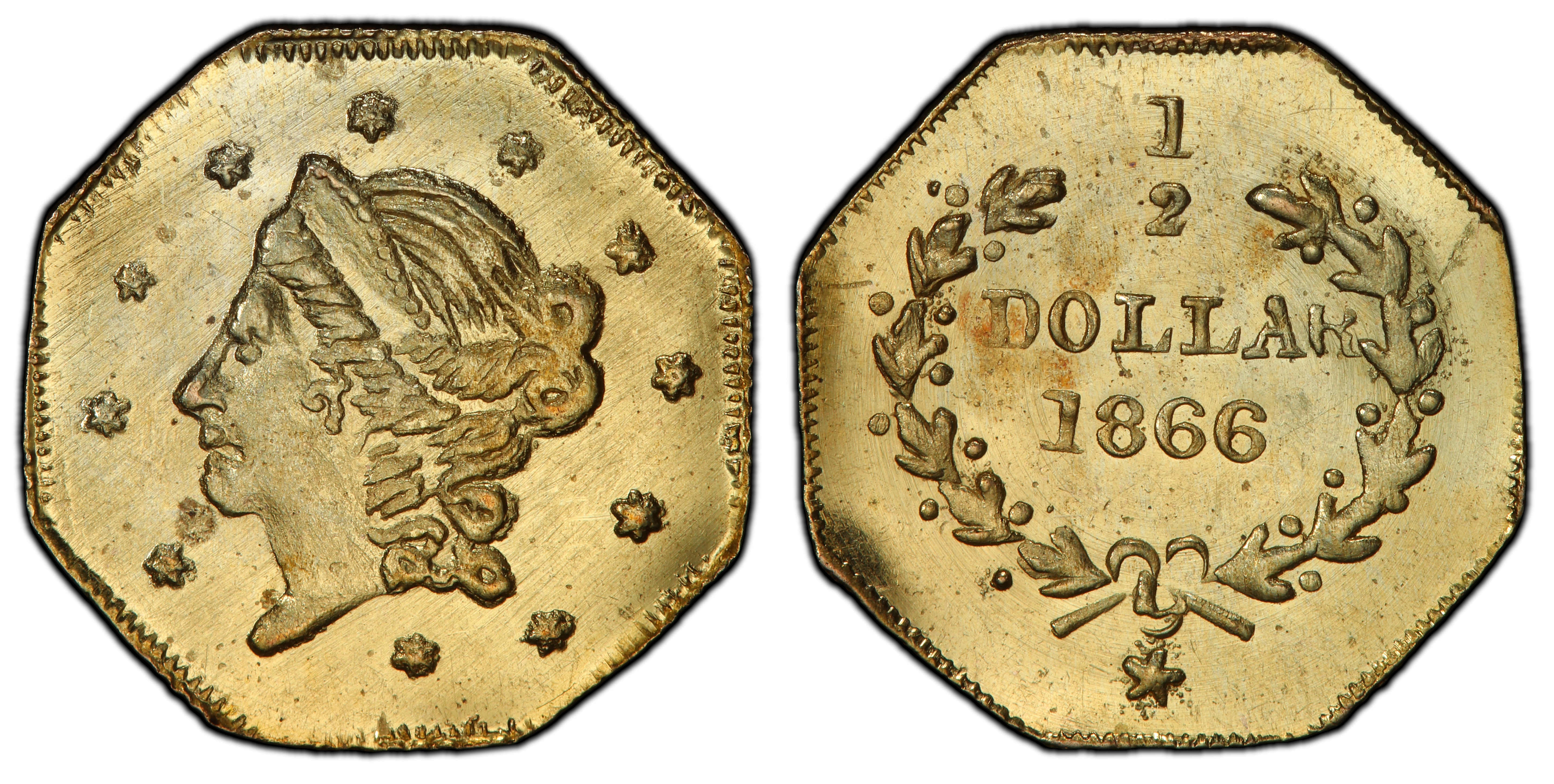
Obverse & Reverse
The 1866 Octagonal Liberty Head 50 Cents, cataloged as Breen-Gillio 903, is a quintessential artifact from the second period of California's private gold coining era. The initial California Gold Rush of 1849 created an immediate and severe shortage of small-denomination coinage for everyday transactions. While the San Francisco Mint began operations in 1854, it focused on larger denominations, leaving a commercial vacuum that private minters, often jewelers, rushed to fill. Early fractional gold pieces from 1852-1856 closely mimicked federal designs and were intended to circulate widely. However, the U.S. government's Coinage Act of 1864 officially outlawed private coinage, fundamentally changing the nature of these pieces. The BG-903, struck two years after this act, belongs to a fascinating 'Period Two' (1859-1882) of production. During this time, the pieces became lighter and their legal status ambiguous. They were no longer true circulating currency in the legal sense but continued to be produced and used, often as souvenirs, keepsakes for tourists, or perhaps as novelties in isolated local economies where federal coinage remained scarce. The minters, like Frontier & Co., operated in a grey area of the law. These 'jeweler's issues' were typically made with less precision than official coinage, often by the 'hammer method' where dies were struck manually, resulting in significant variations in strike quality. The BG-903's octagonal shape and Liberty Head design were classic motifs intended to evoke a sense of legitimacy and connection to the national currency. Despite their technically illegal status, their continued production speaks to a persistent demand and the independent spirit of the American West. Today, these tiny gold pieces are not just numismatic rarities but tangible links to the post-Gold Rush economic landscape of California, representing the transition from a frontier economy to a more integrated part of the nation.
Associated EventCalifornia Gold Rush Economic Aftermath
Reason For MintingTo satisfy a continued commercial and souvenir demand for small-denomination gold pieces after the Coinage Act of 1864.
Minter HistoryFrontier & Co. was one of many private firms, often operated by jewelers and metallurgists in San Francisco, that produced fractional gold pieces during the mid-to-late 19th century. These operations were typically small-scale and capitalized on the local abundance of gold and the scarcity of federal small change. They used hand-operated presses or simple hammer-striking techniques. Their products were not officially sanctioned and varied in weight and fineness, but served a functional purpose in commerce and as mementos of the Gold Rush era.
Historical SignificanceThe BG-903 is significant as a 'Period Two' issue, struck after the federal prohibition on private coinage. It represents the persistence of a local tradition and a market for these unique gold pieces, which had evolved from necessities of commerce into popular souvenirs and objects of private wealth storage. Its existence highlights the slow and uneven enforcement of federal laws on the distant West Coast and the unique economic conditions that prevailed there for decades after the initial Gold Rush.
BG-903
Denomination50 Cents
Minting Period1866
Assayer/MinterFrontier & Co.
Geographic OriginSan Francisco, California
Obverse DescriptionA head of Liberty facing left, her hair tied in a bun. She is surrounded by 11 stars arranged in an arc above and to the sides. The date, 1866, is below the truncation of the neck.
Obverse Inscription1866
Reverse DescriptionThe denomination '50 CENTS' is displayed within a wreath of two olive branches tied with a ribbon at the bottom.
Reverse Inscription50 CENTS
CompositionGold
Stated Fineness Actual Fineness Weight0.75 grams
Diameter10.90 mm
EdgePlain
Unknown
Survival Estimate31-45 known
Rarity ScaleR-5+
This variety is highly sought after for its distinct octagonal shape, classic Liberty Head design, and its status as a 'Period Two' issue. Its R-5+ rarity makes it a challenging and desirable acquisition for specialists in California Fractional Gold, offering a tangible connection to the post-Gold Rush era.
Key VarietiesThe BG-903 itself is a specific die marriage and does not have major recognized varieties from the original minting period. No special collector issues, patterns, or restrikes are known to exist for this specific variety. The primary variations within the broader series are denomination (25C, 50C, $1), shape (Round or Octagonal), and design (Liberty or Indian Head).
Authentication TipsGenuine examples are struck in gold and have a specific weight and diameter. Look for sharp die characteristics consistent with known examples; many counterfeits are cast and show porosity or softness of detail. The style of the numerals in the date and the lettering is a key diagnostic. So-called 'tokens,' which are often gold-plated and made later as souvenirs, will typically not have a denomination like 'CENTS' or 'DOLLAR' and may feel lighter than genuine gold pieces.
Shopping ConsiderationsA premium quality example for this issue is defined by a sharp, well-centered strike. Due to the hammer-striking process, many are weakly struck, particularly on the stars, Liberty's hair details, and the wreath on the reverse. Seek out examples with minimal weakness. Original, uncleaned surfaces with some remaining luster command significant premiums. These tiny coins are prone to being mounted in jewelry; check carefully for evidence of rim filing, solder, or tooling. A smooth, problem-free surface, even with some honest wear, is far preferable to a damaged but higher-grade piece. The census data shows most survivors are in Mint State, so circulated examples are quite rare.
A coin's grade is its condition, rated on a 1-70 scale. For rare coins, this is the most critical factor in determining value, as a tiny difference in preservation can mean a huge difference in price.
Relevant Grade TypesOriginal period issues were business strikes intended for circulation or sale as souvenirs, and are found in Circulated (1-58) and Mint State (MS, 60-70) grades. No Proofs were struck during the original period of issue, and no later-date Proof restrikes are known for this variety. Any coin claiming to be a Proof BG-903 should be regarded with extreme skepticism.
Mint State CharacteristicsUncirculated examples of BG-903 often exhibit a soft, satiny luster rather than a hard, frosty one. The strike is a key determinant of quality; many pieces are weakly struck in the center of both the obverse and reverse. A well-struck example will show clear detail in Liberty's hair and the leaves of the wreath. Due to the softness of the gold and their small size, even Mint State examples can show minor handling marks or 'tick' marks. Planchet quality can also vary, with some showing minor striations or adjustment marks made prior to striking.
Circulated Wear PatternsWear first appears on the highest points: Liberty's cheek, the hair above her ear, and the highest leaves in the wreath. On the reverse, the numerals '50' and the bow of the ribbon will show initial flatness. In lower grades (VF and below), the stars on the obverse will begin to merge with the field, and the date can become weak.
Key Factors For ValueFor the BG-903, the primary value drivers are grade and surface quality. A sharp strike is the most important factor for eye appeal and commands a major premium. Secondly, original, uncleaned surfaces are paramount; any evidence of harsh cleaning, polishing, or removal from jewelry will drastically reduce the value. Coins with a pleasant, original reddish-gold toning are highly prized. Given the rarity, any example without significant problems is desirable, but those certified by PCGS or NGC, especially with a CAC sticker indicating premium quality for the grade, will realize the strongest prices.
PCGS Price Guide
| Grade | Price | Population |
|---|---|---|
| 58 | $400.00 | 2 |
| 58+ | $420.00 | N/A |
| 60 | $450.00 | N/A |
| 61 | $480.00 | 1 |
| 62 | $500.00 | 7 |
| 62+ | $530.00 | N/A |
| 63 | $575.00 | 4 |
| 63+ | $600.00 | N/A |
| 64 | $775.00 | 10 |
| 64+ | $800.00 | N/A |
| 65 | $1,350.00 | 5 |
| 65+ | $1,575.00 | N/A |
| 66 | $2,250.00 | 1 |