1881 G50C BG-957, PL (Regular Strike)
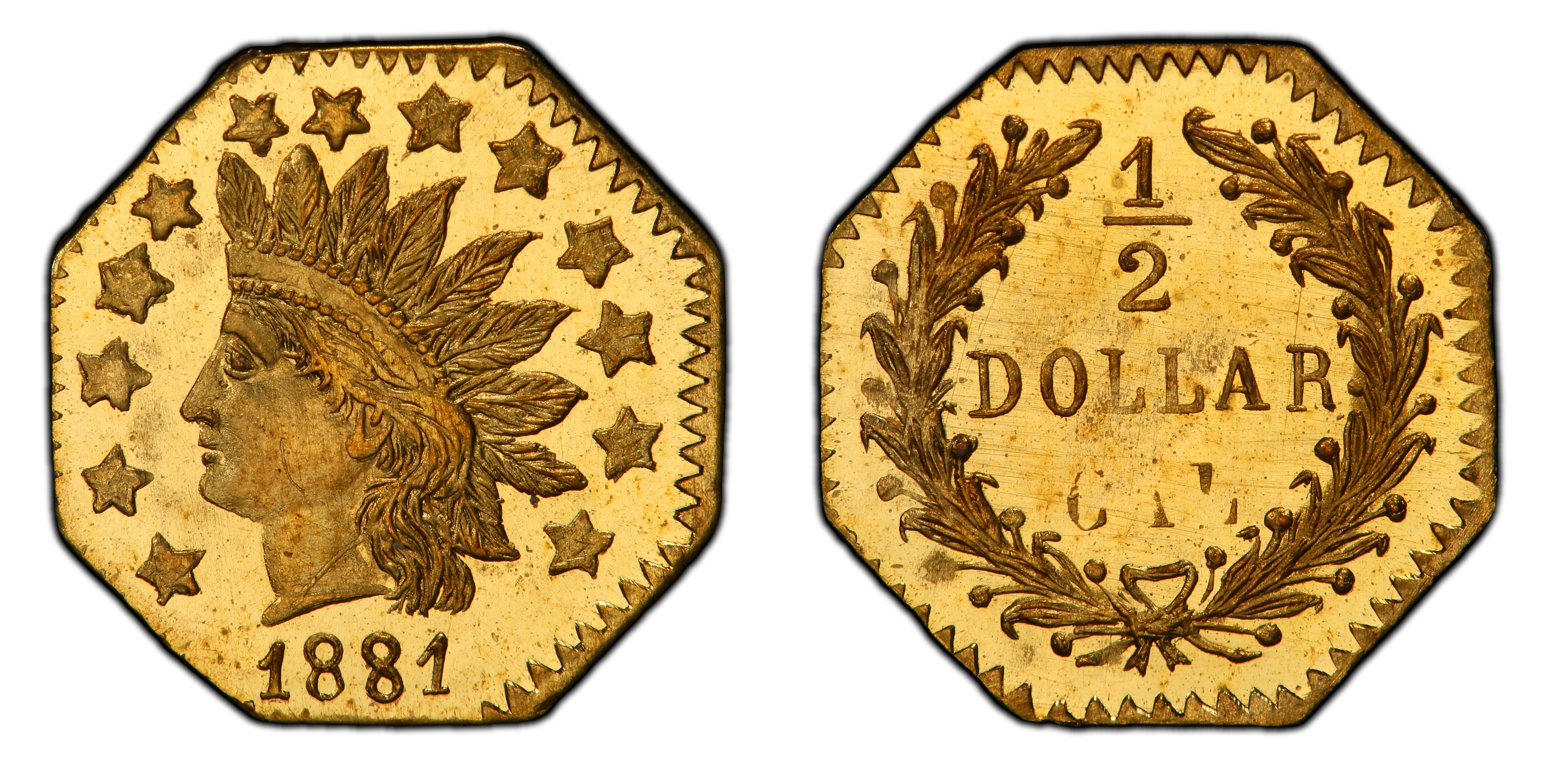
Obverse & Reverse
The 1881 BG-957 50-cent piece emerged in the twilight of the California Fractional Gold era, a period numismatists designate as 'Period Two' (1859-1882). Unlike the 'Period One' issues, which were struck out of genuine commercial necessity to alleviate a dire shortage of small change during the initial Gold Rush, the coins of this later period served a different purpose. By the 1880s, the San Francisco Mint was in full operation, and the state's economy was well-supplied with federal coinage. The acute need for privately minted fractional denominations had vanished. Instead, these small gold pieces were produced primarily by jewelers as souvenirs and novelty items. Capitalizing on the romantic allure of the Gold Rush, these miniature coins were popular keepsakes for tourists and gifts to be sent back East. The Coinage Act of 1864 had made all private coinage illegal, but the law was not strictly enforced against these small tokens until 1883. This legal gray area allowed dozens of anonymous jewelers to continue production. These 'jeweler's issues' were often intentionally underweight relative to their face value and varied widely in metallic composition, ranging from low-purity alloys to near-pure gold. They were typically struck with polished dies, resulting in the Prooflike (PL) surfaces noted in the original request. The Indian Head motif, adopted on some varieties in this period, was a popular artistic choice of the era, evoking a sense of a uniquely 'American' West, distinct from the classical Liberty heads that dominated earlier U.S. coinage. The BG-957 is a quintessential example of this souvenir-driven phase of production, created not for the gritty commerce of a mining camp but for the Victorian parlor.
Associated EventPost-Gold Rush California Tourism
Reason For MintingPrimarily struck to be sold as souvenirs, jewelry, and curiosities reflecting the legacy of the Gold Rush.
Minter HistoryThe specific minter for the BG-957 variety is unrecorded, a common trait for Period Two issues. The production of California Fractional Gold was dominated by numerous San Francisco jewelers who often operated anonymously or with only initials as hallmarks. These craftsmen, experienced in working with small quantities of precious metal, used techniques like hand-hammered striking to produce these miniature pieces. Unlike the earlier, more systematized assayers, these later minters focused on novelty and appeal rather than monetary function.
Historical SignificanceThe BG-957 is significant not as a circulating coin, but as a historical artifact representing the commercialization of the Gold Rush myth. It marks the transition of fractional gold from a vital monetary instrument into a nostalgic souvenir, reflecting how California's identity was being packaged and sold to a national audience by the late 19th century. Its existence highlights a numismatic gray market that persisted for nearly two decades after private coinage was outlawed.
N/A
Denomination50 Cents
Minting Period1881
Assayer/MinterUnknown Private Minter (Jeweler)
Geographic OriginSan Francisco, California (presumed)
Obverse DescriptionAn Indian Head portrait facing left, wearing a feathered headdress. The portrait is surrounded by 13 stars, representing the original colonies. The date '1881' is positioned below the bust.
Obverse Inscription1881
Reverse DescriptionA wreath composed of two branches tied with a bow at the bottom. The inscription 'CALIFORNIA GOLD' appears outside the wreath at the top. The denomination '1/2' is within the center of the wreath.
Reverse InscriptionCALIFORNIA GOLD 1/2
CompositionGold
Stated Fineness Actual FinenessVariable, typical for Period Two issues to be between .500 and .900 fine.
Weight0.25 grams
Diameter10.00 mm
EdgePlain
Unknown
Survival Estimate25-30
Rarity ScaleLow R-6
This variety is sought after for its distinctive octagonal shape, popular Indian Head design, and high rarity. As a Period Two issue, it represents the fascinating 'souvenir' phase of fractional gold production. Examples with sharp strikes and reflective, prooflike surfaces command significant premiums.
Key VarietiesThe primary variety is the BG-957 itself. A key diagnostic is the reverse die, which was so heavily lapped (polished) that the 'CAL' of 'CALIFORNIA GOLD' is very weak or 'attenuated'. An earlier die state, designated BG-957A, exists where the 'CAL' is much clearer. The BG-957A is considered extremely rare, possibly R-8. No known proof restrikes or patterns exist for this specific variety.
Authentication TipsAuthentic BG-957 specimens should exhibit a heavy diagonal die line on the Indian's neck. On the reverse, the weakness of 'CAL' due to the heavily polished die is a key attribution marker. Counterfeits are common in this series; many are brass or gold-plated and often have crude details or a soapy, cast-like appearance. Genuine pieces have sharp, albeit sometimes uneven, strikes. Any piece with a bear on the reverse is a modern replica. Third-party certification by PCGS or NGC is highly recommended for this series.
Shopping ConsiderationsA premium quality BG-957 will have a sharp strike on the central devices, particularly the Indian's facial features and the details of the wreath. Luster is paramount; seek examples with deeply reflective, prooflike (PL) or deep mirror prooflike (DMPL) fields, as this is a hallmark of the issue. The color should be a natural, original reddish- or greenish-gold. Avoid examples that have been cleaned, which will appear unnaturally bright and have hairline scratches. Check for common problems like bending, repaired holes from jewelry use, or edge dings, as these tiny coins were easily damaged. The weakness of the 'CAL' inscription is a feature of the variety, not a defect.
A coin's grade is its condition, rated on a 1-70 scale. For rare coins, this is the most critical factor in determining value, as a tiny difference in preservation can mean a huge difference in price.
Relevant Grade TypesOriginal period issues were business strikes, though primarily intended for collectors and tourists rather than circulation. They are found in both Circulated (AU-58 and lower) and Mint State (MS, 60-70) grades. Because these were jeweler's issues, most surviving examples are Uncirculated. No true Proofs (PR/PF) were struck during the original period of issue. The term 'Prooflike' (PL) is a surface designator for a business strike with reflective fields, which is common and desirable for this variety due to the use of polished dies.
Mint State CharacteristicsUncirculated examples of BG-957 are defined by their luster and strike. High-grade specimens exhibit strong prooflike or deep mirror prooflike surfaces. The strike can be inconsistent; the central devices may be sharp while peripheral lettering, especially the 'CAL' on the reverse, is characteristically weak due to die polishing. Small planchet flaws or lint marks from the striking process are not uncommon and are generally accepted by collectors if they are not distracting. The soft gold is prone to contact marks, so finding a 'clean' surface is a challenge.
Circulated Wear PatternsWhile most did not circulate, any wear would first appear on the highest points: the Indian's cheek, the feathers in the headdress, and the leaves and bow of the wreath on the reverse. On lower-grade circulated examples, the stars and date would begin to lose their sharpness and merge towards the fields.
Key Factors For ValueFor the BG-957, value is driven by three main factors: 1) Surface Quality: Coins with original, undisturbed prooflike surfaces are highly prized over those that are cleaned or hairlined. 2) Strike: A sharp strike on the Indian Head is paramount. 3) Eye Appeal: Specimens with attractive original toning (often a deep reddish-gold) and minimal distracting marks command significant premiums. A CAC sticker for this issue confirms high quality for the grade and will add a substantial premium.
PCGS Price Guide
| Grade | Price | Population |
|---|---|---|
| 63 | $775.00 | N/A |
| 63+ | $850.00 | N/A |
| 64 | $975.00 | N/A |
| 64+ | $1,200.00 | N/A |
| 65 | $2,000.00 | 1 |
| 65+ | $2,250.00 | N/A |
| 66 | $2,500.00 | N/A |
| 66+ | $2,750.00 | N/A |
| 67 | $3,000.00 | N/A |