1859 G25C BG-801, PL (Regular Strike)
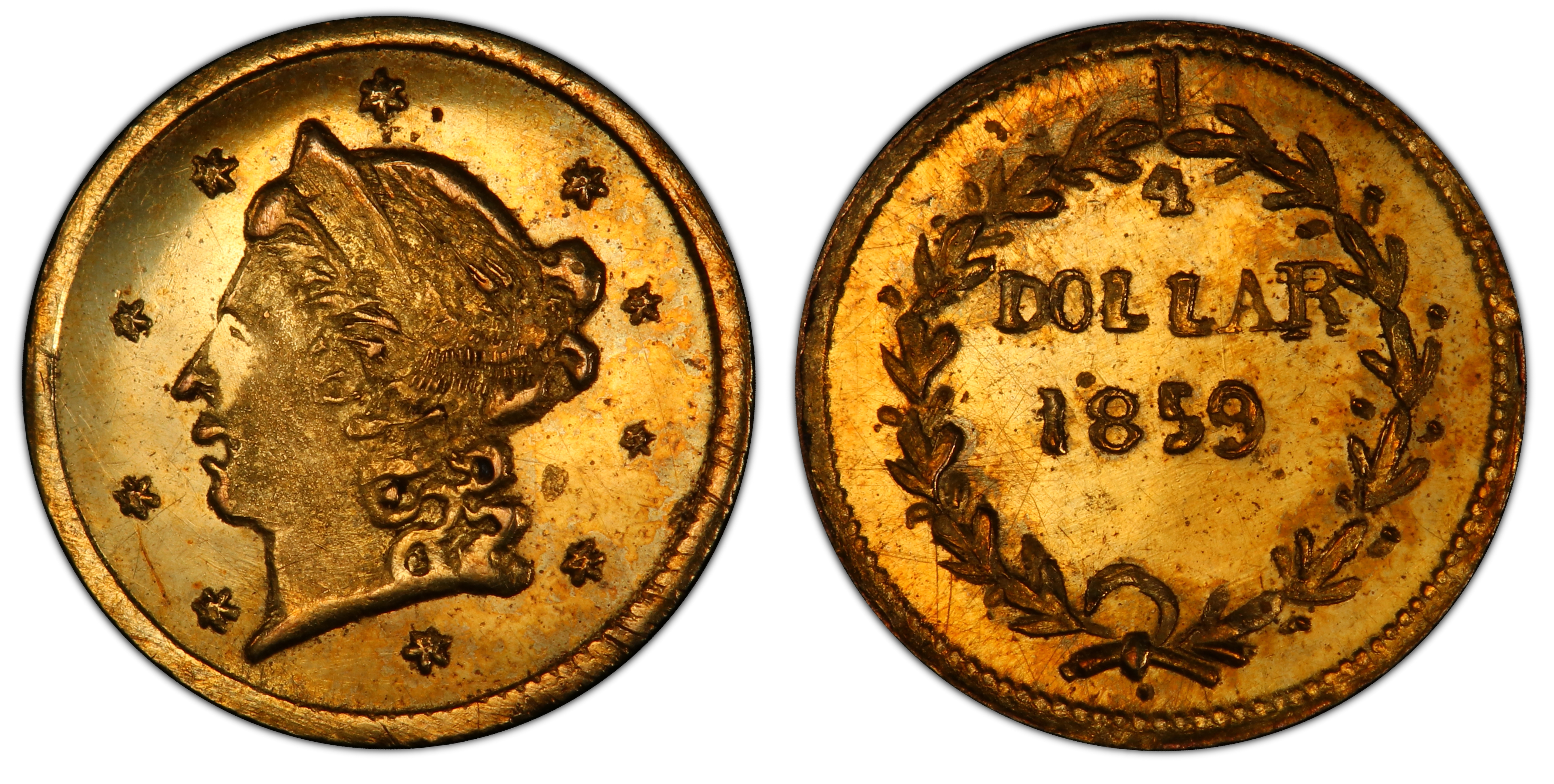
Obverse & Reverse
The 1859 BG-801 25 Cents piece emerges from the second phase of California's private gold coinage, a period numismatists designate as 'Period Two' (1859-1882). The initial impetus for fractional gold, the dire shortage of small change during the early Gold Rush, had largely subsided by this time due to the robust output of the official San Francisco Mint, which opened in 1854. However, the allure of gold and the memory of the 'Days of '49' had created a powerful new market: tourism and memorabilia. Jewelers and private minters in San Francisco, many of French origin, recognized the demand for miniature gold coins as souvenirs and keepsakes. These Period Two issues, unlike their Period One predecessors which were intended to and did circulate, were primarily commercial products sold as curiosities. Consequently, they were often underweight for their stated face value, a fact that would have been unacceptable in commerce but was irrelevant for a souvenir. The BG-801 is a quintessential example of this transition. Struck in 1859, it represents one of the earliest issues of this new wave of souvenir coinage. The production methods remained similar to earlier periods, often involving hand-striking with a hammer, which resulted in significant variability in strike quality. Some pieces, like those designated 'PL' (Prooflike), were struck from fresh, highly polished dies, giving them a mirrored, reflective quality to enhance their appeal to buyers. The anonymous nature of its minter is typical for many Period Two issues, as the producers were jewelers first and minters second, often operating without the prominent maker's marks seen on the larger, earlier territorial ingots and coins. These tiny gold pieces, though no longer essential for commerce, captured the romantic spirit of the Gold Rush and have become a distinct and widely collected field of American numismatics.
Associated EventCalifornia Gold Rush Aftermath & Early Tourism
Reason For MintingPrimarily created to serve the growing demand for souvenirs and keepsakes related to the California Gold Rush, rather than to alleviate a coin shortage.
Minter HistoryThe specific minter or jeweler responsible for the BG-801 variety is unknown. This is common for 'Period Two' California Fractional Gold, where numerous San Francisco jewelers produced a wide variety of these small-denomination pieces for the souvenir trade. Unlike the more prominent assayers of Period One, these minters were often small-scale operators who did not apply an identifiable maker's mark to their products.
Historical SignificanceThe BG-801 is significant not as a coin for circulation, but as a representation of the commercialization of the Gold Rush legacy. It marks the shift from utilitarian private coinage born of necessity to souvenir pieces created to capitalize on California's fame as the 'Golden State,' a practice that would continue for over two decades.
N/A
Denomination25 Cents
Minting Period1859
Assayer/MinterUnknown Private Minter
Geographic OriginSan Francisco, California
Obverse DescriptionA head of Liberty facing left, her hair tied in a bun at the back. She is surrounded by thirteen six-pointed stars, representing the original colonies. The date, 1859, is positioned below the truncation of the neck.
Obverse Inscription1859
Reverse DescriptionThe denomination '25 CENTS' is displayed across two lines within a wreath composed of two olive branches. The wreath is open at the top and tied with a bow at the bottom.
Reverse Inscription25 CENTS
CompositionGold
Stated Fineness Actual FinenessVariable, but generally lower than U.S. Mint standard, consistent with Period Two issues.
Diameter9.50 mm
EdgePlain
Unknown
Survival Estimate75-125 known
Rarity ScaleR-5 (Very Scarce)
This variety is popular due to its classic Liberty Head design, its status as a 'Period Two' type, and the challenge of finding well-struck, high-grade examples. Specimens with the PL (Prooflike) designation are particularly sought after for their superior eye appeal.
Key VarietiesThe primary variety is the regular business strike. Within this, examples designated 'PL' (Prooflike) or 'DMPL' (Deep Mirror Prooflike) by grading services are not distinct die varieties but represent early strikes from highly polished dies. They are collected as a premium version of the regular issue. There are no known original-period patterns or restrikes for this specific BG number.
Authentication TipsGenuine BG-801 coins will have a denominated reverse ('25 CENTS'). Be wary of pieces with a bear on the reverse, as these are modern replicas. The strike is often soft, particularly on the stars and the wreath's bow; a perfectly sharp strike on all elements should be viewed with suspicion. The fabric of the gold should appear original and not brassy or plated. Weakly struck areas or slight planchet imperfections are common on genuine, hand-struck pieces. Use the Breen-Gillio reference for die markers.
Shopping ConsiderationsA premium quality example for its grade will exhibit sharp details, particularly on Liberty's hair and the leaves of the wreath. Many specimens suffer from excessive die polishing, which can wipe out fine details, so finding one with a full strike is key. For PL examples, look for deep, clean, and consistent reflectivity in the fields. Avoid coins that have been harshly cleaned, which imparts a sterile, unnatural look and destroys the value. Original reddish-gold or orange-peel toning is highly desirable. Check for planchet flaws or edge bumps, as these tiny coins were easily damaged.
A coin's grade is its condition, rated on a 1-70 scale. For rare coins, this is the most critical factor in determining value, as a tiny difference in preservation can mean a huge difference in price.
Relevant Grade TypesOriginal period issues were business strikes, although primarily intended as souvenirs rather than for circulation. They are found in Circulated (1-58) and, more commonly, Mint State (MS, 60-70) grades. The 'PL' (Prooflike) designation is not a separate issue type but a descriptor for business strikes made with highly polished dies. No true Proofs were struck during the original period of issue, and there are no known later-date collector restrikes for this variety.
Mint State CharacteristicsIn uncirculated condition, the BG-801 often shows a soft, satiny luster. Strike quality is a major factor; many are softly struck, especially on the wreath's bow and the stars opposite the strongest part of the obverse strike. High-grade examples will show crisp detail in Liberty's hair strands. Prooflike (PL) specimens are known and command a significant premium; their fields will have a distinct reflectivity, though often not as profound as a true Proof coin. Due to the hand-striking process, perfectly centered strikes are uncommon.
Circulated Wear PatternsWear first appears on the highest points: Liberty's cheek, the hair above her ear, and the knot of the bow on the reverse. As wear progresses, the stars on the obverse will begin to lose their points and blend into the fields. On the reverse, the leaves of the wreath will become flattened. In lower grades (VF and below), the date and the word 'CENTS' will show significant weakness.
Key Factors For ValueBeyond the numerical grade, the primary value drivers are strike quality and surface preservation. A sharply struck coin with minimal die polishing will always be worth more than a weakly struck example of the same grade. The presence of a Prooflike (PL) or Deep Mirror Prooflike (DMPL) designation dramatically increases value. Eye appeal is paramount; coins with original, un-tampered surfaces and attractive reddish-gold toning are highly prized. A CAC sticker for this issue provides third-party verification of quality for the grade and often results in a strong price premium.
PCGS Price Guide
| Grade | Price | Population |
|---|---|---|
| 63 | N/A | N/A |
| 66 | $2,000.00 | 1 |
| 67 | N/A | N/A |