1872/1 G25C BG-870 (Regular Strike)
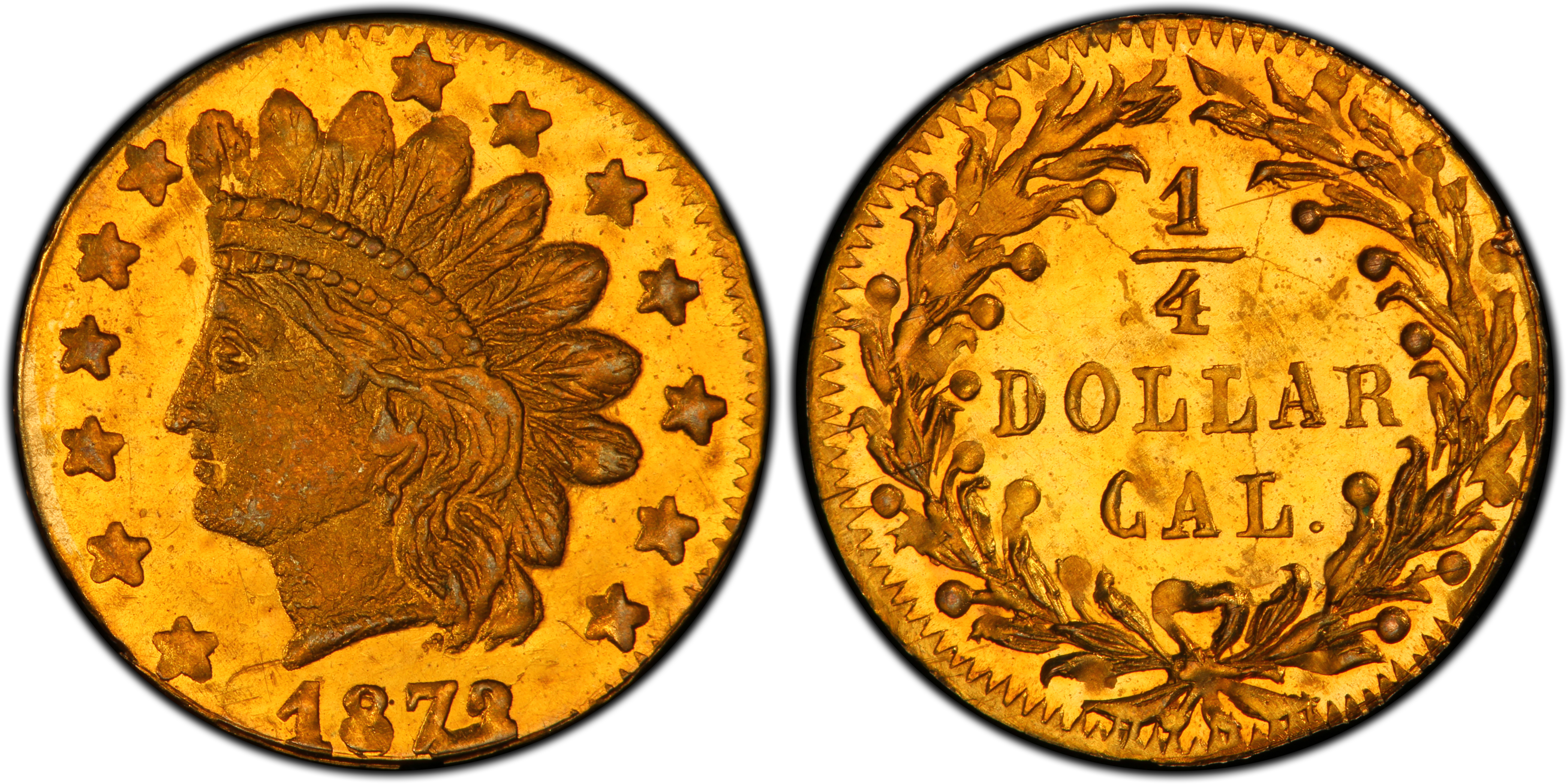
Obverse & Reverse
The 1872/1 BG-870 25-cent piece is a quintessential example of a 'Period Two' California Fractional Gold coin. By the 1870s, the initial, urgent need for small-denomination circulating currency that characterized the Gold Rush (1852-1858) had long subsided. The establishment and robust output of the U.S. Branch Mint in San Francisco had supplied the region with ample federal coinage. Consequently, the private production of fractional gold shifted from a utilitarian necessity to a commercial enterprise catering to tourists, collectors, and the jewelry trade. These small, intricate gold pieces became popular souvenirs of a romanticized Gold Rush past. The minter of this variety, Christopher Ferdinand Mohrig, was a San Francisco jeweler who was one of the more prolific producers of these souvenir coins during this era. The clear 1872/1 overdate is a result of the re-punching of a die from the previous year, a common cost-saving measure among private minters. This period was legally precarious for private mints. The Private Coinage Act of 1864 had made such issues illegal, but enforcement was lax for over a decade. The federal government's attention was focused elsewhere during the Civil War and Reconstruction. This allowed jewelers like Mohrig to operate openly, producing denominated gold pieces that mimicked official coinage in design, if not in intrinsic value. However, the tide turned in the mid-1870s. The Secret Service, under Chief James J. Brooks, began to view these private issues as a potential source of fraud and a violation of federal law. On August 10, 1876, Mohrig's establishment was raided, and he was arrested. His dies and existing coin stock were confiscated and later destroyed, an event that instantly turned his entire output into a collectible with a dramatic backstory and a finite supply. The BG-870, therefore, is not just a coin, but a relic from the final, defiant years of private minting in California, a tangible link to a San Francisco jeweler whose enterprise was ultimately shut down by federal agents.
Associated EventPost-Gold Rush Era California Commerce
Reason For MintingPrimarily produced as souvenirs and for the jewelry trade rather than for circulation, capitalizing on the romanticism of the Gold Rush.
Minter HistoryChristopher Ferdinand Mohrig was a San Francisco-based jeweler and one of the more significant producers of Period Two (1858-1882) California Fractional Gold. His operations were extensive enough to produce numerous die varieties, cataloged by Breen and Gillio from BG-790 through BG-799V, as well as other issues. Mohrig's career as a private minter came to an abrupt end on August 10, 1876, when he was arrested by the U.S. Secret Service for violating the Coinage Act of 1864. The confiscation and destruction of his equipment and inventory explain the relative rarity of many of his issues.
Historical SignificanceThis coin represents the 'souvenir' or 'jeweler's issue' phase of California Fractional Gold, a period when the pieces were created more as keepsakes than as a necessary medium of exchange. The prominent overdate provides insight into the production methods of private minters, and the coin's connection to Christopher Mohrig's arrest by the Secret Service lends it significant numismatic intrigue and a well-documented terminal date for his operations.
BG-870
DenominationG25C (Gold 25 Cents)
Minting Period1872
Assayer/MinterChristopher Ferdinand Mohrig
Geographic OriginSan Francisco, California
Obverse DescriptionA portrait of a Native American (Indian Head) facing left, wearing a feathered headdress. The portrait is surrounded by 13 five-pointed stars. The date, 1872/1, is below the bust. The most prominent feature is the '2' punched over a '1' in the date.
Obverse Inscription1872/1
Reverse DescriptionThe denomination '25 CENTS' is displayed within a wreath composed of two branches tied with a bow at the bottom. An inner beaded circle surrounds the denomination.
Reverse Inscription25 CENTS
CompositionGold
Stated Fineness Actual FinenessTypically lower than federal issues, varying by minter, but specific fineness for BG-870 is not documented.
EdgePlain
Unknown
Survival Estimate75-125
Rarity ScaleR-4
The BG-870 is highly popular with collectors due to its clear and dramatic 1872/1 overdate, a visually interesting feature that tells a story of die reuse. As a product of Christopher Mohrig's mint, its history is tied to the dramatic federal crackdown on private coinage, adding a layer of historical appeal. The Indian Head motif is also a classic and sought-after design within the series.
Key VarietiesThe primary variety is the 1872/1 overdate itself. Some examples are found with die rotations, with reverses sometimes rotated up to 90 degrees. High-quality specimens may be designated as 'Prooflike' (PL) by grading services, commanding a significant premium for their reflective fields. No proof or special collector strikings from the period are known.
Authentication TipsAuthentication should be performed by a specialist or third-party grading service. Key diagnostics include the precise shape and position of the '2' over the underlying '1'. The overall fabric of the coin, including die flow lines and striking characteristics, should be consistent with known genuine examples. Modern replicas are common; they often have a soapy, indistinct appearance, incorrect weight, or may be made of brass or gilded base metal. Genuine Period Two pieces must have a denomination; pieces with a bear on the reverse or lacking a denomination are almost always modern souvenirs.
Shopping ConsiderationsA premium quality BG-870 will exhibit a sharp, well-defined strike, particularly on the details of the headdress feathers and the numbers in the date, including the overdate. Luster is a key factor; look for examples with frosty devices and original, uninterruped cartwheel luster. Prooflike (PL) examples are especially desirable and command strong premiums. Common issues to avoid include harsh cleanings, which strip the original surfaces and leave fine scratches, and jewelry mounting or repair, which is common for these souvenir pieces. Pay close attention to the high points for any tooling or smoothing of marks. A strong, clear overdate adds to the eye appeal and value.
A coin's grade is its condition, rated on a 1-70 scale. For rare coins, this is the most critical factor in determining value, as a tiny difference in preservation can mean a huge difference in price.
Relevant Grade TypesOriginal period issues were business strikes intended for the souvenir market, not general circulation, though some may have seen minor handling. They are found in both Circulated (1-58) and, more commonly, Mint State (MS, 60-70) grades. No Proofs (PR/PF) were struck during the original period of issue. The term 'Prooflike' (PL) is a designation applied to business strikes with highly reflective fields, and these are particularly sought after for this variety. There are no known later-date restrikes.
Mint State CharacteristicsUncirculated examples are judged by the quality of their strike, luster, and marks. The BG-870 is often found reasonably well-struck, but weakness on the highest points of the feathers or the wreath is not uncommon. Luster can range from soft and satiny to bright and flashy on Prooflike specimens. Due to their small size and handling as souvenirs, even high-grade examples can show minor contact marks or 'ticks' from contact with other pieces. An MS-63 is an average grade, while examples reaching MS-65 or higher are considered premium quality.
Circulated Wear PatternsFor examples that saw handling or circulation, wear will first appear on the highest points of the design. On the obverse, check the cheekbone of the Indian Head and the tips of the headdress feathers. On the reverse, the high points of the wreath's leaves and the bow will show the first signs of friction and flattening. In lower grades (VF and below), the finer details of the feathers will merge and the legends will begin to soften.
Key Factors For ValueBeyond the numerical grade, value is driven by several key factors. Firstly, the strength and clarity of the 1872/1 overdate; a bold and easily discernible overdate is more desirable. Secondly, surface quality is paramount. An example with original, uncleaned 'skin' and strong luster will always be worth more than a cleaned or polished coin of the same grade. Eye appeal, which includes attractive original gold toning (often with reddish or greenish hues) and a lack of distracting marks, plays a huge role. Finally, certification by a top-tier grading service (PCGS or NGC) is standard, and a CAC sticker for this issue indicates premium quality for the grade and will add a significant premium.
PCGS Price Guide
| Grade | Price | Population |
|---|---|---|
| 53 | $200.00 | 1 |
| 53+ | $210.00 | N/A |
| 55 | $220.00 | 3 |
| 55+ | $230.00 | N/A |
| 58 | $240.00 | 4 |
| 58+ | $250.00 | N/A |
| 60 | $300.00 | 4 |
| 61 | $320.00 | 6 |
| 62 | $340.00 | 32 |
| 62+ | $360.00 | N/A |
| 63 | $400.00 | 98 |
| 63+ | $425.00 | N/A |
| 64 | $475.00 | 76 |
| 64+ | $600.00 | N/A |
| 65 | $1,150.00 | 18 |
| 65+ | $1,350.00 | N/A |
| 66 | $2,000.00 | 2 |