1871 G25C BG-812 (Regular Strike)
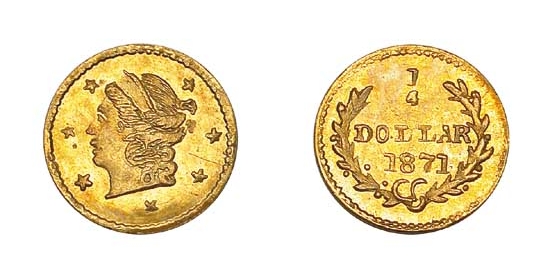
Obverse & Reverse
The 1871 BG-812 25 Cent piece belongs to the second great era of California Fractional Gold, known to numismatists as 'Period Two' (1858-1882). Unlike the 'Period One' issues, which were struck out of genuine commercial necessity during the initial chaos of the Gold Rush, these later pieces were created primarily as souvenirs and keepsakes. By the 1870s, the United States Mint in San Francisco was in full operation, producing ample federal coinage for the region's economy and eliminating the acute shortage of small change that had plagued the West Coast two decades prior. The raison d'être for these tiny gold coins had shifted from commerce to novelty. They were tangible, affordable mementos of the great Gold Rush, easily sent back East in a letter or worn as jewelry. The minters of these 'jeweler's issues' were often anonymous, operating in a legally grey area. The Coinage Act of 1864 had made the private minting of currency illegal, but the law was not aggressively enforced against these small-denomination tokens until the early 1880s. To circumvent the law, many minters produced pieces that were technically tokens or charms, though they bore denominations. The BG-812, however, is a denominated issue, boldly stating '1/4 DOLLAR' on its reverse, a testament to the lax enforcement of the era. These pieces were typically struck crudely using a hammer method, where a top die was struck with a sledgehammer onto a planchet resting on a bottom die, resulting in inconsistent strike quality. The gold content was also unregulated and often far below the coin's face value, a fact well understood by the public who purchased them as curios, not for monetary exchange. The BG-812 is a direct link to this fascinating twilight period of private coinage in America, representing the commercial capitalization of the Gold Rush's enduring mystique.
Associated EventPost-Gold Rush California Economy
Reason For MintingPrimarily created to be sold as souvenirs and keepsakes capitalizing on the legacy of the California Gold Rush.
Minter HistoryThe specific assayer or jeweler who produced the BG-812 variety is unknown, a common characteristic of 'Period Two' California Fractional Gold. Most of these pieces were made by various jewelers in San Francisco who had the skills to work with gold and cut dies. Unlike the more prominent 'Period One' assayers who often marked their work (e.g., Moffat & Co.), the souvenir-era minters typically remained anonymous to avoid potential legal trouble and because their primary business was jewelry, not coinage.
Historical SignificanceThe BG-812 is significant not as a circulating coin, but as a numismatic artifact representing the transition of private California gold from a necessary form of currency to a commercialized souvenir. It reflects the romantic, enduring legacy of the Gold Rush and the entrepreneurial spirit of jewelers who met a new market demand for affordable relics of that transformative era. Its existence highlights a period of lax federal enforcement regarding private coinage, a loophole that closed definitively in the early 1880s.
BG-812
Denomination25 Cents
Minting Period1871
Assayer/MinterUnknown private jeweler
Geographic OriginSan Francisco, California
Obverse DescriptionA fairly crude depiction of a Liberty Head facing left, modeled after contemporary federal gold coinage. The portrait is surrounded by thirteen five-pointed stars, representing the original colonies. The date '1871' is positioned below the bust.
Obverse Inscription1871
Reverse DescriptionA wreath composed of two branches tied together at the bottom with a bow. The wreath encircles the denomination '1/4' and the word 'DOLLAR'. A small dot or center mark may be visible inside the wreath.
Reverse Inscription1/4 DOLLAR
CompositionGold
Stated Fineness Actual FinenessVariable, typically 14-22 karats for Period Two issues, but often lower than Period One examples.
EdgePlain
Unknown
Survival Estimate31-75 known. The combined PCGS and NGC population reports show approximately 40-50 examples graded in all conditions, supporting this rarity level.
Rarity ScaleR-5
The BG-812 is sought after by specialists in California Fractional Gold for its defined rarity (R-5) and as a representative of the later 'jeweler's issue' period. Its small size and connection to the Gold Rush legend give it broad historical appeal. Completing a set of all BG-varieties for a given year is a significant challenge, making individual, problem-free examples desirable.
Key VarietiesThe BG-812 itself is a specific die-pair variety. No major, intentional varieties from the time of minting are known. There are no known official restrikes or pattern pieces associated with this variety. Collectors should be aware that the broader series of California Fractional Gold is rife with contemporary counterfeits, later-made souvenir tokens (often without a denomination or with 'CHARM' on them), and modern replicas, which are distinct from original Period Two issues.
Authentication TipsAuthenticity is key. Genuine BG-812 pieces are struck in gold, not gold-plated base metal. They should show the denomination '1/4 DOLLAR'. Look for sharp die characteristics consistent with known examples; mushy or tool-marked details are red flags. The style of the Liberty portrait and the wreath should match exemplars in auction archives. Many fakes are poorly made, but some can be deceptive. Professional authentication by PCGS or NGC, who attribute by BG number, is highly recommended.
Shopping ConsiderationsFor a 'premium quality' example, look for a sharp strike, especially on Liberty's hair details and the bow on the reverse wreath. Original, lustrous surfaces are highly prized over cleaned or polished examples. Due to the crude manufacturing process, perfectly struck specimens are rare and command significant premiums. Minor planchet flaws or strike weakness in peripheral areas can be acceptable, but distracting scratches, rim bumps, or signs of having been mounted in jewelry will significantly lower the value. Eye appeal is paramount; a coin with attractive, original reddish-gold toning is far more desirable than a brighter, but harshly cleaned, piece.
A coin's grade is its condition, rated on a 1-70 scale. For rare coins, this is the most critical factor in determining value, as a tiny difference in preservation can mean a huge difference in price.
Relevant Grade TypesOriginal 1871 BG-812 pieces were business strikes, technically intended as tokens rather than circulating currency, and are found in Circulated (1-58) and, more commonly, Mint State (MS, 60-70) grades, as many were saved as souvenirs. No proofs were struck during the original minting period. Any piece described as a 'Proof' is likely a later-date fantasy piece or replica and is not a genuine BG-812.
Mint State CharacteristicsUncirculated examples of BG-812 often exhibit a soft, satiny luster. The strike is frequently uneven; a fully struck piece with sharp details on the highest points of Liberty's hair and the wreath's bow is rare and desirable. Planchets were not always perfectly prepared, so minor inherent flaws may be present. Light die polish lines or minute die cracks are characteristic of the issue and not necessarily a detriment. Contact marks, even small ones, can be prominent due to the softness of the gold.
Circulated Wear PatternsWear first appears on the highest points of the design: Liberty's cheek, the hair above her eye, and the leaves and bow of the wreath on the reverse. On moderately circulated examples, the finer details of the hair and leaves will be flattened, and the stars will begin to lose their sharpness. In lower grades, the date and legends become weak, but are often still legible due to the simplicity of the design.
Key Factors For ValueThe primary value drivers for a BG-812 are grade and surface preservation. An example with original, undisturbed luster and minimal contact marks will command a substantial premium over one that has been cleaned, polished, or damaged. Sharpness of strike is the next key factor; well-struck examples are always in higher demand. Finally, attractive eye appeal, often characterized by a pleasing original gold patina, significantly enhances value. A CAC sticker on a graded holder indicates premium quality for the grade and will typically result in a higher market price.
PCGS Price Guide
| Grade | Price | Population |
|---|---|---|
| 58 | $230.00 | 2 |
| 58+ | $240.00 | N/A |
| 60 | $275.00 | 1 |
| 61 | $300.00 | 1 |
| 62 | $345.00 | 5 |
| 62+ | $365.00 | N/A |
| 63 | $400.00 | 5 |
| 63+ | $430.00 | N/A |
| 64 | $475.00 | 16 |
| 64+ | $500.00 | N/A |
| 65 | $700.00 | 12 |
| 65+ | $750.00 | N/A |
| 66 | $1,100.00 | 2 |
| 66+ | $1,250.00 | N/A |
| 67 | $2,750.00 | 2 |
| 67+ | $3,250.00 | 1 |