1865 G25C BG-822, PL (Regular Strike)
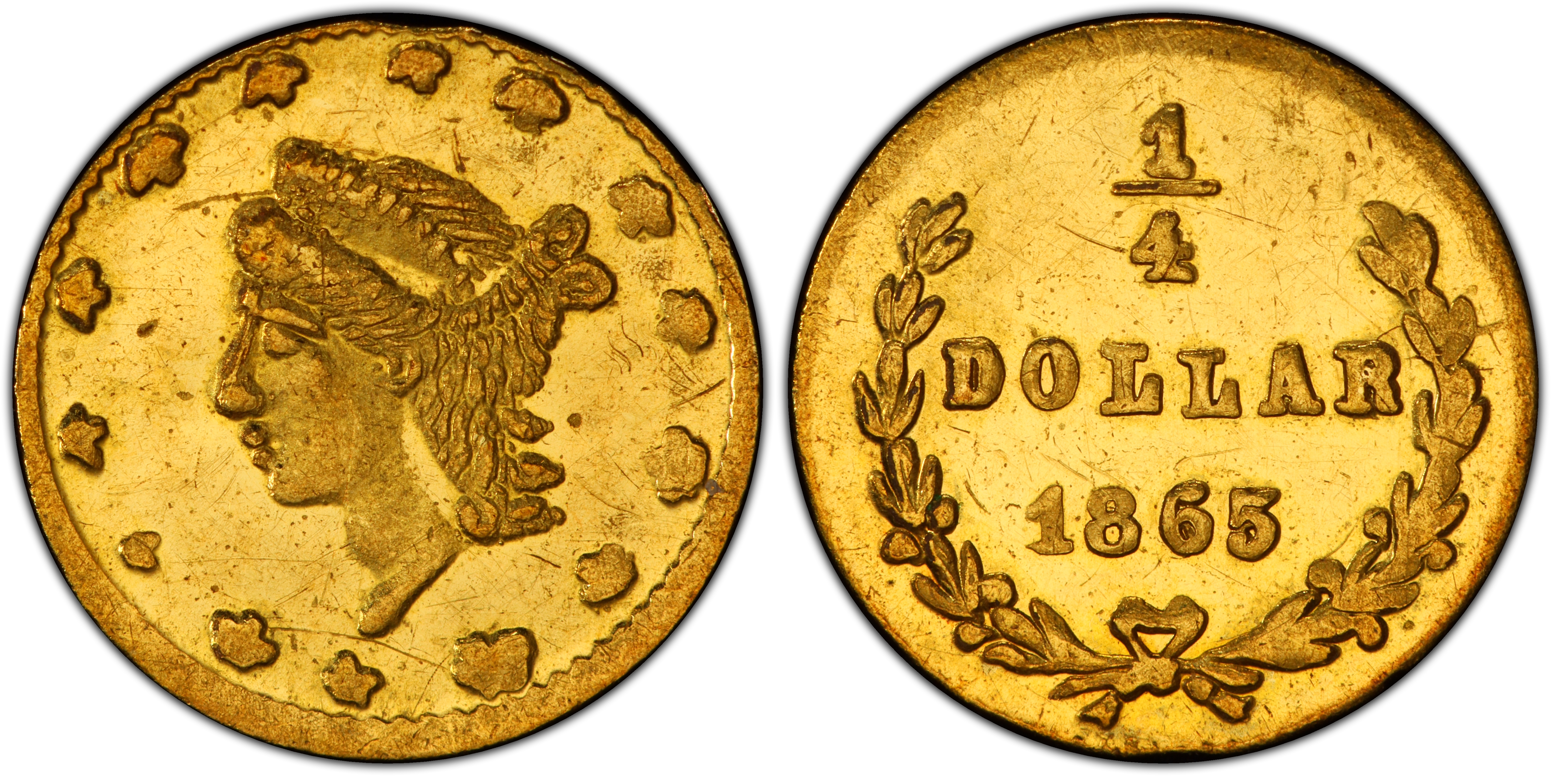
Obverse & Reverse
The 1865 BG-822 25 Cents represents a fascinating and legally ambiguous chapter in American monetary history. Born from the continued, yet evolved, economic conditions of post-Gold Rush California, this tiny gold piece is classified as a 'Period Two' issue in the canonical Breen-Gillio reference. The initial wave of California Fractional Gold (Period One, 1852-1857) arose from a genuine and severe shortage of small-denomination coinage for everyday transactions. Miners with pouches of gold dust found it impractical to purchase a drink or a meal. Jewelers and metalsmiths, primarily in San Francisco, filled this void by striking gold quarters, half dollars, and dollars that mimicked federal designs to inspire public confidence. However, by the late 1850s, the San Francisco Mint was in full operation, alleviating the acute coin shortage. The rationale for producing fractional gold shifted. The pieces transitioned from being essential circulating currency to desirable souvenirs and keepsakes. Easterners and Europeans were fascinated by the 'Wild West,' and these miniature gold coins became popular mementos of the California adventure. This 1865 issue is particularly significant due to its date. The United States Congress passed the Coinage Act of April 22, 1864, which explicitly outlawed the private minting of coinage. In theory, this should have terminated the production of fractional gold. In practice, federal ambivalence and the logistical challenges of enforcing such laws on the distant West Coast meant the statute was largely ignored for nearly two decades. San Francisco jewelers continued to produce their wares, often with dates reflecting the current year, in open defiance of the law. It wasn't until a concerted effort by the Secret Service in 1883 that production was finally halted. Therefore, the BG-822 was struck in a legal grey area, technically illicit but practically tolerated. These Period Two pieces were often of lower gold fineness and lighter weight than their Period One predecessors, reflecting their new role as novelties rather than true currency intended to pass at face value. They represent the enduring romanticism of the Gold Rush and the entrepreneurial spirit of the jewelers who catered to a burgeoning tourist and souvenir market.
Associated EventPost-Gold Rush California Economy
Reason For MintingPrimarily struck as souvenirs and jewelry items for a public fascinated with the California Gold Rush, continuing production despite a federal law prohibiting private coinage.
Minter HistoryThe specific minter of the BG-822 variety, like most Period Two issues, is unknown. The work is attributed to the many skilled but anonymous jewelers and goldsmiths operating in San Francisco in the 1860s. These craftsmen used hand-operated presses to strike coins, resulting in significant variation in quality and strike. While some earlier Period One makers signed their work with initials (e.g., 'F.D.' for Frontier & Deviercy), most Period Two pieces are unattributed.
Historical SignificanceThe BG-822 is historically significant as a numismatic artifact produced in defiance of the Coinage Act of 1864. It marks the transition of fractional gold from necessary coinage to commercial souvenir, reflecting both the laxity of federal law enforcement on the West Coast and the powerful, lasting allure of the Gold Rush in the American imagination. Each piece is a tangible link to this unique period of tolerated illegality and commerce.
N/A
Denomination25 Cents
Minting Period1865
Assayer/MinterUnknown Jeweler(s)
Geographic OriginSan Francisco, California
Obverse DescriptionA head of Liberty facing left, her hair tied in a bun. She is surrounded by thirteen five-pointed stars, typically seven to the left and six to the right.
Obverse Inscription Reverse DescriptionThe denomination '1/4 DOLLAR' and the date '1865' are enclosed within a wreath of leaves and berries. The wreath is tied with a bow at the bottom.
Reverse Inscription1/4 DOLLAR 1865
CompositionGold
Stated Fineness Actual FinenessVariable, but generally lower than federal standards for Period Two issues.
Weight0.25 grams
Diameter9.50 mm
EdgePlain
Unknown
Survival Estimate75-125. Based on combined PCGS and NGC population reports totaling around 60-70 unique coins, with an allowance for resubmissions and raw, uncertified examples.
Rarity ScaleR-5 (Rare: 31-75 known)
This coin is highly sought after for its historical context as a 'souvenir' issue struck after private coinage was outlawed. Its tiny size, gold composition, and direct connection to the Gold Rush era make it a classic piece of Americana. The BG-822 is a popular and relatively accessible variety for collectors starting a set of Period Two Liberty Head types.
Key VarietiesThe primary variety noted by grading services is the 'PL' or Prooflike designation, awarded to examples with exceptionally mirrored fields from freshly polished dies. No major die variations from the original minting period are widely recognized for BG-822. Unlike some territorial issues, there are no known later-date restrikes or pattern pieces associated with this specific variety.
Authentication TipsGenuine examples are struck in gold and should have a corresponding density and feel. The design elements, while sometimes softly struck, should be consistent with known examples and not exhibit the casting bubbles or soapy details of many modern replicas. Period Two originals are denominated '1/4 DOLLAR'; many fakes and charms from the 20th century are marked '1/4 CAL GOLD' and often feature a bear on the reverse, a design not found on authentic 19th-century issues. The font and style of the date and legends should be carefully compared to certified examples.
Shopping ConsiderationsA premium quality BG-822 is defined by a sharp, well-centered strike, particularly on Liberty's hair and the leaves of the wreath. Look for examples with minimal contact marks; the soft gold makes these coins very susceptible to damage. The most desirable pieces possess vibrant, original mint luster, often with a slightly reddish or orange-peel texture. The 'PL' designation commands a significant premium. Avoid coins that have been harshly cleaned, which strips the original surface and imparts a dull, lifeless appearance. Also be wary of pieces that have been used in jewelry, looking for evidence of removed solder or rim damage.
A coin's grade is its condition, rated on a 1-70 scale. For rare coins, this is the most critical factor in determining value, as a tiny difference in preservation can mean a huge difference in price.
Relevant Grade TypesOriginal 1865 BG-822 issues were business strikes intended for sale as souvenirs, not general circulation. They are found in Circulated (1-58) and, more commonly, Mint State (MS, 60-70) grades. No true Proofs (PR/PF) were struck during the original period of issue. The 'PL' (Prooflike) designation for some Mint State business strikes is a distinct category, referring to the coin's mirrored finish, not its method of manufacture.
Mint State CharacteristicsUncirculated examples of BG-822 often have a soft, satiny luster. Strike quality varies; many show weakness on the highest points of the design, such as Liberty's hair details above the eye and the tips of the wreath leaves. Planchet quality can also be inconsistent, with minor striations or 'as-made' imperfections sometimes present. Truly choice examples will have a strong strike, clean surfaces, and bright luster, with prooflike examples being the most coveted.
Circulated Wear PatternsWear first appears on the highest points of the coin. On the obverse, check for flatness on Liberty's cheek, the hair bun, and the strands of hair above the forehead. On the reverse, the high points of the wreath's leaves and the bow will show initial friction and loss of detail. On lower-grade circulated examples, the stars and legends will begin to merge with the fields.
Key Factors For ValueFor the BG-822, the key value drivers are, in order: grade, surface quality, and strike. A sharply struck MS-63 can be more valuable than a weakly struck MS-64. Original, uncleaned surfaces with attractive reddish-gold toning are highly prized. The presence of a CAC sticker indicates premium quality for the grade and typically adds a significant premium. The 'PL' designation can easily double the value of a non-PL coin in the same numerical grade due to its enhanced eye appeal and rarity.
PCGS Price Guide
| Grade | Price | Population |
|---|---|---|
| 63 | $600.00 | 1 |