1876 G50C BG-953 (Regular Strike)
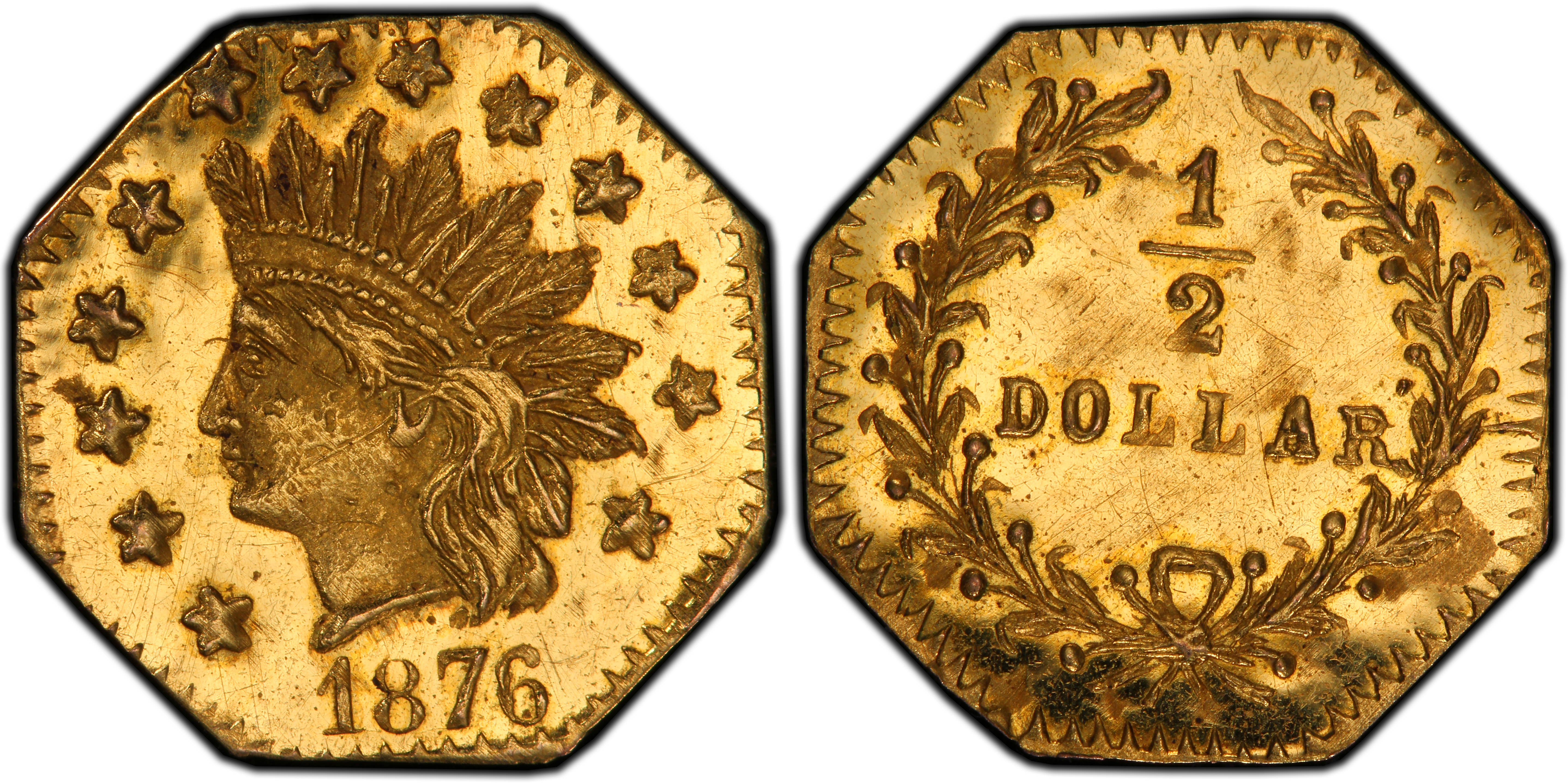
Obverse & Reverse
The 1876 G50C BG-953 is a product of the fascinating and complex 'Period Three' (1872-1882) of California Fractional Gold production. By this era, the fever of the initial Gold Rush had long subsided, but California's economy was maturing. The United States was in the midst of the 'Long Depression' following the Panic of 1873, and small-denomination coinage remained useful, particularly in the West where hard money was preferred. The primary impetus for these later-date small gold tokens was not a dire currency shortage, as in the 1850s, but rather a burgeoning market for souvenirs and keepsakes. The Philadelphia Centennial Exposition of 1876, celebrating the nation's 100th birthday, created a massive demand for novelties and mementos. San Francisco jewelers and private minters, who had a long history of working with local gold, capitalized on this trend by producing hundreds of varieties of small-denomination gold 'coins'. These pieces were eagerly purchased by tourists, locals, and attendees of the Exposition as tangible, valuable reminders of California's golden heritage. Unlike their predecessors from Period One (1852-1856), these later issues were not primarily intended to circulate as money, though some undoubtedly did. They were openly sold as charms, jewelry, and collector's items. The BG-953, with its crisp 'Indian Princess' design, was a classic example of this commercial enterprise. Herman J. Brand was a key manufacturer during this period, producing dies for numerous issuers. These tokens were typically sold for slightly more than their gold value, creating a profitable business model. The practice finally came to a definitive end in 1883, when a U.S. Treasury official, acting on the Private Coinage Act of 1864, ruled that such pieces violated federal law, leading to the cessation of their production and the destruction of existing dies and hubs.
Associated EventPhiladelphia Centennial Exposition of 1876
Reason For MintingPrimarily created to be sold as souvenirs and keepsakes for tourists and collectors, capitalizing on the demand generated by the 1876 Centennial Exposition.
Minter HistoryHerman J. Brand was a German immigrant and skilled die-sinker who operated in San Francisco. He was one of the most prolific producers of dies for California Fractional Gold during Period Three (1872-1882). While not a 'minter' in the sense of operating a large mint, his firm produced the dies that were used by various jewelers and issuers, such as Robert B. Gray & Co., to strike these small gold pieces. His work is characterized by its quality and the sheer number of varieties he enabled, many of which are now cataloged in the Breen-Gillio reference. His operations ceased following the federal government's crackdown on private coinage in the early 1880s.
Historical SignificanceThe BG-953 represents the commercialization and final chapter of the private gold coinage era in California. It is not a coin born of necessity like its 1850s counterparts, but rather a numismatic souvenir reflecting California's identity and the national celebratory mood of 1876. Its existence highlights the transition from a frontier economy to one integrated into the broader United States, where private coinage was no longer tolerated but its legacy was romanticized and sold as a commodity. These pieces are a tangible link to the Centennial Exposition and the enduring allure of the Gold Rush.
N/A
Denomination50 Cents
Minting Period1876
Assayer/MinterHerman J. Brand (manufacturer); Robert B. Gray & Co. (likely issuer)
Geographic OriginSan Francisco, California
Obverse DescriptionA beaded border encloses a Liberty head design, often referred to as an 'Indian Princess' style. The portrait faces left and is adorned with a feathered headdress. Thirteen stars encircle the portrait, representing the original thirteen colonies.
Obverse Inscription[No Inscription - design features only]
Reverse DescriptionA beaded border surrounds a wreath composed of two olive branches tied at the bottom with a ribbon. The denomination '50 CENTS' is displayed within the wreath, and the date '1876' is positioned below the wreath but above the lower beading. A small mintmark-like letter 'G' is often visible below the ribbon bow.
Reverse Inscription50 CENTS 1876 G
CompositionGold
Stated Fineness Actual FinenessApproximately .800 to .900 fine, though varies.
Weight0.25 grams
Diameter10.00 mm
EdgePlain
Unknown
Survival Estimate500-750
Rarity ScaleR-4
The BG-953 is highly popular due to its association with the 1876 Centennial year, its attractive 'Indian Princess' design, and its status as a relatively common and accessible type coin within the complex California Fractional Gold series. It serves as an excellent entry point for collectors.
Key VarietiesThe primary issue is the 'Regular Strike' business strike. No proof or special collector issues from the period of manufacture are known or recognized. Varieties within the broader G50C category for the year exist, differentiated by die states, placement of the 'G' mintmark, and other minute details, but BG-953 refers to a specific die marriage. Collectors should be aware that modern replicas and copies are abundant and distinct from original 1876 issues.
Authentication TipsAuthentic examples have a characteristic soft, satiny luster, not the hard, proof-like finish of modern replicas. The details, while sometimes softly struck, should be consistent with known genuine examples; pay close attention to the shape of the stars, the details in the feathers, and the font of the date and denomination. The weight should be very close to 0.25 grams. Many fakes are underweight or overweight. The 'G' mintmark below the wreath is a key diagnostic point for this variety group and should be examined for proper shape and placement. Pieces set in jewelry often show evidence of soldering or rim damage.
Shopping ConsiderationsA premium quality BG-953 will exhibit a sharp strike, especially on the high points of the headdress feathers and the details within the wreath. Original, uncleaned surfaces are paramount; look for a consistent, warm golden patina. Many examples were cleaned or polished for use in jewelry, which severely impairs their value. Avoid examples with significant rim bumps, scratches, or evidence of being removed from a bezel. A CAC sticker on a certified coin provides an extra layer of confidence regarding originality and quality for the assigned grade.
A coin's grade is its condition, rated on a 1-70 scale. For rare coins, this is the most critical factor in determining value, as a tiny difference in preservation can mean a huge difference in price.
Relevant Grade TypesOriginal 1876 issues were all business strikes intended for sale as souvenirs, not for general circulation in the traditional sense, though some saw minor handling. They are found in Circulated (AU-58 and below) and Mint State (MS, 60-70) grades. AU examples are common due to handling as keepsakes. True Mint State examples retain full original luster. No proofs were struck during the original period of issue, and any piece described as a 'Proof' from this era is either a modern copy or has been misidentified; these are numismatically distinct items with no connection to the original minting.
Mint State CharacteristicsIn uncirculated grades, the BG-953 should display a vibrant, satiny luster. The strike is often somewhat soft, particularly in the center of the obverse (Liberty's cheek) and on the bow of the wreath on the reverse. A well-struck example with sharp central details commands a premium. Due to their small size and method of production, even Mint State examples may show minor planchet flaws or handling marks from being stored together. The fields should be clean and free of distracting marks.
Circulated Wear PatternsWear first appears on the high points of the design. On the obverse, look for flattening on the feathers of the headdress and on Liberty's cheek and eyebrow. On the reverse, the leaves of the wreath and the bow will show the first signs of friction. In lower circulated grades (VF and below), the smaller details of the feathers and leaves will begin to merge, and the beaded border will show significant wear.
Key Factors For ValueThe primary value drivers for an 1876 BG-953 are grade and surface preservation. An uncirculated example is worth many times more than a circulated one. Original, uncleaned surfaces with attractive luster ('eye appeal') are critical. Coins that have been harshly cleaned, polished, or damaged by jewelry mounting are heavily penalized in the market. Strike quality is a significant factor; a coin with a full, sharp strike is much more desirable than a weakly struck counterpart in the same numerical grade. A CAC sticker indicating superior quality for the grade will add a substantial premium.
PCGS Price Guide
| Grade | Price | Population |
|---|---|---|
| 55 | $250.00 | 1 |
| 55+ | $265.00 | N/A |
| 58 | $275.00 | 2 |
| 58+ | $290.00 | N/A |
| 60 | $325.00 | N/A |
| 61 | $350.00 | 1 |
| 62 | $425.00 | 5 |
| 62+ | $450.00 | N/A |
| 63 | $500.00 | 12 |
| 63+ | $575.00 | N/A |
| 64 | $825.00 | 10 |
| 64+ | $950.00 | N/A |
| 65 | $1,550.00 | 6 |
| 65+ | $1,750.00 | N/A |
| 66 | $2,250.00 | N/A |