1869 G25C BG-830 (Regular Strike)
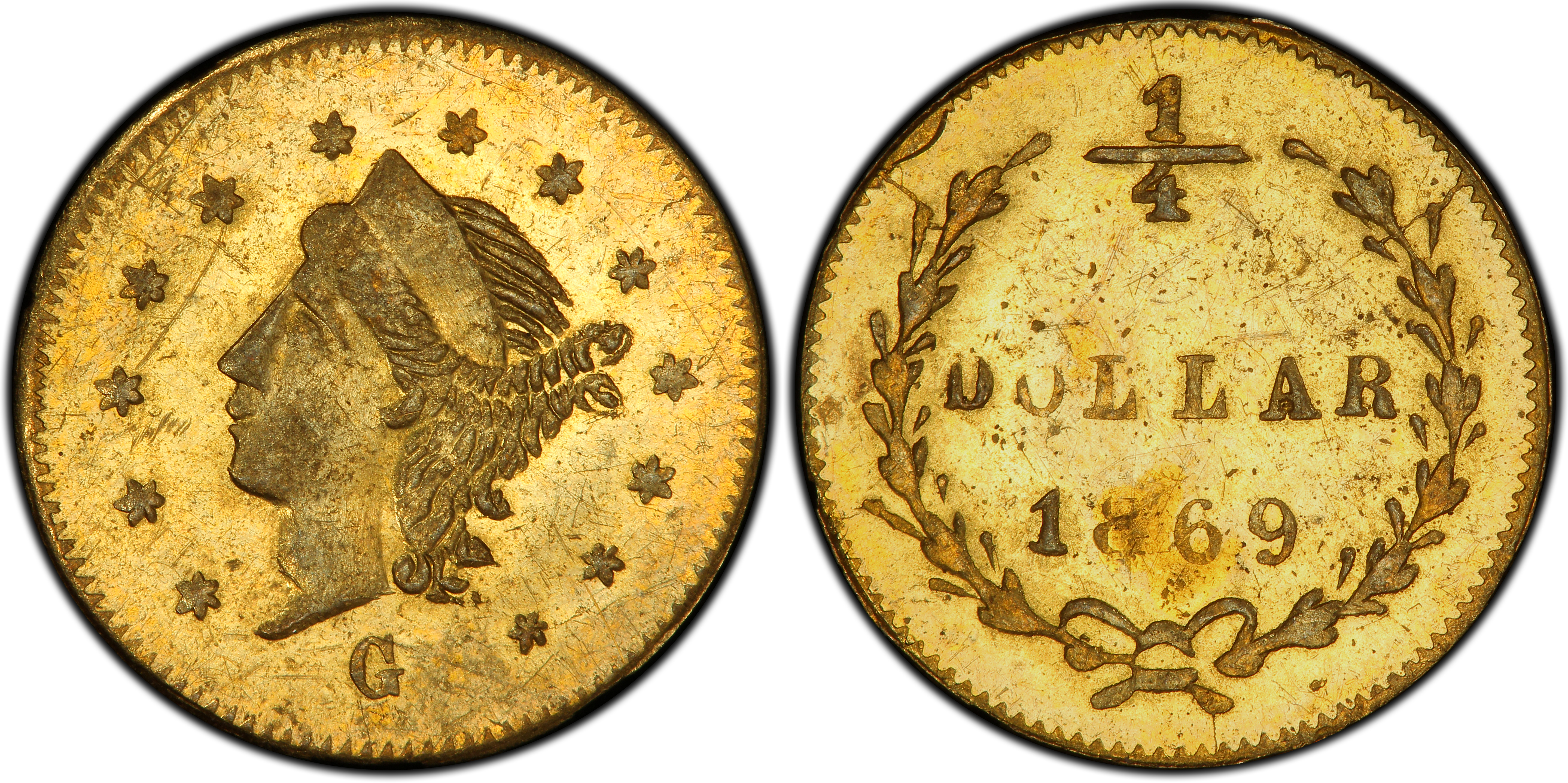
Obverse & Reverse
The 1869 BG-830 25 Cent piece is a product of the second major phase of California Fractional Gold production (1858-1882), often referred to by numismatists as 'Period Two'. Unlike the earlier 'Period One' issues which were struck to alleviate a severe shortage of small denomination coinage during the initial frenzy of the Gold Rush, Period Two pieces were created in a different economic climate. By 1869, the San Francisco Mint was in full operation, and the acute need for private coinage for daily commerce had subsided. Instead, these small gold pieces were manufactured primarily by jewelers and artisans in San Francisco as souvenirs and keepsakes. They catered to a public fascinated with the Gold Rush narrative, serving as mementos of the romanticized pioneer era. The Coinage Act of 1864 had officially made private coinage illegal, but enforcement was lax in the West until the early 1880s, allowing this production to continue. These 'jeweler's issues' were often lighter and sometimes of lower fineness than their Period One predecessors, as their purpose was novelty rather than monetary circulation. The BG-830, dated 1869, is a quintessential example of this later period. Struck crudely, likely by the hammer method common for these issues, its existence speaks to the enduring legacy of the Gold Rush and the entrepreneurial spirit of California's craftsmen. While not intended for widespread circulation, they were traded and collected, eventually becoming a distinct and popular field of numismatics. Their story is less about fulfilling a monetary crisis and more about the commercialization of a historical phenomenon.
Associated EventPost-Gold Rush California Economy
Reason For MintingPrimarily struck as souvenirs and jewelry items for a public nostalgic for the Gold Rush, rather than for general circulation.
Minter HistoryThe specific minter or jeweler responsible for the BG-830 die marriage is unknown, a common trait for many Period Two California Fractional Gold varieties. Production was often anonymous, carried out by various jewelers centered in San Francisco who created a wide array of these small gold tokens for the robust souvenir market. While some makers are identified by initials (e.g., 'G' for Robert B. Gray on other varieties), BG-830 bears no such identifying marks.
Historical SignificanceThe BG-830 is significant not as a circulating coin but as a tangible artifact of the post-Gold Rush souvenir industry in California. It represents the transition of fractional gold from a necessary form of currency to a collectible novelty, reflecting a maturing society that was beginning to mythologize its own recent past. Its rarity today underscores the limited production and low survival rate of these delicate items.
N/A
Denomination25 Cents
Minting Period1869
Assayer/MinterUnknown Private Minter
Geographic OriginSan Francisco, California
Obverse DescriptionA small, crudely rendered Liberty Head facing left, surrounded by thirteen stars. The portrait is a simplified imitation of the designs used on contemporary federal gold coinage. The date '1869' is typically below the bust, though its position can vary slightly.
Obverse Inscription1869
Reverse DescriptionThe denomination '1/4 DOLLAR' is enclosed within a wreath. The wreath is composed of two branches tied by a bow at the bottom. The design is typically simple and can show weakness in strike.
Reverse Inscription1/4 DOLLAR
CompositionGold
Stated Fineness Actual FinenessVaries, but typically lower than federal coinage, often ranging from .500 to .800 fine.
Diameter9.70 mm
EdgePlain
Unknown; likely very small.
Survival EstimateFewer than 20 believed to exist.
Rarity ScaleHigh R-7 (4-12 known). Some sources cite High R-5, indicating a slightly larger but still very small population.
This coin appeals to specialists in California Fractional Gold and collectors of Gold Rush-era material. Its primary allure is its extreme rarity and its connection to the romantic history of the Old West. As a dated Period Two issue, it is a key representative of the 'souvenir' phase of this fascinating series.
Key VarietiesThe BG-830 itself is a single, specific die marriage (obverse 8, reverse 29 in the Breen-Gillio classification). No major varieties struck during the original minting period are known. As with all California Fractional Gold, no later-date restrikes or collector issues were produced by the original minter. Modern replicas and copies are common and should be distinguished from genuine pieces.
Authentication TipsGenuine BG-830s will exhibit characteristics of manual, crude striking. Look for a soft, slightly irregular strike, not the sharp, uniform look of a modern machine-made copy. The surfaces may have a slightly wavy or uneven quality from the hammer-striking process. The gold will have the color and luster consistent with a 19th-century alloy. Counterfeits are often brassy in color, have sharper details than originals, and may have tool marks or a 'soapy' appearance from being cast. Attribution to the specific BG-830 die state via high-magnification comparison with known genuine examples is the ultimate confirmation.
Shopping ConsiderationsFor a 'premium quality' BG-830, a potential buyer should prioritize sharpness of strike and originality of the surfaces. Given the crude manufacturing, a well-centered and fully struck example is highly desirable and rare. Look for evidence of original, prooflike or satiny luster in the protected areas, rather than a uniformly dull or harshly cleaned surface. Many surviving examples are ex-jewelry and may show signs of soldering, tooling, or harsh cleaning; coins free of these impairments command a significant premium. A slightly wavy planchet is not uncommon and is considered a characteristic of manufacture, not a defect. Certification by a top-tier grading service (PCGS or NGC) is highly recommended for this issue due to its rarity and the prevalence of counterfeits.
A coin's grade is its condition, rated on a 1-70 scale. For rare coins, this is the most critical factor in determining value, as a tiny difference in preservation can mean a huge difference in price.
Relevant Grade TypesOriginal 1869 BG-830 pieces were business strikes, although their intended purpose was for souvenirs rather than circulation. They are found in Circulated (1-58) and Mint State (MS, 60-70) grades. Due to their nature, most survivors are in higher grades (AU or MS), as they saw little to no circulation. No proofs were struck during the original period of issue, and no later-date official restrikes exist.
Mint State CharacteristicsAn uncirculated BG-830 is defined by the presence of original mint luster. This luster is often satiny or prooflike, a common characteristic of hammer-struck gold. Strike quality is a key differentiator; many are weakly struck on the high points of Liberty's hair and the leaves of the wreath. A specimen with a sharp, bold strike is rare and commands a premium. Due to the softness of the gold and crude production, even Mint State examples can have small planchet flaws, fissures, or minute handling marks. A lack of such characteristics, combined with a sharp strike, would define a top-tier example.
Circulated Wear PatternsOn this coin, wear would first appear on the highest points of the design. For the obverse, this would be Liberty's cheek, the hair above her eye, and the highest curls of hair. On the reverse, the high points of the wreath's leaves and the bow would show the first signs of friction. In lower grades (VF and below), the finer details of the hair and leaves would become flat, and the legends would start to merge with the fields.
Key Factors For ValueThe primary value driver for BG-830 is its rarity. Beyond that, grade and eye appeal are paramount. A high-grade example (MS-62 or better) is a major condition rarity. Surface quality is critical; an example with original, undisturbed prooflike or lustrous surfaces is far more valuable than one that has been cleaned, polished, or previously mounted in jewelry. Strike sharpness is the next key factor, with well-struck pieces being highly sought after. Finally, an attractive, original reddish-gold toning can enhance eye appeal and value. A CAC sticker on a certified example would provide a strong premium, indicating superior quality for the grade.
PCGS Price Guide
| Grade | Price | Population |
|---|---|---|
| 50 | $235.00 | 1 |
| 50+ | $240.00 | N/A |
| 53 | $250.00 | N/A |
| 53+ | $260.00 | N/A |
| 55 | $275.00 | 3 |
| 55+ | $280.00 | N/A |
| 58 | $300.00 | 8 |
| 58+ | $310.00 | N/A |
| 60 | $340.00 | N/A |
| 61 | $400.00 | 3 |
| 62 | $450.00 | 6 |
| 62+ | $500.00 | N/A |
| 63 | $575.00 | 4 |
| 63+ | $700.00 | N/A |
| 64 | $850.00 | 2 |