1878/6 G25C BG-884, PL (Regular Strike)
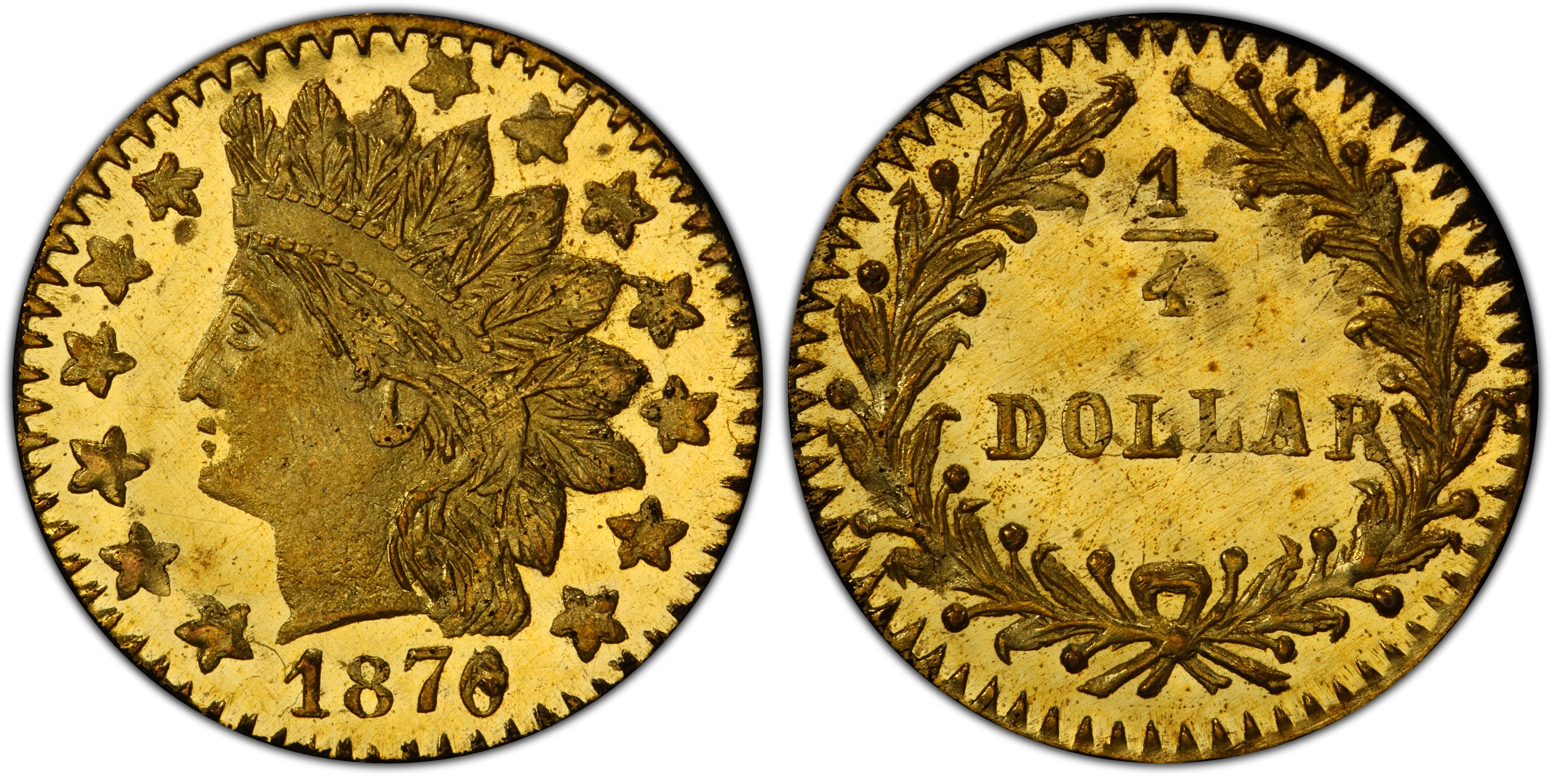
Obverse & Reverse
The 1878/6 G25C, cataloged as Breen-Gillio 884, is a quintessential example of a 'Period Two' California Fractional Gold piece. By the 1870s, the initial, desperate need for small circulating currency that spurred the creation of 'Period One' (1852-1857) issues had largely subsided. The establishment and efficient operation of the San Francisco Mint in 1854 had supplied the region with ample federal coinage. However, a new market emerged for the charming, miniature gold coins: the burgeoning tourist and souvenir trade. San Francisco, having transformed from a chaotic boomtown into a sophisticated metropolis, was a major destination. Jewelers and private minters, such as Robert B. Gray & Co., astutely recognized this demand. They began producing vast quantities of small-denomination gold pieces, not as a monetary necessity, but as keepsakes, charms for jewelry, and mementos of the romanticized Gold Rush era. These 'Jeweler's Issues' were often of lower gold purity than their Period One predecessors and were produced with a focus on novelty and aesthetic appeal rather than intrinsic value. The BG-884 is a product of this environment. It was struck from a die that was originally dated 1876, which was then crudely re-engraved to '1878' to keep the product current. This overdate feature speaks volumes about the pragmatic, commercial nature of the operation; old dies were simply repurposed to save on costs. These pieces never truly circulated in the traditional sense. Instead, they were sold by merchants, jewelers, and vendors to locals and tourists alike, tangible and affordable pieces of 'California Gold.' Their production continued until the U.S. Secret Service, concerned about potential confusion with federal coinage and outright fraud, cracked down on private minters, effectively ending the era of California Fractional Gold by 1883.
Associated EventCalifornia Gold Rush Tourist & Souvenir Trade
Reason For MintingPrimarily produced for sale as souvenirs and jewelry charms to the tourist trade in San Francisco, not for monetary circulation.
Minter HistoryRobert B. Gray & Co. was a prominent San Francisco jewelry firm and a prolific manufacturer of Period Two California Fractional Gold. Around 1859, Gray purchased the business, including dies and equipment, from another established jeweler and minter, Antoine Louis Nouizillet. Gray continued to use some of Nouizillet's old dies before creating his own, which are distinguished by the hallmark 'G' on the obverse, as seen on the BG-884. His operation was a commercial success, producing a wide variety of dated quarter dollar, half dollar, and dollar pieces throughout the 1860s and 1870s to satisfy the significant demand for gold souvenirs. According to research by Breen and Gillio, Gray's pieces were often of higher weight and intrinsic value than many other competing jeweler's issues of the period. The business was sold to the California Jewelry Co. in 1871, though pieces bearing the 'G' mintmark continued to be struck with existing dies.
Historical SignificanceThe BG-884 is significant not as a circulating coin, but as a historical artifact representing the commercialization of the Gold Rush legend. It marks the transition of California Fractional Gold from a necessary form of currency to a popular souvenir item, reflecting the changing economic and cultural landscape of late 19th-century California.
BG-884
Denomination25 Cents
Minting Period1878
Assayer/MinterRobert B. Gray & Co.
Geographic OriginSan Francisco, California
Obverse DescriptionA stylized head of a Native American (Indian Head) facing left, wearing a feathered headdress. The portrait is surrounded by thirteen stars representing the original colonies. The date '1878' is below the bust, with the '8' clearly punched over a '6'. The minter's hallmark 'G' is located to the right of the date, between the final star and the truncation of the neck.
Obverse Inscription1878 G
Reverse DescriptionThe denomination '1/4' is centered within a wreath composed of two olive branches. The wreath is open at the top and tied with a bow at the bottom. The legend 'CALIFORNIA GOLD' is inscribed in an arc around the wreath, separated by the top of the wreath.
Reverse InscriptionCALIFORNIA GOLD 1/4
CompositionGold
Stated Fineness Actual FinenessVariable, but generally lower than federal coinage, often in the 14 to 20 karat range.
Weight0.24 grams
Diameter9.80 mm
EdgePlain
Unknown
Survival Estimate31-45
Rarity ScaleHigh R-5
The BG-884 is highly sought after due to its dramatic and clear 1878/6 overdate, a feature that provides tangible evidence of the die-making and minting practices of the era. Its connection to the well-documented minter Robert B. Gray & Co. adds to its appeal. The availability of examples with prooflike surfaces makes it a favorite among collectors who prize exceptional eye appeal in this challenging series.
Key VarietiesThe 1878/6 overdate is the primary and defining variety for BG-884. No major sub-varieties or special collector restrikes from a later period are known to exist. Collectors may focus on different die states, though these are not formally cataloged, looking for variations in the prominence of the underlying '6' or the development of die cracks. The key distinction for collectors is the quality of the strike and the nature of the surfaces (business strike vs. prooflike).
Authentication TipsAuthentic examples are struck on very thin planchets, a key characteristic of genuine fractional gold. The overdate should be examined closely; the top loop of the underlying '6' is typically visible within the top loop of the '8', and the tail of the '6' can often be seen within the bottom loop of the '8'. The strike is often somewhat crude, with weakness possible in the centers or peripheries. Counterfeits are often thicker, have a soapy or cast-like appearance, incorrect weight, and may lack the diagnostic sharpness of the overdate feature. All genuine pieces must have a denomination; pieces with a bear on the reverse are modern replicas.
Shopping ConsiderationsWhen acquiring an 1878/6 G25C, the primary factor is surface quality and eye appeal. A 'premium quality' example for its grade will exhibit sharp details, particularly on the feathers of the headdress and the numerals of the overdate. Seek out specimens with original, lustrous surfaces. For this variety, prooflike (PL) examples command a significant premium; look for deep, clear reflectivity in the fields contrasted with frosty devices. Common problems include harsh cleanings, which dull the luster and leave hairlines, and previous use in jewelry, which can result in rim damage, scratches, or evidence of solder. A coin certified by a major grading service (PCGS or NGC) is highly recommended for authenticity and grade verification.
A coin's grade is its condition, rated on a 1-70 scale. For rare coins, this is the most critical factor in determining value, as a tiny difference in preservation can mean a huge difference in price.
Relevant Grade TypesAll original examples of BG-884 were struck as business strikes, though many were produced with specially prepared, polished dies to create a mirrored, prooflike finish for the souvenir market. They are found in Circulated grades (1-58) and, more commonly, in Mint State (MS, 60-70). The 'PL' (Prooflike) designation is a modifier applied to Mint State coins that exhibit deeply mirrored fields. No true Proofs were struck during the original period of issue.
Mint State CharacteristicsUncirculated examples are defined by their luster. A typical business strike will have a soft, satiny glow. Prooflike (PL) specimens are the most desirable, displaying watery or flashy mirrored fields. Strike quality varies; many are well-defined, but weakness on the high points of the Indian's cheek and the feathers is not uncommon. Due to the softness of the gold and the commercial production process, even high-grade Mint State examples often show small die polishing lines (striations) and minor planchet flaws, which are characteristic of the issue and generally accepted.
Circulated Wear PatternsWear first appears on the highest points of the design: the cheekbone of the Indian Head, the eyebrow, and the feathers in the headdress. On the reverse, the leaves and bow of the wreath will show initial friction and flattening. On lower-grade circulated examples, the stars and legends will begin to weaken and merge with the fields, and the overdate feature may become less distinct.
Key Factors For ValueFor the BG-884, the most significant value drivers are the grade and the prooflike designation. A certified MS-64PL will be worth substantially more than a regular MS-64. The clarity and boldness of the 8/6 overdate is a critical factor; well-defined overdates are prized. Surface preservation is paramount; specimens with clean, original surfaces free of distracting marks, hairlines, or carbon spots command strong premiums. Finally, exceptional eye appeal, often characterized by attractive original toning over lustrous or prooflike fields, will always drive spirited bidding. A CAC sticker for this issue confirms premium quality for the grade and adds a significant premium.
PCGS Price Guide
| Grade | Price | Population |
|---|---|---|
| 64 | N/A | 1 |
| 65 | $2,150.00 | 1 |
| 65+ | $2,500.00 | N/A |
| 66 | $3,000.00 | N/A |