1870 G25C BG-761, PL (Regular Strike)
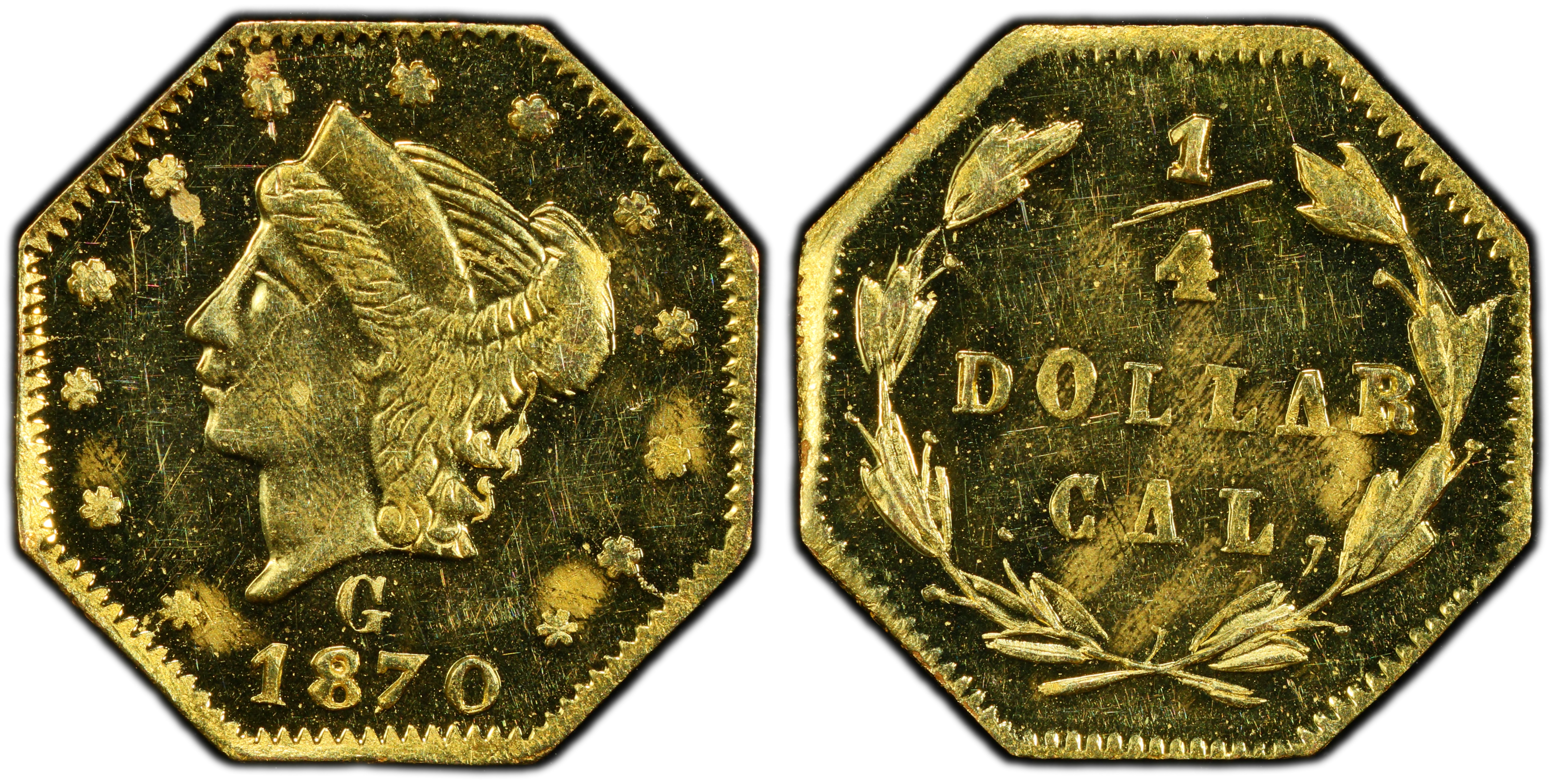
Obverse & Reverse
The 1870 Octagonal Liberty Head 25 Cents, cataloged as BG-761, is a quintessential example of 'Period Two' California Fractional Gold. Unlike their 'Period One' predecessors (1852-1857), which were struck to alleviate a severe shortage of small change during the initial chaos of the Gold Rush, Period Two pieces were primarily manufactured as souvenirs and jewelry items. By 1870, the San Francisco Mint was in full operation, supplying the region with ample federal coinage and rendering private issues for circulation unnecessary. However, the allure of California gold and the romance of the Gold Rush had captivated the nation. Enterprising jewelers in San Francisco, such as Robert B. Gray & Co., recognized a burgeoning tourist and novelty market. They began producing these miniature gold 'coins,' which, while denominated, were not intended to and did not seriously circulate as currency. The intrinsic value of these pieces was significantly less than their face value. The production process often involved meticulous, high-pressure strikes on polished planchets to create visually appealing items, which is why many survivors exhibit Proof-Like (PL) or Deep Mirror Proof-Like (DMPL) surfaces. The Coinage Act of 1864 had made private coinage illegal, but the law was not strictly enforced against these small souvenir tokens until the Secret Service cracked down in 1883. This legal gray area allowed jewelers to openly produce and sell these pieces for over two decades. The BG-761, with its classic Liberty Head motif mimicking federal coinage but in an octagonal shape, was perfectly designed to appeal to visitors and collectors as a tangible, yet affordable, piece of Gold Rush history. Its existence today is a direct link to this fascinating transitional period in California's economic and cultural landscape, from a raw frontier to a destination of romance and memory.
Associated EventPost-Gold Rush California Tourism
Reason For MintingTo be sold as souvenirs and jewelry items to tourists and collectors, capitalizing on the romanticism of the California Gold Rush.
Minter HistoryRobert B. Gray & Co. was a prominent San Francisco jewelry firm active in the production of California Fractional Gold during 'Period Two' (1858-1882). Around 1859, Gray acquired the business of Antoine Louis Nouzillet, a well-known 'Period One' minter, including his dies and punches. Gray continued to use some of Nouzillet's equipment while also creating new dies, some of which bear his hallmark 'G'. Gray's issues are noted for being generally heavier and of higher intrinsic value than many other contemporary jeweler-made pieces. The firm produced a variety of octagonal and round quarter dollar, half dollar, and dollar pieces until Gray sold his interests to the California Jewelry Co. (owned by the Levison Brothers) in 1871.
Historical SignificanceThe BG-761 represents the commercialization of the Gold Rush legacy, shifting from functional private currency to nostalgic souvenirs. It highlights a period of lax federal oversight on private minting and showcases the fine craftsmanship of San Francisco jewelers who catered to a national fascination with the West.
N/A
Denomination25 Cents
Minting Period1870
Assayer/MinterRobert B. Gray & Co.
Geographic OriginSan Francisco, California
Obverse DescriptionA classic Liberty Head portrait facing left, reminiscent of the design on contemporary U.S. federal gold coinage. The portrait is surrounded by thirteen stars representing the original colonies. The date '1870' appears below the bust truncation.
Obverse Inscription1870
Reverse DescriptionA wreath of two branches tied with a bow at the bottom. The denomination '1/4 DOL.' is inscribed within the wreath. The inscription 'CALIFORNIA GOLD' encircles the wreath along the upper border. The octagonal planchet has a beaded border on both sides.
Reverse InscriptionCALIFORNIA GOLD 1/4 DOL.
CompositionGold
Stated Fineness Actual FinenessVaries, typically 14 to 22 karats.
Weight0.24 grams
Diameter9.60 mm
EdgePlain
Unknown, but very limited.
Survival EstimateFewer than 200 believed to exist.
Rarity ScaleR-4 (Very Scarce)
This variety is highly sought after for its sharp, often Proof-Like strikes, historical significance as a 'Period Two' souvenir issue, and its connection to the prominent jeweler Robert B. Gray & Co. The octagonal shape and miniature Liberty Head design make it a classic and visually appealing type piece.
Key VarietiesThe primary variety is the regular strike BG-761. Special collector designations include Proof-Like (PL) and Deep Mirror Proof-Like (DMPL), which are not separate strikings but rather represent regular business strikes made with polished dies and planchets. These are highly desirable and command significant premiums. No known patterns or official restrikes exist.
Authentication TipsGenuine BG-761s are very thin and lightweight. Counterfeits are often thicker, heavier, and have a 'soapy' or cast appearance with weak details. Look for sharp, well-defined stars and lettering. All genuine 'Period Two' pieces must be denominated (e.g., 'DOL.' or 'CENTS'); pieces that say 'CAL GOLD' with a bear on the reverse are modern replicas. The strike on genuine pieces can be uneven, with some areas of weakness, a feature often missing on modern fakes. Owning a copy of the Breen-Gillio reference is the best defense.
Shopping ConsiderationsFor a premium quality example, seek a specimen with deeply mirrored fields and frosty devices, justifying a PL or DMPL designation from a top grading service. The sharpness of the strike is paramount; look for full definition in Liberty's hair details and the leaves of the wreath. Original, reddish-gold toning is highly prized and indicates undisturbed surfaces. Avoid examples that have been cleaned, polished, or used in jewelry, as these issues drastically reduce value. Even high-grade examples can have minor planchet flaws or weak areas due to the crude manufacturing process; these are often acceptable if they do not detract from the overall eye appeal.
A coin's grade is its condition, rated on a 1-70 scale. For rare coins, this is the most critical factor in determining value, as a tiny difference in preservation can mean a huge difference in price.
Relevant Grade TypesAll original 1870 BG-761s are considered business strikes. They are found in Circulated (1-58) grades, though this is less common for souvenir issues, and more frequently in Mint State (MS, 60-70) grades. No true Proofs were struck. However, due to preparation with polished dies and planchets, many Mint State examples qualify for the Proof-Like (PL) or Deep Mirror Proof-Like (DMPL) designation, which describes the coin's appearance but does not change its strike type from business strike.
Mint State CharacteristicsAn uncirculated BG-761 is defined by its luster and absence of wear. High-quality examples exhibit reflective, mirror-like fields. The strike is often sharp in the center but can show some softness at the periphery, especially on the points of the stars. The extreme thinness of the planchet can result in minor unevenness. The presence of uninterrupted, flashy luster in the fields is the key determinant of a high-end Mint State coin, particularly one deserving of a PL or DMPL designation.
Circulated Wear PatternsOn circulated examples, wear first appears on the highest points: Liberty's cheek, hair curls above the ear, and the ribbon bow on the reverse wreath. On lower-grade pieces, the stars will begin to merge with the fields, and the fine details of the wreath will become flat. The date and inscriptions, being relatively protected, are usually among the last elements to become illegible.
Key Factors For ValueThe single most important factor for this coin is the quality and depth of the proof-like surfaces; a DMPL coin will command a much higher premium than a standard MS example. Secondly, sharpness of strike is critical, as many fractional pieces are softly struck. Thirdly, pristine, original surfaces free of distracting marks, hairlines, or evidence of cleaning are essential for a top-tier price. A CAC sticker, verifying premium quality for the grade, adds a significant premium for this series.
PCGS Price Guide
| Grade | Price | Population |
|---|---|---|
| 63 | N/A | 2 |