1870 G25C BG-752, PL (Regular Strike)
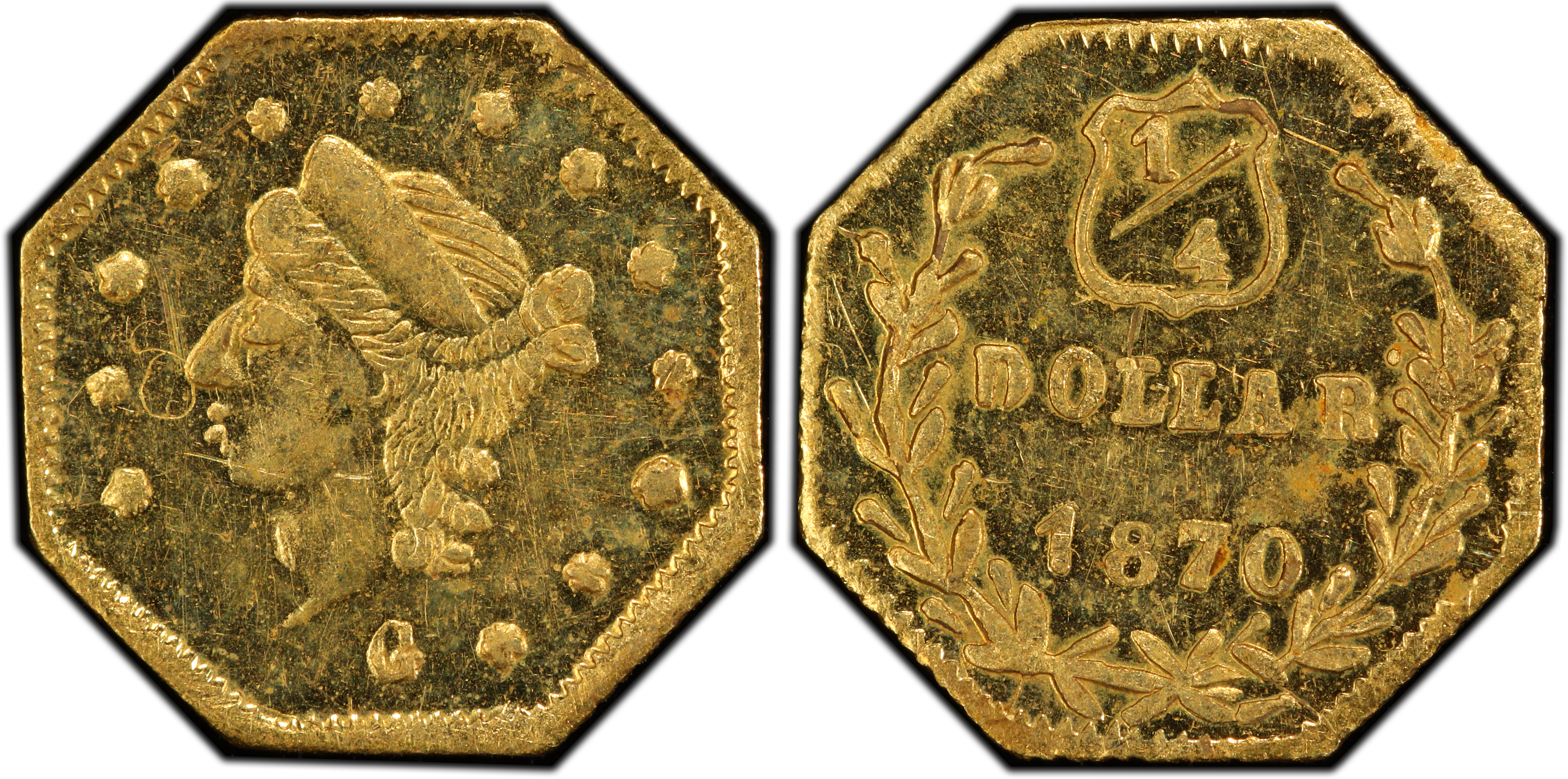
Obverse & Reverse
The 1870 BG-752 25 Cents is a quintessential example of a 'Period Two' California Fractional Gold piece. By 1870, the acute shortage of small denomination coinage that had plagued California in the early 1850s had been resolved by the output of the official San Francisco Mint, which opened in 1854. The impetus for producing these miniature gold pieces had shifted entirely from commerce to novelty. The first period of fractional gold (1852-1857) saw various jewelers and assayers strike tiny coins to address the lack of circulating small change. These 'Period One' issues, while often underweight, were genuinely intended to and did circulate to some extent. By contrast, the 'Period Two' issues, struck from 1858 to 1882, were created almost exclusively as souvenirs and keepsakes. Jewelers in San Francisco, many of French origin, recognized a robust market among tourists, locals, and those sending mementos of the Gold Rush back East. These pieces were mass-produced with a dizzying array of die varieties, often with crude and whimsical artistry, and were sold for a modest premium over their minimal gold content. The BG-752 variety, attributed to the firm of Robert B. Gray & Co., fits perfectly within this context. It was not intended to make change at a saloon but to be placed in a locket or jewelry box. The Coinage Act of 1864 made private coinage illegal, but it was not rigorously enforced against these small souvenir pieces until the early 1880s, allowing their production to flourish throughout this period. The sheer number of dies and the relatively high survival rate of mint state examples attest to their status as collectibles from the very day they were struck.
Associated EventPost-Gold Rush California Economic Growth
Reason For MintingStruck primarily as a souvenir or novelty item for the jewelry trade, not to alleviate a coinage shortage as earlier issues had been.
Minter HistoryRobert B. Gray was a prominent manufacturing jeweler active in San Francisco during the latter half of the 19th century. He is one of the more prolific and well-documented makers of Period Two fractional gold. His firm produced a wide variety of these miniature gold pieces, characterized by specific design elements and die characteristics that numismatists like Walter Breen and Ronald J. Gillio have painstakingly cataloged. Unlike the shadowy figures behind some earlier fractional issues, Gray's operation was a known commercial enterprise catering to the public's fascination with gold and the legacy of the Gold Rush.
Historical SignificanceThe BG-752 represents the commercialization and romanticizing of the Gold Rush. Its existence demonstrates the shift from utilitarian private coinage born of necessity to the creation of nostalgic tokens. As a group, Period Two fractionals are a tangible link to the tourist and jewelry trade of 19th-century San Francisco and are studied for their vast array of die varieties, offering a rich field for numismatic specialists.
Not Applicable
Denomination25 Cents (Quarter Dollar)
Minting Period1870
Assayer/MinterRobert B. Gray & Co.
Geographic OriginSan Francisco, California
Obverse DescriptionLiberty Head facing left, her hair tied in a bun. She is surrounded by 13 stars of varying size and crudeness. The portrait is distinct for this variety, often described as having a 'bulbous throat' or a prominent 'Adam's apple,' a key diagnostic. The engraver's initial 'G' for Gray is located below the truncation of the neck, far from the bust tip.
Obverse InscriptionG
Reverse DescriptionThe reverse features the denomination '25 CENTS' and the date '1870' enclosed within a simple shield. This is the only shield reverse variety known for 1870-dated 25 Cent pieces.
Reverse Inscription25 CENTS 1870
CompositionGold
Stated Fineness Actual FinenessVaries, but typically between .500 and .750 fine. The gold content was substantially less than the face value.
Diameter9.80 mm
EdgePlain
Unknown, but likely several hundred to a few thousand.
Survival Estimate31-75 coins known.
Rarity ScaleR-6 (High R-5 to Low R-6)
This variety is highly collectible due to its distinctive 'Adam's apple' portrait, unique shield reverse for the date, and its status as a product of the well-known jeweler Robert B. Gray. It is a popular type coin within the extensive and challenging California Fractional Gold series.
Key VarietiesThe BG-752 is itself a specific die variety. No major sub-varieties from the period of minting are known. As these were business strikes (albeit for souvenir purposes), no original Proofs were made. Later restrikes or copies of California fractionals exist, but are typically cruder, have incorrect diagnostics, or are unmarked tokens without a denomination to comply with later laws. Collectors should focus on authenticated original period pieces.
Authentication TipsGenuine examples will exhibit a sharp, albeit sometimes uneven, strike from manually operated presses. Key diagnostics are the prominent 'Adam's apple' on Liberty's throat and the specific style of the shield reverse. The surfaces of authentic pieces often have a slightly prooflike or reflective quality, even on circulated examples. Counterfeits are common in this series but often have a soapy, cast-like appearance, incorrect weight, or lack the fine die details. Any piece with a bear on the reverse is a 20th-century token, not a genuine 19th-century coin. Authentication by a major grading service (PCGS or NGC) is highly recommended.
Shopping ConsiderationsA premium quality example for its grade will show a bold strike, particularly on the stars and the details within the shield. Original, lustrous surfaces are highly prized. Look for pieces with reflective or prooflike fields, which are common for this variety and command a premium. Avoid examples that have been cleaned, which will appear hazy or show hairline scratches, diminishing the value significantly. Also, beware of tooling or repairs, especially around the rims, as these tiny coins were often mounted as jewelry and subsequently damaged.
A coin's grade is its condition, rated on a 1-70 scale. For rare coins, this is the most critical factor in determining value, as a tiny difference in preservation can mean a huge difference in price.
Relevant Grade TypesOriginal BG-752 coins were business strikes, intended for sale as souvenirs. They are found in Circulated (1-58) grades, though this is less common as they were not heavily used in commerce, and Mint State (MS, 60-70) grades. No Proof (PR/PF) examples were struck during the original period of issue. Any piece described as a 'Proof' is likely a later-date restrike or fantasy piece and is not considered part of the original series.
Mint State CharacteristicsUncirculated examples of BG-752 often possess bright, prooflike (PL) or deep mirror prooflike (DMPL) surfaces, a hallmark of many Period Two fractionals struck from fresh, polished dies. Luster is typically vibrant and flashy rather than soft. The strike can be uneven due to the manual screw press method used; it is common to see weakness in the stars on one side while the other side is sharp. Small planchet flaws or 'cuds' are not uncommon and are accepted as part of the coin's character. Contact marks, even small ones, can be very distracting on such a tiny canvas and will greatly affect the grade.
Circulated Wear PatternsOn circulated examples, wear first appears on the high points of Liberty's cheek, hair, and the bulbous part of her throat. On the reverse, the highest points of the shield's outline and the numbers in the date will show the first signs of friction and flattening. In lower grades (VF and below), the stars will begin to merge with the fields and the finer lines of the shield will be obliterated.
Key Factors For ValueSurface quality is paramount. A coin with original, undisturbed prooflike surfaces will always be worth more than a hazy or cleaned specimen of the same grade. Strike is also critical; a fully struck example with all 13 stars clearly delineated is highly desirable. Eye appeal, which includes attractive original gold toning (sometimes with reddish or orange hues) and a lack of distracting marks, plays a major role. For this series, a CAC sticker signifies a premium quality piece for the grade and often results in a significantly higher market value.
PCGS Price Guide
| Grade | Price | Population |
|---|---|---|
| 61 | $525.00 | N/A |
| 62 | $600.00 | 1 |
| 62+ | $725.00 | N/A |
| 63 | $950.00 | N/A |
| 63+ | $1,150.00 | N/A |
| 64 | $1,750.00 | N/A |