1880 G50C BG-955 (Regular Strike)
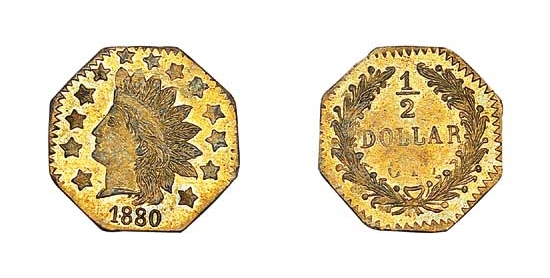
Obverse & Reverse
The 1880 G50C BG-955 is a quintessential example of a 'Period Two' California Fractional Gold piece. By 1880, the urgent commercial need for small denomination coinage that characterized the 1850s Gold Rush had long since been met by the San Francisco Mint, which began full-scale operations in 1854. The initial fractional issues, known as 'Period One' (1852-1857), were struck to alleviate a severe shortage of circulating small change and saw some use in commerce, despite being privately issued and often underweight. However, the pieces struck from 1859 to 1882 fall into a different category. Coined primarily by jewelers in San Francisco, these later issues were not intended to serve as a circulating medium of exchange. Instead, they were created to satisfy a burgeoning tourist and souvenir market. Visitors to California, captivated by the romantic legacy of the Gold Rush, eagerly purchased these miniature gold coins as mementos of their trip. The Coinage Act of 1864 had officially prohibited the private minting of coins, but enforcement was lax in the West until the Secret Service finally cracked down in 1883. This legal gray area allowed numerous jewelers to produce a wide variety of designs, often backdating them or using ambiguous denominational markings to skirt the law. The BG-955, dated 1880, falls squarely into this 'suppressed jewelers' issue' era. Its existence speaks to the continued fascination with gold and the mythos of the '49ers. These pieces were machine-struck, allowing for a higher quality and greater uniformity than the earlier hammered issues, but they were still made with substantially less gold than their face value would imply, functioning more as a token or charm than a coin. Their numismatic significance today lies in their rarity, their connection to the tourist trade of 19th-century San Francisco, and the diverse artistry they display within a uniquely American private coinage tradition.
Associated EventCalifornia Gold Rush Tourist & Souvenir Trade
Reason For MintingPrimarily created for sale as souvenirs and jewelry items for tourists, capitalizing on the romanticism of the Gold Rush.
Minter HistoryThe specific minter for BG-955 is unknown, as is common for many 'Period Two' issues. These coins were typically produced by various San Francisco-based jewelers who catered to the tourist trade. Unlike the earlier Period One minters like Frontier, Deviercy & Co., the makers of these later pieces rarely applied identifiable hallmarks. Their operations were focused on producing attractive, low-cost novelties rather than establishing a reputation as private assayers.
Historical SignificanceThis coin is significant not as a medium of exchange, but as a physical artifact of the post-Gold Rush souvenir industry in California. It represents the commercialization of the Gold Rush legacy and the final chapter of privately issued gold pieces in the United States before federal law was strictly enforced. Its rarity makes it a key variety for specialists collecting the extensive Breen-Gillio series of California Fractional Gold.
BG-955
DenominationG50C
Minting Period1880
Assayer/MinterUnknown Private Minter
Geographic OriginSan Francisco, California
Obverse DescriptionThe obverse features a stylized head of a Native American (Indian Head) facing left, wearing a feathered headdress. The portrait is surrounded by thirteen stars, representing the original colonies. The date '1880' is positioned below the bust truncation.
Obverse Inscription1880
Reverse DescriptionThe reverse design consists of a simple wreath of two branches tied together by a bow at the bottom. Within the wreath, the denomination is expressed on three lines: '1/2', followed by 'CAL.', and a small decorative element or 'dot' below. The overall shape of the coin is octagonal.
Reverse Inscription1/2 CAL.
CompositionGold
Stated Fineness Actual FinenessVariable, but generally a lower fineness than U.S. Mint issues.
EdgePlain
Unknown
Survival Estimate13-20 known examples.
Rarity ScaleR-6 (Very Rare)
The 1880 G50C BG-955 is highly sought after by specialists for its R-6 rarity and attractive Indian Head design on an octagonal planchet. As a 'Period Two' issue, it is a key component for collectors seeking to complete a comprehensive set of the Breen-Gillio varieties. Its high grade in the known population adds to its appeal, as most surviving examples are in Mint State.
Key VarietiesAn important die state has been noted by numismatists: an early die state exists where the 'CAL' on the reverse is bold and fully struck. This is contrasted with later states where 'CAL' can be largely effaced or weak, as seen on the Breen-Gillio plate coin. No later-date Proof restrikes or patterns are known to exist for this specific variety.
Authentication TipsGenuine examples of BG-955 will exhibit sharp, well-defined details consistent with a machine strike, unlike modern cast counterfeits which often have a soft or porous appearance. The lettering and stars should be precise. A key diagnostic is the specific style of the Indian Head portrait and the font used for the reverse inscription, which should be compared against known genuine examples, such as those pictured in major grading service population reports. Be wary of pieces with incorrect weight, diameter, or an unusually yellow, brassy color, which may indicate a gold-plated replica. Unlisted varieties not present in the Breen-Gillio reference should be treated with extreme caution.
Shopping ConsiderationsWhen acquiring an 1880 BG-955, a 'premium quality' example is defined by a sharp strike, particularly on the feathers of the headdress and the details of the wreath. Look for coins with original, undisturbed surfaces and a pleasing luster; many high-grade examples exhibit prooflike or semi-prooflike fields. The ideal piece will possess a rich, honey-gold or peach-gold coloration. Common problems to avoid are signs of having been mounted in jewelry, such as rim damage or solder marks, though this is less common on high-grade survivors. Given the coin's small size, light surface abrasions can be distracting, so seek an example with clean fields and good eye appeal. Third-party certification from PCGS or NGC is virtually essential for establishing authenticity and grade.
A coin's grade is its condition, rated on a 1-70 scale. For rare coins, this is the most critical factor in determining value, as a tiny difference in preservation can mean a huge difference in price.
Relevant Grade TypesOriginal examples of BG-955 were business strikes, but they were not intended for circulation and were sold as souvenirs. Consequently, they are almost exclusively found in Mint State (MS, 60-70) grades. It is highly unusual to encounter a circulated example. No proofs were struck during the original period of issue, and no later-date restrikes are known.
Mint State CharacteristicsIn uncirculated grades, the quality of BG-955 is judged by the sharpness of the strike, the quality of the luster, and the presence of contact marks. The strike can be variable; look for full definition in the headdress feathers and the bow of the wreath. Luster can range from satiny to deeply prooflike and mirrored, with the latter commanding a significant premium. Due to being handled as novelties, even high-grade specimens can show minor contact marks or hairlines, but the cleaner the surfaces, the more desirable the coin.
Circulated Wear PatternsAlthough exceedingly rare in circulated grades, wear would first appear on the highest points of the design. On the obverse, this would be the cheekbone of the Indian and the highest feathers in the headdress. On the reverse, the high points of the wreath's leaves and the bow would show the first traces of friction and flattening of detail.
Key Factors For ValueFor the BG-955, the key value drivers are grade, surface quality, and eye appeal. A high numerical grade (e.g., MS-65 or better) is paramount. The presence of prooflike (PL) or deep prooflike (DPL) surfaces, indicating a strike from highly polished dies, adds a significant premium. Eye appeal is crucial; coins with original, attractive coloration and clean, mark-free surfaces are prized. The early die state with a bold 'CAL' is a subtle but important factor for specialists. A CAC sticker for this issue would confirm premium quality for the grade and add to its value.
PCGS Price Guide
| Grade | Price | Population |
|---|---|---|
| 62 | $550.00 | 7 |
| 62+ | $575.00 | N/A |
| 63 | $750.00 | 5 |
| 63+ | $800.00 | N/A |
| 64 | $1,100.00 | 6 |
| 64+ | $1,200.00 | N/A |
| 65 | $2,000.00 | 2 |
| 65+ | $2,250.00 | N/A |
| 66 | $2,750.00 | 1 |
| 68 | N/A | N/A |