1852 G50C BG-962, PL (Regular Strike)
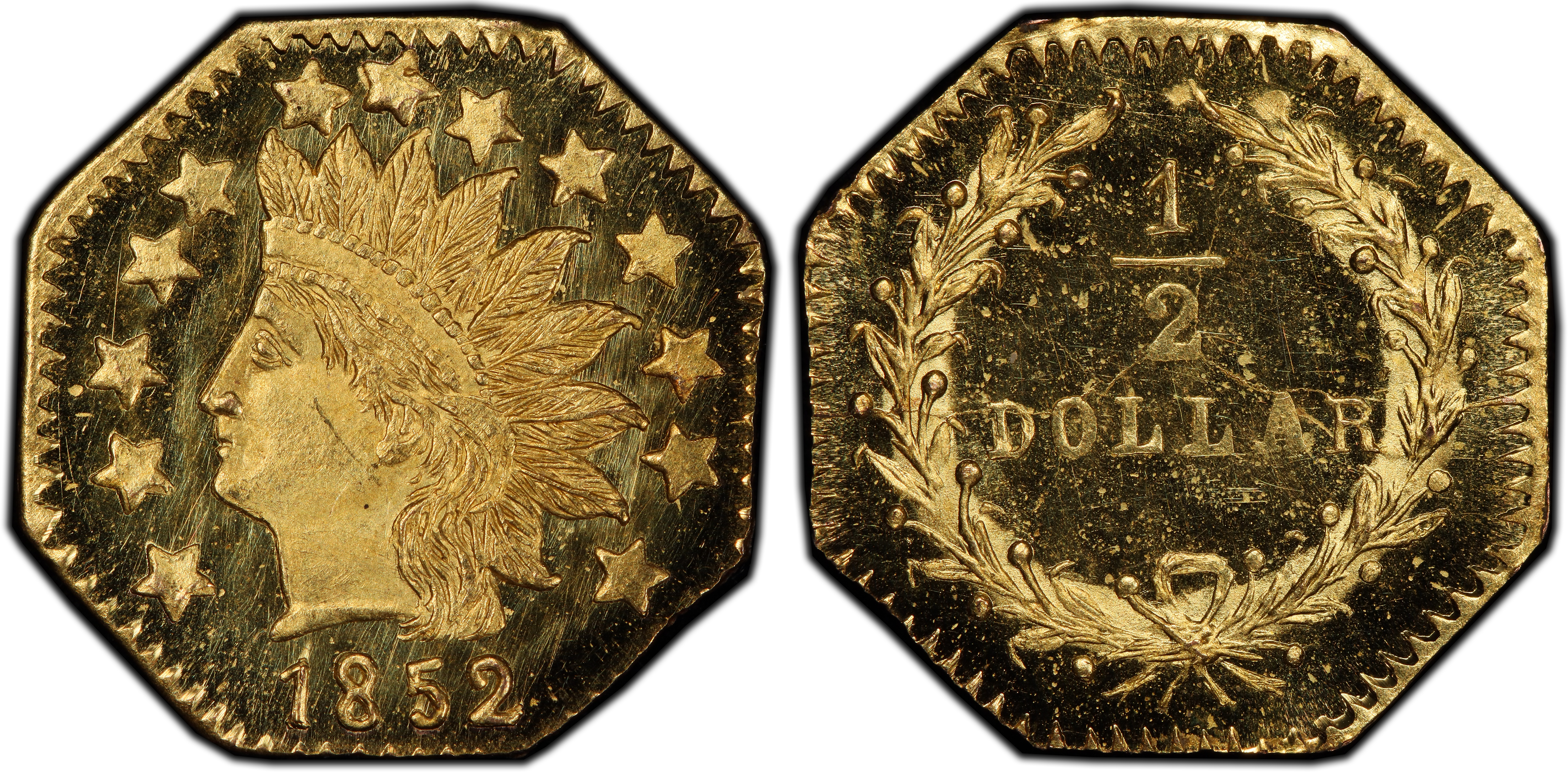
Obverse & Reverse
The BG-962 half dollar is a quintessential artifact of the chaotic and economically vibrant era of the California Gold Rush. Following the discovery of gold at Sutter's Mill in 1848, a massive influx of over 300,000 people descended upon California, creating an instant and overwhelming demand for goods and services. This boom, however, was crippled by a severe shortage of circulating small-denomination coinage. While miners were extracting vast quantities of gold, the smallest official U.S. coin was the silver three-cent piece, and the smallest gold coin was the dollar, both of which were scarce on the West Coast. Daily transactions for a meal, a drink, or basic supplies were often conducted with pinches of gold dust, an inaccurate and contentious system. To fill this critical monetary void, private jewelers and metallurgists in San Francisco began striking their own small-denomination coins in 1852. These pieces, now known as 'California Fractional Gold,' were technically tokens or private issues but were accepted in local commerce out of sheer necessity. The BG-962 belongs to 'Period One' (1852-1857) of this coinage, a time when the pieces were genuinely intended to circulate and more closely resembled federal issues in design, albeit miniaturized. Their production was a crude but effective process, often involving hand-cut dies and manual hammering, leading to significant variations in strike and quality. These tiny coins were notoriously lightweight for their stated value, a fact that was not lost on the public. While tolerated initially, they quickly drew criticism and were eventually supplanted by the arrival of official U.S. coins from the newly established San Francisco Mint in 1854. Despite their short-lived role in commerce, they became popular as souvenirs and curiosities, easily mailed back East as a memento of the gold fever that gripped the nation. The extreme rarity of the BG-962 today, classified as R-7, indicates a very small original mintage, likely only a few dozen pieces, with perhaps only four to twelve examples believed to have survived.
Associated EventCalifornia Gold Rush
Reason For MintingTo alleviate a severe shortage of small-denomination coinage for everyday commercial transactions in Gold Rush-era California.
Minter HistoryAntoine Louis Nouizillet was a French-born jeweler who established a business in San Francisco during the Gold Rush. He was one of the key private minters of 'Period One' California Fractional Gold. Nouizillet's pieces are known for their distinctive style and are often identified by his initials or through die attribution, as is the case with the BG-962. He operated both independently and in partnership with other jewelers like M. Deriberpe (D.N.) and F. Routhier (N.R.). Around 1859, Nouizillet sold his business, including his dies and punches, to another prominent jeweler, Robert B. Gray, who continued to produce fractional gold pieces.
Historical SignificanceThe BG-962 is a tangible link to the private enterprise that created a functional economy from scratch during the California Gold Rush, representing a fascinating chapter in American monetary history before the federal government fully asserted its control over coinage. Its existence underscores the resourcefulness of frontier entrepreneurs in solving immediate economic problems.
BG-962
Denomination50 Cents
Minting Period1852
Assayer/MinterAntoine Louis Nouizillet
Geographic OriginSan Francisco, California
Obverse DescriptionAn octagonal planchet featuring a stylized bust of a Native American (often referred to as an 'Indian Head') facing left. The portrait is typically crudely engraved, surrounded by thirteen stars of varying quality and placement. The date '1852' appears below the bust.
Obverse Inscription1852
Reverse DescriptionThe reverse features the denomination '1/2' at the center, enclosed within a wreath composed of two branches tied together by a bow at the bottom. The legend 'CALIFORNIA GOLD' encircles the wreath along the outer edge.
Reverse InscriptionCALIFORNIA GOLD 1/2
CompositionGold
Stated Fineness Actual FinenessTypically .880 to .900 (using native California gold which had a high silver content)
Weight0.85 grams
Diameter11.50 mm
EdgePlain
Extremely Low (likely less than 100)
Survival Estimate4-12 pieces
Rarity ScaleR-7
This coin is highly coveted for its extreme rarity (R-7), its connection to the earliest period of fractional gold production, and its historic link to the California Gold Rush. As a 'Period One' issue, it is considered a true circulating artifact, not just a souvenir, which adds to its numismatic importance. The octagonal shape and Indian Head design are iconic features of the series.
Key VarietiesThe primary variety is the regular business strike. A 'PL' (Prooflike) designation is given to examples struck from freshly polished dies, resulting in mirrored fields. These are exceptionally rare and represent the earliest strikes from the dies. There are no known official restrikes or patterns for this specific variety.
Authentication TipsGenuine pieces are very thin and often weakly struck, especially at the centers. The gold color is often a lighter yellow due to the natural silver alloy. Be wary of pieces that are thick, have a brassy color, or display a bear on the reverse, as these are common characteristics of later souvenirs and fakes. The engraving on genuine pieces is characteristically crude but sharp in its own way; modern fakes often have a 'mushy' or cast-like appearance. Referencing the die characteristics in the Breen-Gillio reference is essential for positive attribution.
Shopping ConsiderationsA premium quality example for its grade will show a relatively sharp strike for the issue, with clear date and legends. Original, lustrous surfaces are paramount; many surviving examples have been cleaned or used as jewelry. Look for undisturbed 'skin' and avoid pieces with harsh cleaning lines, excessive marks, or evidence of being mounted. For a PL-designated coin, the quality of the mirrored fields is key; deep, clear reflectivity with minimal distracting marks will command a significant premium. Given the rarity, any example, even in a lower circulated grade, is a major acquisition.
A coin's grade is its condition, rated on a 1-70 scale. For rare coins, this is the most critical factor in determining value, as a tiny difference in preservation can mean a huge difference in price.
Relevant Grade TypesOriginal period issues were business strikes intended for circulation, found in Circulated (1-58) and Mint State (MS, 60-70) grades. No true Proofs were struck during the original period. The 'PL' (Prooflike) designation is applied to business strikes that exhibit mirrored surfaces from being among the first coins struck with freshly polished dies; they are not a separate issue but rather a special condition of the business strike.
Mint State CharacteristicsUncirculated examples of BG-962 are exceptionally rare. A key determinant of quality is the strike; many are weakly struck on the high points of the Indian's cheek and the wreath on the reverse. Luster is typically subdued and satiny, though PL examples will have reflective, mirror-like fields. Due to the crude hammering process, even Mint State examples may show minor planchet flaws or adjustment marks, which are often considered part of the coin's character.
Circulated Wear PatternsWear first appears on the high points of the Indian's cheek, hair, and headdress feathers. On the reverse, the highest points of the wreath and the fraction '1/2' will show the first signs of friction. In lower grades (VG and below), the stars on the obverse may become indistinct and the legends will begin to merge with the fields.
Key Factors For ValueExtreme rarity is the primary value driver. Beyond that, surface preservation is critical; a coin with original, uncleaned surfaces will always be worth multiples of a cleaned or damaged example. The sharpness of the strike is highly important for this issue, as well-struck specimens are rare. Eye appeal, encompassing attractive original color and minimal distracting marks, is a major factor. A Prooflike (PL) designation significantly increases value, and a CAC sticker on any certified example provides an additional level of confidence and commands a strong premium.
PCGS Price Guide
| Grade | Price | Population |
|---|---|---|
| 63 | $1,650.00 | N/A |
| 63+ | $1,750.00 | N/A |
| 64 | $2,100.00 | 1 |
| 64+ | $2,500.00 | N/A |
| 65 | $3,500.00 | N/A |
| 65+ | $4,250.00 | N/A |
| 66 | $5,500.00 | 1 |
| 66+ | $6,500.00 | N/A |
| 67 | $8,250.00 | N/A |