1875 G50C BG-948, PL (Regular Strike)
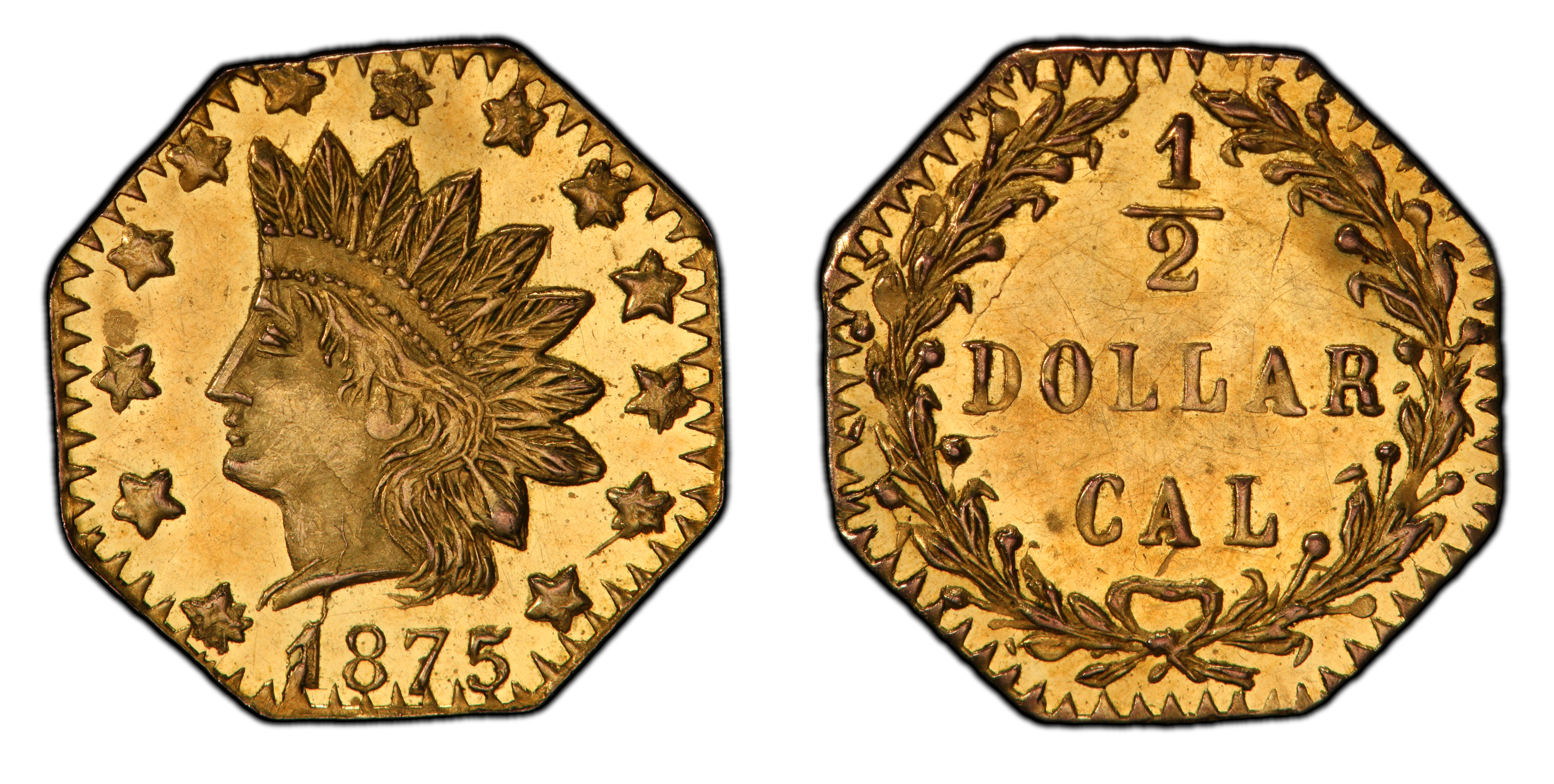
Obverse & Reverse
The 1875 BG-948 50 Cents represents a fascinating and complex chapter in American currency, belonging to the 'Period Two' or 'Jeweler's Issues' of California Fractional Gold. By the mid-1870s, the initial, urgent need for small denomination coinage that arose from the Gold Rush had largely subsided. The San Francisco Mint was in full operation, producing ample federal coinage for commerce. However, the tiny, privately-struck gold pieces, born of necessity in the 1850s, had found a new and enduring purpose as souvenirs, keepsakes, and objects of curiosity. These later issues were produced not to alleviate a coin shortage, but to satisfy a national fascination with the California Gold Rush. Entrepreneurs, often jewelers by trade, continued to strike these miniature gold coins, backdating them to the Gold Rush era to enhance their appeal. The Coinage Act of 1864 had explicitly forbidden the private issuance of currency, but enforcement was lax, particularly for these small tokens which were not a serious threat to circulating federal money. Minter Herman J. Brand is believed to be the producer of this specific variety. His operation, like others of the time, likely used hand-operated presses to strike thin gold planchets. The dies for the BG-948 are noted for their rapid deterioration, a common issue for privately-produced coinage made with less-than-optimal steel and hardening techniques. This rapid die failure is a primary reason for the variety's significant rarity today. These pieces were never intended to be full-weight coins; their value was in their novelty and their material, not their stated denomination. They were sold as mementos to tourists and mailed back East as affordable golden novelties from the storied West, serving as a tangible link to the now-mythologized era of the '49ers.
Associated EventPost-Gold Rush Era / Western Expansion
Reason For MintingPrimarily created to be sold as souvenirs and curios to a public fascinated with the California Gold Rush.
Minter HistoryHerman J. Brand was one of several San Francisco jewelers and businessmen who entered the lucrative market for private gold tokens in the 1870s. While detailed biographical information is scarce, numismatic scholarship attributes several Breen-Gillio varieties to him. His work is characteristic of the 'Period Two' issues, which were typically lighter and more commercial in nature than the earlier 'Period One' necessity coinage. The rapid die failure seen on varieties like BG-948 suggests a small-scale operation, possibly using hand-engraved dies and manual screw presses. These producers operated in a legal gray area until a final crackdown by the Secret Service in the early 1880s ended the production of denominated fractional gold.
Historical SignificanceThe BG-948 is a prime example of a 'suppressed jeweler's issue,' representing the commercialization of the Gold Rush legacy. It is significant not as a coin used in daily commerce, but as a cultural artifact that demonstrates how the allure of gold was packaged and sold to a wider American audience long after the initial rush had ended. Its rarity, tied directly to its production difficulties, makes it a key piece for specialists collecting the later, more enigmatic period of fractional gold.
N/A
Denomination50 Cents
Minting Period1875
Assayer/MinterHerman J. Brand (presumed)
Geographic OriginSan Francisco, California
Obverse DescriptionA right-facing Indian Head, likely stylized after contemporary federal coinage but of a cruder, local engraving style. The portrait is surrounded by thirteen stars representing the original colonies. The date '1875' is below the bust.
Obverse Inscription1875
Reverse DescriptionThe denomination '1/2' is enclosed within a wreath of leaves and berries. The inscription 'CALIFORNIA GOLD' appears outside the wreath, along the upper border of the octagonal planchet.
Reverse InscriptionCALIFORNIA GOLD 1/2
CompositionGold
Stated Fineness Actual FinenessVaries, typically 14 to 22 karats for jeweler's issues.
Weight0.25 grams
Diameter10.00 mm
EdgePlain
Very Low
Survival EstimateFewer than 30
Rarity ScaleR-6 (13-30 known)
This variety is highly sought after by specialists due to its high rarity (R-6), association with the later period of fractional gold production, and the challenge of finding a well-struck example from the rapidly failing dies. The octagonal shape and Indian Head motif add to its classic appeal.
Key VarietiesThe BG-948 is a single, distinct variety. There are no known major variations, patterns, or restrikes from the period of issue. The defining characteristic of the variety is its specific die pairing and the diagnostic evidence of die deterioration, such as cracks and softness of detail, which become more pronounced through the very limited production run. The 'PL' (Prooflike) designation in the user's input refers to individual specimens with reflective surfaces, a common characteristic of fresh die states for this series, not a separate proof striking.
Authentication TipsGenuine examples of BG-948 are characteristically thin and light. The strike is often soft, particularly on the high points of the design, due to the failing dies. Look for a mushiness in the stars and wreath details. Counterfeits are often thicker, have a soapy or cast-like appearance, incorrect weight, and may feature a bear on the reverse, a motif never used on authentic 19th-century fractional gold. Authentication by a major third-party grading service is highly recommended.
Shopping ConsiderationsFor this specific issue, a 'premium quality' example is defined less by absolute grade and more by the strength of the strike. Given the inherent weakness from the dies, a specimen with a sharp central portrait and clear date is highly desirable and commands a significant premium. Look for original, undisturbed surfaces with prooflike or satiny luster. Avoid examples that have been harshly cleaned, which will appear unnaturally bright and show hairlines. Tooling to 'improve' details is a concern on rare varieties like this, so scrutinize the fields around the design elements for unnatural marks. Attractive, subtle reddish-gold toning is also a significant plus for eye appeal.
A coin's grade is its condition, rated on a 1-70 scale. For rare coins, this is the most critical factor in determining value, as a tiny difference in preservation can mean a huge difference in price.
Relevant Grade TypesAll known original examples of BG-948 are business strikes, intended for sale as novelties. They are found in Circulated (1-58) and, more commonly, Mint State (MS, 60-70) grades, as many were saved as souvenirs. The term 'Prooflike' (PL) is a surface descriptor for business strikes with reflective fields, not a separate method of manufacture. No true Proofs were struck in 1875 for this issue.
Mint State CharacteristicsAn uncirculated BG-948 is defined by its luster, which can range from satiny to deeply prooflike. Strike is a major issue; most examples will show some weakness in the stars, date, or wreath, even in high grades. A well-struck specimen is the exception. Due to the softness of the gold and their history as keepsakes, contact marks and hairlines are common, even on high-grade pieces. The quality of the luster and the relative sharpness of the strike are the key differentiators between MS grades.
Circulated Wear PatternsWear first appears on the highest points of the design: the cheek and the details of the headdress on the obverse, and the high points of the wreath leaves on the reverse. On moderately circulated examples, the finer feathers and the digits of the date will begin to lose their sharpness. In lower grades (VF and below), the stars may begin to merge with the fields and the legend CALIFORNIA GOLD will show significant flattening.
Key Factors For ValueFor the 1875 BG-948, value is determined by a hierarchy of factors. Rarity is paramount, as this is an R-6 variety. Second is the strike; a sharply struck example can be worth several times more than a weakly struck piece of the same numerical grade. Third is surface quality; coins with clean, original, prooflike surfaces are prized. Eye appeal, encompassing attractive original toning and a lack of distracting marks, is also crucial. A CAC sticker for this issue would confirm premium quality for the grade and add a significant price premium.
PCGS Price Guide
| Grade | Price | Population |
|---|---|---|
| 64 | $1,100.00 | 2 |
| 66 | N/A | N/A |