1864 G50C BG-917 (Regular Strike)
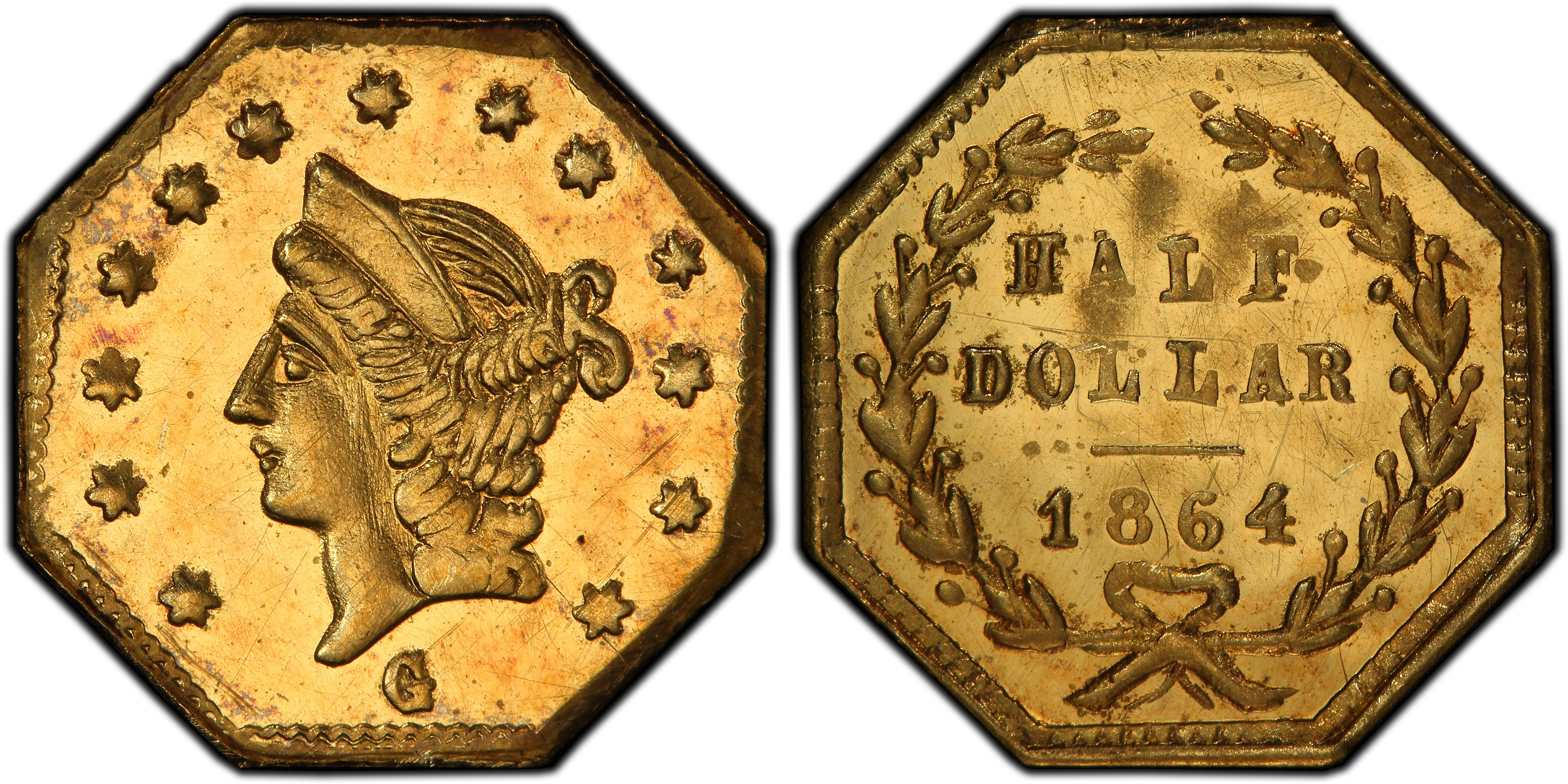
Obverse & Reverse
The 1864 BG-917 50 Cents piece emerges from the second major period of California Fractional Gold production, a fascinating era driven by the lingering economic realities of the Gold Rush. By the mid-1860s, the initial frenzy had subsided, but California's economy remained distinct from the rest of the Union, which was then embroiled in the Civil War. The introduction of fiat 'Greenback' currency in the East was met with deep skepticism in the hard-money economy of the West, where gold was king. Consequently, small-denomination coinage remained chronically scarce. While federal silver coins theoretically circulated, they were often hoarded or shipped east. This created a persistent need for a local medium of exchange for minor transactions. Jewelers and engravers, such as the French immigrant firm of Gaime, Guillemot & Co. in San Francisco, stepped into this void. These artisans, leveraging their skills in metalwork, produced tiny gold coins in 25-cent, 50-cent, and dollar denominations. These were not government-sanctioned coins but privately issued tokens whose value was derived from their intrinsic gold content and public acceptance. The BG-917 variety, with its classic Liberty head design, was a product of this environment, intended to facilitate everyday commerce—paying for a drink, a newspaper, or a loaf of bread. Unlike the earlier, cruder issues of the 1850s, pieces from this period often exhibited higher quality engraving and striking, reflecting a more established and competitive market. However, their small size and the variable quality of the gold used meant they were a constant source of numismatic and legal debate, eventually leading to federal legislation in 1864 that criminalized the private issuance of coinage, though production continued clandestinely for some years.
Associated EventPost-Gold Rush California / American Civil War Era
Reason For MintingA severe shortage of circulating small-denomination coinage in California's hard-money economy created a commercial need for privately issued gold tokens for daily transactions.
Minter HistoryGaime, Guillemot & Co. was a firm of French jewelers and engravers operating in San Francisco during the 1860s and early 1870s. Located at 622 Clay Street, they were among the most prolific and skilled producers of California Fractional Gold. Their work is characterized by fine, detailed engraving, often emulating the style of official U.S. Mint coinage but with their own distinct artistic flair. They produced a wide variety of dies for different denominations, and their issues are a cornerstone of any comprehensive California small-denomination gold collection. The partnership eventually dissolved, but their numismatic legacy persisted through the vast number of attractive and historically significant tokens they introduced into circulation.
Historical SignificanceThe BG-917 and other fractional gold pieces are tangible artifacts of California's unique economic isolation and insistence on a hard-money standard during the Civil War. They represent a solution to a regional economic problem through private enterprise, challenging the federal government's monopoly on coinage and ultimately prompting legislation to end the practice. They are a direct link to the daily commercial life of mid-19th century California.
N/A
Denomination50 Cents
Minting Period1864
Assayer/MinterGaime, Guillemot & Co.
Geographic OriginSan Francisco, California
Obverse DescriptionA beaded border encircles a right-facing portrait of a Capped Liberty Head, similar in style to the contemporary U.S. gold dollar. Thirteen stars surround the portrait, representing the original colonies. The date '1864' is positioned below the bust's truncation.
Obverse Inscription1864
Reverse DescriptionA beaded border encircles a wreath composed of two olive branches tied together at the bottom with a bow. The denomination '50 CENTS' is displayed in two lines within the wreath. Above the denomination, the letter 'G' is present, representing the minter Gaime, Guillemot & Co.
Reverse Inscription50 CENTS G
CompositionGold
Stated Fineness Actual FinenessVaries, but generally between .450 and .750 fine.
Weight0.97 grams
Diameter12.70 mm
EdgePlain
2,000 - 5,000
Survival Estimate200 - 300
Rarity ScaleR-5
The BG-917 is highly popular with collectors due to its attractive, classic design, its identifiable minter's mark ('G'), and its status as a widely available and representative example of Period Two California Fractional Gold. It serves as an excellent entry point into the series while also being a staple in advanced collections.
Key VarietiesThe primary variety is the 'Regular Strike' business issue intended for circulation. No original proof strikings are known. Collectors should be aware of the broader classification of California Fractionals into Period One (anonymous issuers, 1852-1857), Period Two (jeweler-marked issues, 1858-1882, like this piece), and Period Three (souvenir issues made after 1882). The BG-917 is a definitive Period Two piece. There are no major die varieties of BG-917 itself, but collectors often seek examples with different die states or minor striking anomalies.
Authentication TipsGenuine BG-917 coins have a specific 'feel' and luster. The details, especially the fine lines in Liberty's hair and the leaves of the wreath, should be sharp, not mushy or tool-marked as seen on many copies. The 'G' mintmark has a distinct shape and position. Common counterfeits are often brassy in color, overweight or underweight, and may show casting bubbles or seam lines on the edge. Comparing a suspect coin to high-resolution images of certified examples is crucial. Authentication by a major third-party grading service is highly recommended for this series.
Shopping ConsiderationsA premium quality BG-917 will exhibit a sharp, well-centered strike. Look for full definition in Liberty's hair details, the stars, and the wreath leaves. Original, unconserved surfaces are paramount; many examples have been harshly cleaned, polished, or used as jewelry, all of which drastically reduce value. Seek out coins with undisturbed, slightly matte 'skin' and original luster in the protected areas. Attractive, subtle reddish-gold toning is a plus. Avoid pieces with significant rim bumps, scratches, or evidence of tooling or repairs in the fields. A coin with strong eye appeal and originality in a lower grade is often more desirable than a harshly cleaned higher-grade example.
A coin's grade is its condition, rated on a 1-70 scale. For rare coins, this is the most critical factor in determining value, as a tiny difference in preservation can mean a huge difference in price.
Relevant Grade TypesOriginal 1864 BG-917 issues were business strikes made for general circulation. They are found in Circulated grades (AG-3 to AU-58) and Mint State grades (MS-60 to MS-70). No proofs were struck during the original period of issue. Any piece described as a 'Proof' is almost certainly a later-period souvenir restrike or a modern copy and should not be confused with these original, circulating tokens.
Mint State CharacteristicsUncirculated examples of BG-917 typically possess a soft, satiny luster rather than a deeply prooflike or frosty one. The strike is often somewhat soft in the centers, particularly on the highest points of Liberty's hair and the details within the bow on the reverse. Planchet quality can be inconsistent, so it is common to see minor, mint-made adjustment marks or striations, which should not be confused with post-minting damage. Contact marks are common due to the softness of the gold and their use in commerce, with the cheek and central fields being the most susceptible areas.
Circulated Wear PatternsWear first appears on the highest points of the design. On the obverse, check the hair strands above Liberty's eye and ear, her cheekbone, and the tips of the stars. On the reverse, the highest points of the wreath leaves and the knot of the bow will show the first signs of friction and flattening. In lower grades (VG and below), the date and the word 'CENTS' will become weak and may merge with the fields.
Key Factors For ValueFor the BG-917, the primary value driver is surface preservation. An example with original, uncleaned surfaces and some remaining luster will command a significant premium over a cleaned or polished coin of the same technical grade. Secondly, the sharpness of the strike is key; a well-struck piece with full details is always more desirable. Finally, eye appeal, which encompasses toning, luster, and the absence of distracting marks, plays a major role. A CAC sticker for this issue indicates superior quality for the grade and will result in a substantial price premium, as it confirms the coin's originality and strong visual appeal.
PCGS Price Guide
| Grade | Price | Population |
|---|---|---|
| 45 | $190.00 | 2 |
| 45+ | $195.00 | N/A |
| 50 | $200.00 | 3 |
| 50+ | $215.00 | N/A |
| 53 | $230.00 | 5 |
| 53+ | $235.00 | N/A |
| 55 | $250.00 | 17 |
| 55+ | $275.00 | N/A |
| 58 | $315.00 | 18 |
| 58+ | $340.00 | N/A |
| 60 | $375.00 | 2 |
| 61 | $400.00 | 8 |
| 62 | $450.00 | 24 |
| 62+ | $575.00 | N/A |
| 63 | $900.00 | 9 |
| 63+ | $1,075.00 | N/A |
| 64 | $1,250.00 | N/A |
| 64+ | $1,650.00 | N/A |
| 65 | $3,750.00 | 1 |