1870 G25C BG-758, DMPL (Regular Strike)
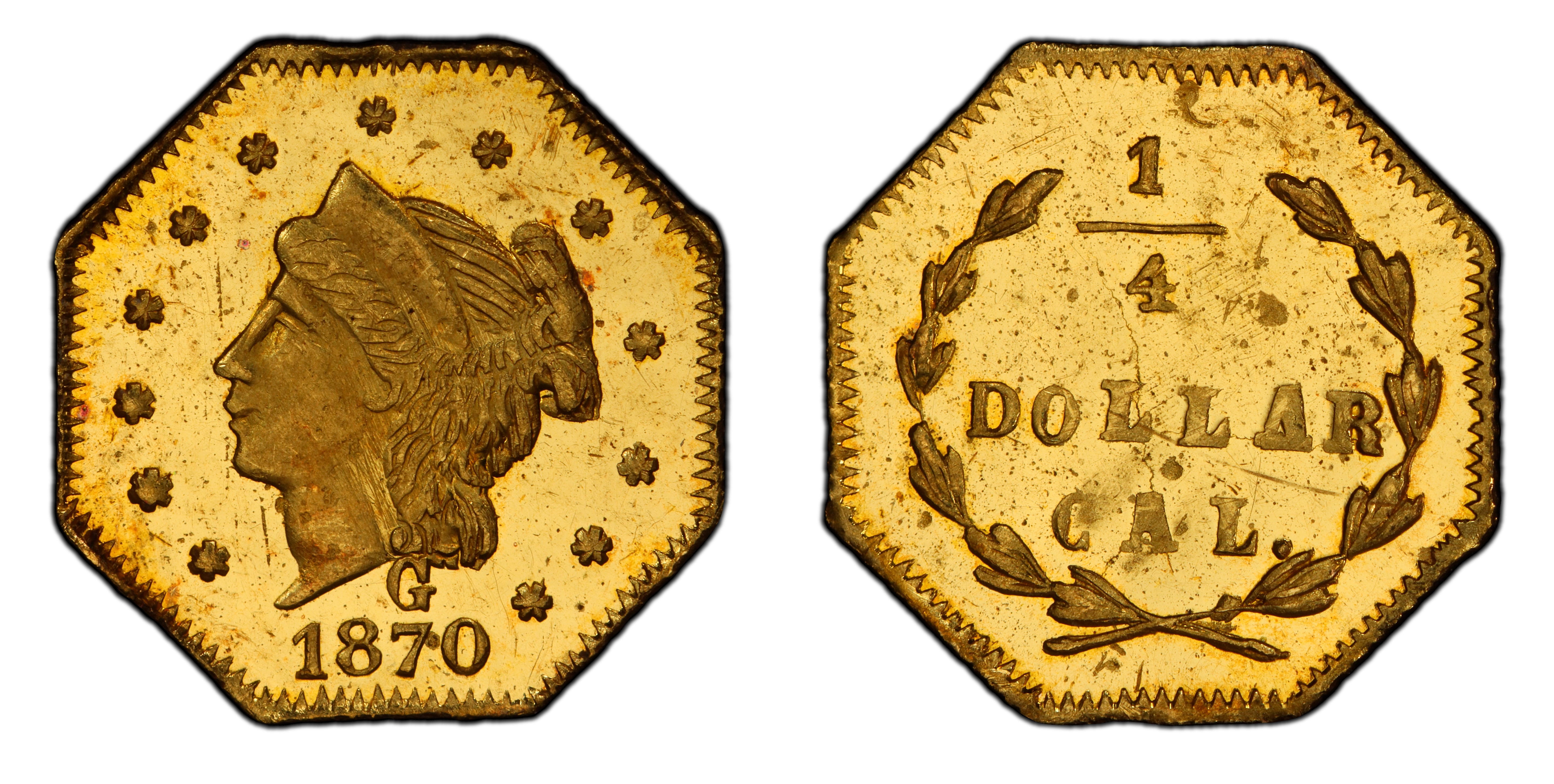
Obverse & Reverse
The 1870 BG-758 25 Cents represents a fascinating chapter in American economic history, born from the unique conditions of post-Gold Rush California. By 1870, the initial, desperate need for any form of circulating coinage that spurred the first period of fractional gold (1852-1857) had largely subsided. The establishment and robust production of the San Francisco Mint had filled the territory with official U.S. silver and gold coins. However, a new market had emerged for the diminutive gold pieces: souvenirs and curiosities. Entrepreneurs, primarily jewelers in San Francisco, recognized the allure that these tiny gold coins held for tourists, travelers, and those back East who were captivated by the romance of the California Gold Rush. These 'Period Two' issues, including the BG-758, were not intended to serve as critical currency but as keepsakes and novelty items. This shift in purpose is reflected in their composition; they were often struck from gold of a lower fineness than their Period One predecessors and contained a bullion value significantly below their face value. The manufacturing process was rudimentary, often employing the 'hammer method,' where dies were struck by hand, leading to significant variations in strike quality. The BG-758 is a product of this environment, a so-called 'jeweler's issue' struck by an anonymous craftsman. Its dies, however, connect it to a larger body of work; its obverse die was also used to strike the BG-757 and BG-759 varieties, indicating a single, organized source for these related issues. The extreme rarity of the BG-758 today suggests its original mintage was minuscule, perhaps only a test striking or a very limited run before the reverse die was retired. Its deeply prooflike (DMPL) surfaces indicate it was struck using highly polished dies, a deliberate technique to enhance its visual appeal for the souvenir market. As private coinage, its existence was legally tenuous after the Coinage Act of 1864, but enforcement was lax until the early 1880s, allowing these fascinating pieces to be produced. Today, the BG-758 is a celebrated rarity, a tangible link to the commercial ingenuity of California's jewelers and the enduring mystique of the Gold Rush era.
Associated EventCalifornia Gold Rush Aftermath
Reason For MintingPrimarily created as a novelty souvenir for the burgeoning tourist trade in California, rather than to alleviate a currency shortage.
Minter HistoryThe specific minter of the BG-758 variety is unknown, which is characteristic of the 'Period Two' or 'jeweler's issues' of California Fractional Gold. These pieces were produced by various jewelers and private entrepreneurs in San Francisco who saw a commercial opportunity in creating gold souvenirs. Unlike the earlier assayers who prominently marked their work, these later producers often remained anonymous. The shared obverse die with BG-757 and BG-759 indicates a common, albeit unidentified, origin for this small family of coins.
Historical SignificanceThe BG-758 is a prime example of a 'Period Two' California Fractional Gold coin, significant for what it represents about the evolution of private coinage in the West. Its primary role as a souvenir rather than a circulating coin illustrates the economic maturation of California and the commercialization of the Gold Rush legend itself. Its high rarity and specialized manufacture with polished dies highlight the numismatic sophistication of some private minters catering to a collector and tourist market.
N/A
Denomination25 Cents
Minting Period1870
Assayer/MinterUnknown Private Minter
Geographic OriginSan Francisco, California
Obverse DescriptionA Liberty Head, facing left, with LIBERTY inscribed on her coronet. The head is surrounded by thirteen six-pointed stars, representing the original colonies. The date, 1870, is positioned below the bust.
Obverse InscriptionLIBERTY, 1870
Reverse DescriptionThe denomination '1/4 DOLLAR' is inscribed within a wreath of two olive branches. The wreath is open at the top. A key diagnostic for the BG-758 reverse die is the placement of 'CAL.' below the denomination and a horizontal fraction bar. This specific reverse die was used only for the BG-758 variety.
Reverse Inscription1/4 DOLLAR CAL.
CompositionGold
Stated Fineness Actual FinenessVariable, typical for Period Two issues to be of lower fineness (e.g., 14-20 karats), significantly less than the .900 fineness of federal gold.
EdgePlain
Extremely low; likely fewer than 20 pieces.
Survival EstimateFewer than 10 known. As of April 2018, PCGS had certified only five examples in all grades, with none graded by NGC. This is a premier rarity.
Rarity ScaleR-8 (Very Rare)
The BG-758 is a collector's prize of the highest order due to its extreme rarity (R-8), attractive octagonal shape, and the desirable DMPL designation. The combination of a unique reverse die, a minuscule survival rate, and strong visual appeal makes it a target for advanced specialists in the California Fractional Gold series.
Key VarietiesThe primary variety is the BG-758 as described. There are no known major variations from the original minting period. Its obverse die is shared with the very scarce BG-757 and the more common BG-759, creating an interesting collecting opportunity for die-state specialists. No later-date restrikes or patterns are known to exist for this specific variety.
Authentication TipsAuthentication requires expert examination. Key diagnostics include the specific die characteristics of the BG-758: a unique reverse die with a horizontal fraction bar and 'CAL.' below 'DOLLAR.' A crucial identifying feature mentioned in auction records is a 'distinguishing arc that appears to be some sort of striking imperfection' on the reverse. The strike is often sharp on the Liberty portrait but may show weakness elsewhere. All uncertified examples should be viewed with extreme suspicion, as the field is rife with counterfeits and replicas, which often lack the correct die markers, have a soapy or incorrect luster, and may feature a bear motif, which is not found on genuine period issues.
Shopping ConsiderationsAcquiring a BG-758 is a once-in-a-lifetime opportunity for most collectors. A premium quality example would be one of the few certified Mint State coins. Given the DMPL designation, look for deeply mirrored fields and frosted devices, which create a strong cameo contrast. Even high-grade examples are noted as being 'a bit weakly struck,' so some softness in peripheral areas is expected and not necessarily a detriment. Focus on coins with clean, flashy surfaces free of distracting hairlines or marks, as these are magnified by the mirrored fields. The unique striking arc on the reverse should be present and can serve as a pedigree marker. Given the rarity, any certified example is significant, but the finest known (e.g., MS64) would command an immense premium.
A coin's grade is its condition, rated on a 1-70 scale. For rare coins, this is the most critical factor in determining value, as a tiny difference in preservation can mean a huge difference in price.
Relevant Grade TypesOriginal examples of BG-758 were business strikes, though produced with a special finish for sale to collectors and tourists. They are found in Circulated (AU and lower, though exceedingly rare) and Mint State (MS, 60-70) grades. The DMPL (Deep Mirror Prooflike) designation is not a grade but a descriptor of the surface finish, indicating it was struck with highly polished dies, and it adds significant value. No true Proofs were struck in 1870, and there are no known later-date collector restrikes of this variety.
Mint State CharacteristicsA Mint State BG-758 is defined by its pristine, reflective surfaces. The quality is determined by the depth and clarity of the mirrors in the fields and the frost on the devices. The strike can be uneven; the central portrait of Liberty is often sharp, but weakness may be present on the stars or wreath. As these are tiny, soft gold coins, even a high-grade specimen may have minuscule handling marks or planchet imperfections. A premium MS example will have overwhelming eye appeal stemming from the dramatic cameo contrast.
Circulated Wear PatternsOn this octagonal Liberty Head design, wear first appears on the highest points: the hair over Liberty's ear and eye, her cheekbone, and the coronet. On the reverse, the highest points of the wreath's leaves and the numbers in the fraction would show the first traces of friction. In lower grades (which are virtually unknown for this variety), the legend and stars would begin to lose their sharpness.
Key Factors For ValueFor the BG-758, value is driven by three main factors: 1) Absolute Rarity: With only a handful of examples known, any appearance on the market is a major event. 2) Grade: The difference between an AU58 and an MS64 is monumental in value. 3) Surface Quality & Eye Appeal: The quality of the DMPL finish is paramount. A coin with deep, clear mirrors and thick, frosty devices will command a significant premium over a piece with hazy or hairlined surfaces. Certification by PCGS or NGC is non-negotiable, and a CAC sticker on one of the few known examples would denote premium quality for the grade and add substantially to its value.
PCGS Price Guide
| Grade | Price | Population |
|---|---|---|
| 65 | $23,500.00 | 1 |