1874/3 G50C BG-945 (Regular Strike)
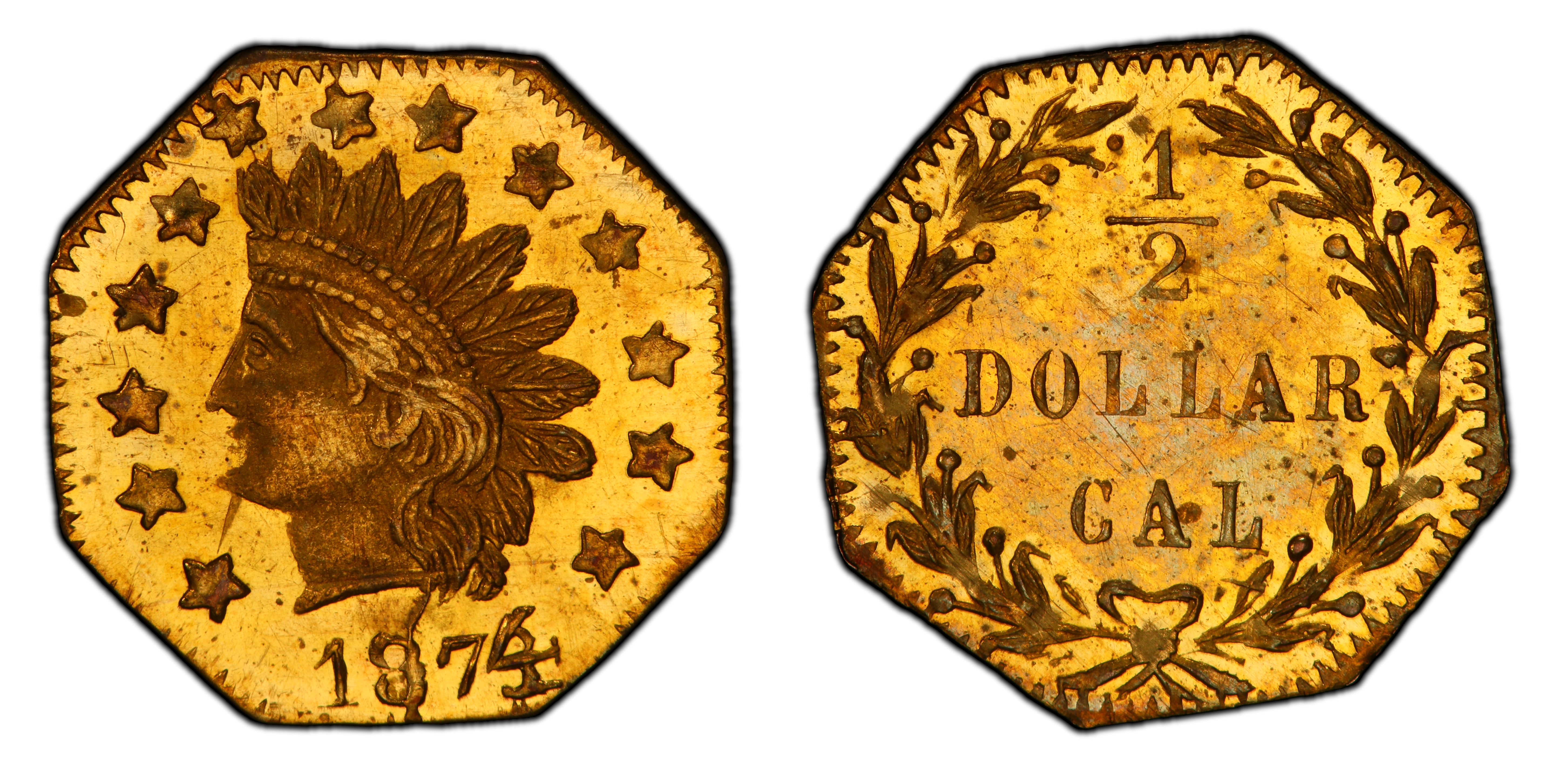
Obverse & Reverse
The 1874/3 50 Cents, cataloged as Breen-Gillio 945, is a quintessential example of 'Period Two' California Fractional Gold. By the 1870s, the initial, desperate need for small denomination circulating currency that characterized the Gold Rush's first decade had largely subsided. The establishment and robust production of the San Francisco Mint, which opened in 1854, had supplied the region with ample federal coinage. Consequently, the private production of fractional gold shifted from a necessity to a novelty. These later pieces, often termed 'jeweler's issues,' were primarily created by San Francisco's manufacturing jewelers as souvenirs, keepsakes for tourists, and items of adornment. Unlike the earlier 'Period One' issues which were intended to circulate and contained gold value somewhat commensurate with their face value, Period Two pieces were notoriously underweight and often of a lower gold fineness. The minters, whose identities are now mostly lost to history, operated in a legal gray area. The Coinage Act of 1864 had prohibited private coinage, but enforcement was lax until the early 1880s. To circumvent the law, minters often used backdating, with pre-1864 dates, or omitted the word 'DOLLAR.' The BG-945, with its 1874 date, was struck during this period of waning enforcement and likely catered to a public fascinated with the fading romance of the Gold Rush. The use of an Indian Head motif was a popular design choice of the era, evoking a uniquely American, frontier aesthetic. The clear 1874/3 overdate is a fascinating production artifact, indicating the re-punching of a die from the previous year, a common practice among private minters to conserve resources.
Associated EventPost-Gold Rush Era California Commerce
Reason For MintingPrimarily struck as a souvenir or keepsake for the tourist trade rather than for general circulation.
Minter HistoryThe specific minter for BG-945 is unknown. Most Period Two fractionals were produced anonymously by various manufacturing jewelers in San Francisco who took advantage of the lingering demand for Gold Rush memorabilia and lax enforcement of private coinage laws. These craftsmen were skilled metalworkers but were not official assayers, and their products were commercial novelties rather than official currency.
Historical SignificanceThis coin represents the transition of California Fractional Gold from utilitarian currency of necessity to commercial souvenir items. It is a tangible link to the robust tourist trade of 1870s San Francisco and illustrates a common minting practice of the time—the use of overdated dies. Its existence highlights the legal ambiguities surrounding private minting in the post-Civil War era.
N/A
Denomination50 Cents
Minting Period1874
Assayer/MinterUnknown
Geographic OriginSan Francisco, California
Obverse DescriptionAn Indian Head motif facing left, wearing a feathered headdress. The portrait is encircled by thirteen stars.
Obverse InscriptionNo inscription.
Reverse DescriptionThe denomination '1/2' is enclosed within a wreath of leaves. The date is positioned below the wreath, and the inscription 'CALIFORNIA GOLD' appears along the upper periphery outside the wreath.
Reverse InscriptionCALIFORNIA GOLD 1/2 1874
CompositionGold
Stated Fineness Actual FinenessVariable, often low fineness (typically 10-14k, or around .417 to .585 fine), which was characteristic of Period Two jeweler's issues.
Weight0.25 grams
Diameter10.00 mm
EdgePlain
Unknown
Survival Estimate76-100 known
Rarity ScaleHigh R-4
The 1874/3 BG-945 is popular among collectors for its distinct octagonal shape, classic Indian Head design, and clear overdate feature. As a Period Two issue, it is more affordable than many of the earlier circulating types, making it an accessible entry point into the fascinating world of California Fractional Gold. The clear diagnostic of the overdate adds significant numismatic interest.
Key VarietiesThe primary variety is the 1874/3 overdate itself. No major sub-varieties from the original minting period are widely recognized. No special collector issues, patterns, or restrikes are known to exist for this specific Breen-Gillio number.
Authentication TipsGenuine examples are very thin and struck in gold, though often of low fineness. Look for a sharp, albeit sometimes uneven, strike quality characteristic of hand-operated presses. The '4' over '3' overdate should be clear under magnification, with remnants of the '3' visible, particularly around the top and lower curves of the '4'. Counterfeits are common; many are thicker, have a soapy or cast-like appearance, incorrect weight, or are made of brass. Be wary of pieces with a bear on the reverse, as this is a common motif on modern replicas, not genuine 19th-century issues.
Shopping ConsiderationsA premium quality example for its grade will exhibit a bold strike, especially on the feathers of the headdress and the details of the wreath. Seek out coins with minimal distracting marks and original, lustrous surfaces. The color of the gold can vary due to the alloy, but pieces with a pleasing, uniform reddish-gold or yellow-gold hue are most desirable. The clarity of the overdate is a key value driver; a bold and easily discernible 4/3 commands a premium. Avoid examples that have been harshly cleaned, polished, or show evidence of being mounted in jewelry, such as solder marks or excessive rim damage.
A coin's grade is its condition, rated on a 1-70 scale. For rare coins, this is the most critical factor in determining value, as a tiny difference in preservation can mean a huge difference in price.
Relevant Grade TypesOriginal issues of BG-945 were business strikes, although likely intended as souvenirs rather than for hard circulation. They are found in Circulated (1-58) and, more commonly, Mint State (MS, 60-70) grades due to their nature as keepsakes. No original Proofs were struck. While some Period Two issues are described as 'Prooflike' (PL) due to polished dies, these are a characteristic of the business strike manufacturing process and are not true Proof coins.
Mint State CharacteristicsUncirculated examples often feature a semi-prooflike or satiny luster, a result of the dies being polished by the jewelers who made them. The strike can be inconsistent; a fully struck piece with all feathers and wreath details sharp is rare and desirable. Small planchet flaws or adjustment marks are not uncommon and should be evaluated based on their severity and impact on eye appeal. Contact marks, even on high-grade examples, are common due to the softness of the low-karat gold.
Circulated Wear PatternsOn circulated specimens, wear first appears on the high points of the design. For the obverse, this is the cheek and the feathers of the headdress. On the reverse, the highest points of the wreath leaves and the fraction '1/2' will show the first signs of friction and metal loss. In lower grades (VF and below), the stars on the obverse and the letters in the legends will begin to weaken.
Key Factors For ValueThe primary value drivers for this coin are grade and surface quality. An example with original, uncleaned surfaces and strong luster will always command a premium. The strength and clarity of the 1874/3 overdate are critical; a bold overdate is worth significantly more than a weak one. Eye appeal is paramount—a coin with a sharp strike and attractive, original color will be prized. For certified coins, a CAC sticker indicates premium quality for the grade and often results in a higher market value.
PCGS Price Guide
| Grade | Price | Population |
|---|---|---|
| 55 | $300.00 | 5 |
| 55+ | $310.00 | N/A |
| 58 | $325.00 | 6 |
| 58+ | $335.00 | N/A |
| 60 | $350.00 | 1 |
| 61 | $400.00 | 6 |
| 62 | $450.00 | 15 |
| 62+ | $465.00 | N/A |
| 63 | $525.00 | 17 |
| 63+ | $575.00 | N/A |
| 64 | $675.00 | 13 |
| 64+ | $850.00 | 1 |
| 65 | $1,450.00 | 2 |
| 65+ | $1,600.00 | N/A |
| 66 | $1,750.00 | N/A |