1869 G50C BG-907 (Regular Strike)
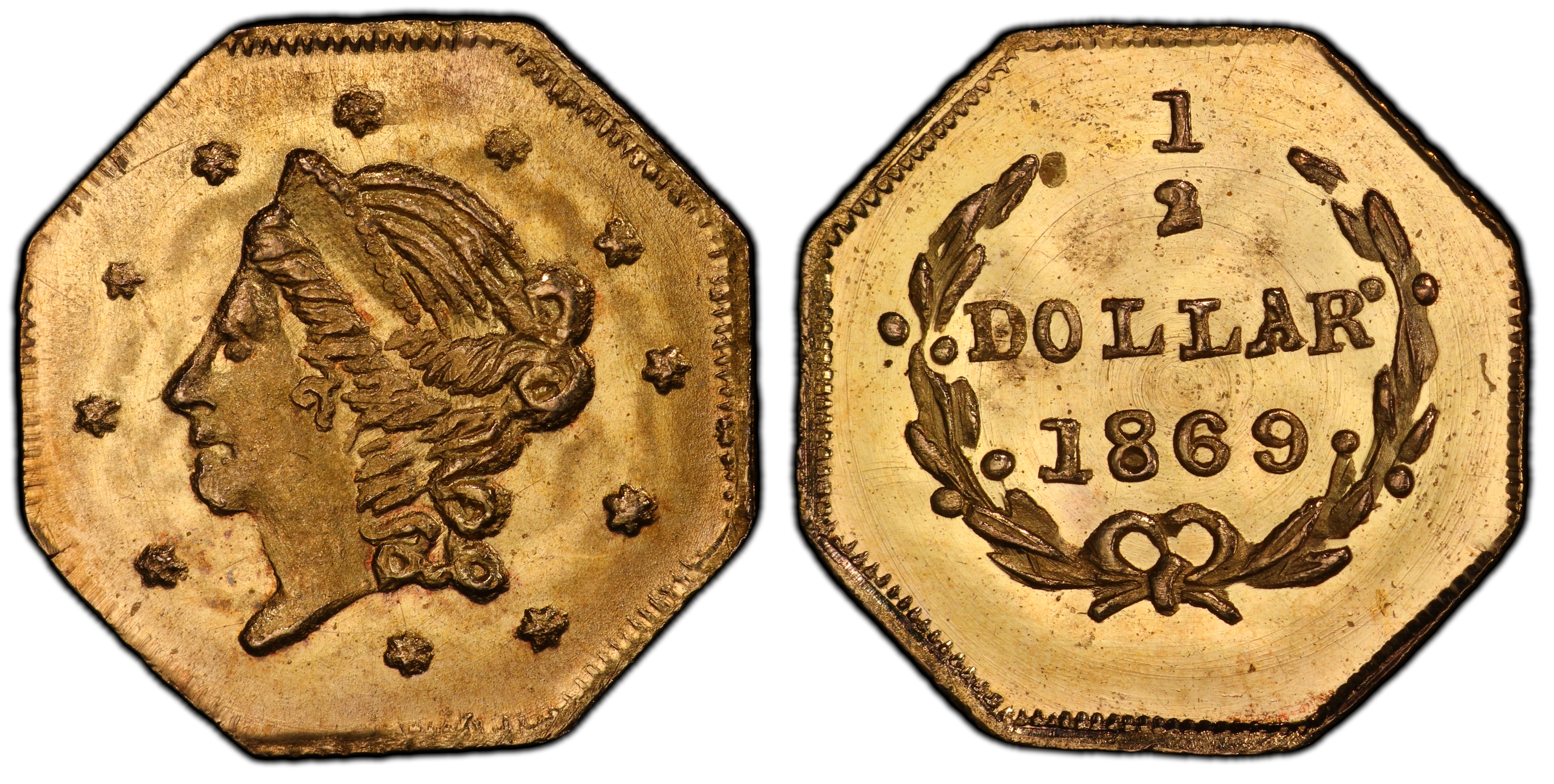
Obverse & Reverse
The 1869 G50C BG-907 is a quintessential example of 'Period Two' California Fractional Gold. By the late 1860s, the initial, desperate need for small denomination coinage that characterized the Gold Rush's peak in the early 1850s had largely subsided. The establishment of the San Francisco Mint in 1854 had supplied the region with ample federal coinage for daily transactions. Consequently, the private production of fractional gold transitioned from a vital economic necessity to a robust market for souvenirs and keepsakes. San Francisco jewelers, leveraging their skills in working with precious metals, became the primary manufacturers of these small, attractive gold tokens. These pieces were eagerly purchased by tourists, visiting businessmen, and locals alike, who often sent them back East in letters as a tangible piece of the romanticized California Gold Rush. The Coinage Act of 1864 had officially prohibited the private issuance of coinage, but enforcement on the West Coast was lax. It wasn't until a more public enforcement action in 1871 and a Secret Service visit in 1883 that the practice of denominating these 'coins' was effectively curtailed. Thus, the 1869 BG-907 existed in a gray area of legality, produced openly by jewelers like Frontier & Co. not for circulation, but as commercial novelties. Their intrinsic value was substantially less than their face value, classifying them numismatically as tokens rather than true coins. Despite this, their direct connection to the Gold Rush narrative, the skill of their manufacture, and their delicate beauty have made them a highly popular and historically significant collecting field.
Associated EventPost-Gold Rush California Economy
Reason For MintingPrimarily produced as souvenirs and novelty items for the tourist trade, not for general circulation.
Minter HistoryFrontier & Co. was a San Francisco-based jewelry firm active during the mid-to-late 19th century. The partnership evolved from an earlier firm involving Pierre Frontier and Eugene Deviercy (F.D.). By 1864, the firm was known as Frontier & Co. and was a notable producer of 'jeweler's issues' of California Fractional Gold. Like their contemporaries, they used skilled die work and common design punches to create a variety of these popular gold souvenirs. Their products are characteristic of the 'Period Two' issues, which were generally lighter and more diverse in design than the earlier, circulating 'Period One' pieces.
Historical SignificanceThe BG-907 represents the maturation of the California Fractional Gold series from utilitarian coinage into a commercial souvenir industry. It serves as a tangible artifact of California's burgeoning tourism and the romantic mythology that had already grown around the Gold Rush, just two decades after its start. Its existence also highlights a period of lax federal oversight regarding private minting.
N/A
DenominationG50C
Minting Period1869
Assayer/MinterFrontier & Co.
Geographic OriginSan Francisco, California
Obverse DescriptionA classic Liberty Head motif, facing left, with hair tied in the back. The portrait is encircled by 13 six-pointed stars, representing the original colonies. The date '1869' is positioned below the bust.
Obverse Inscription1869
Reverse DescriptionThe denomination '1/2' is central, enclosed within a delicate wreath of leaves and berries. The inscription 'CALIFORNIA GOLD' follows the upper curve of the wreath, separated by the top of the wreath's bow.
Reverse Inscription1/2 CALIFORNIA GOLD
CompositionGold
Stated Fineness Actual FinenessTypically lower than federal standards, varying from 14 to 22 karats.
EdgePlain
Unknown
Survival EstimateFewer than 75 known
Rarity ScaleR-5 (Low R-5)
This variety is highly sought after by specialists for its definite attribution to Frontier & Co. and its status as a scarce R-5 issue. As one of only two octagonal half-dollar varieties dated 1869 in the Breen-Gillio series, its appeal is magnified. High-grade examples are particularly prized for their sharp strikes and excellent visual aesthetics.
Key VarietiesNo major varieties are noted for the BG-907 die marriage during its period of issue. Unlike federal coinage, there are no known proof strikings, patterns, or official restrikes. All genuine examples are considered business strikes, though they were produced for souvenir purposes.
Authentication TipsAuthenticity is paramount in this series. Genuine BG-907 examples often exhibit diagnostic die characteristics, including faint die lines on Liberty's chin and at the back of her head. The strike can be uneven, a result of the hammer-striking process used by private jewelers. The style of the numerals and letters should be compared against known genuine examples, as modern counterfeits and replicas are extremely common. Many fakes are gold-plated base metal and may feature incorrect design details, such as a bear on the reverse, which is not present on genuine denominated issues.
Shopping ConsiderationsA premium quality example of BG-907 is defined by a sharp, well-centered strike, which is not always the case for this issue. Look for full definition in the strands of Liberty's hair and the individual leaves of the reverse wreath. Original, undisturbed surfaces with a 'frosty' or 'caramel-gold' luster command significant premiums. Avoid examples that have been cleaned, polished, or previously mounted in jewelry, as evidenced by rim damage or solder marks. Planchet quality can vary; some examples are known on slightly uneven or flaky planchets, which is a manufacturing characteristic and not necessarily a post-strike flaw.
A coin's grade is its condition, rated on a 1-70 scale. For rare coins, this is the most critical factor in determining value, as a tiny difference in preservation can mean a huge difference in price.
Relevant Grade TypesAll original examples of BG-907 were produced as business strikes, primarily for souvenir sales rather than circulation. They are found in both Circulated (1-58) and Mint State (MS, 60-70) grades. Despite their souvenir nature, some pieces did experience handling and wear. No Proof (PR/PF) examples were struck during the original minting period, and there are no known later-date Proof restrikes.
Mint State CharacteristicsUncirculated examples are characterized by their mint luster, which is often frosty and sometimes described as having a rich caramel or coppery-gold hue. The strike is a key determinant of quality; top-tier examples will have sharp details on Liberty's hair curls and the wreath leaves. Due to the manual striking process, some weakness, particularly on the highest points or near the edges, is common and should be assessed on a case-by-case basis. Contact marks, even small ones, can be distracting on such a tiny coin and will impact the grade.
Circulated Wear PatternsWear first appears on the highest points of the design. On the obverse, look for flattening on the hair above Liberty's eye and ear, and on her cheekbone. On the reverse, the high points of the wreath's leaves and the bow at the bottom will show the first signs of friction and loss of detail. In lower grades (VF and below), the stars and peripheral lettering will begin to merge with the fields.
Key Factors For ValueFor the BG-907, value is driven by three main factors: grade, surface quality, and eye appeal. A high numerical grade (e.g., MS-65 vs. MS-63) creates a substantial price difference. Surface quality is crucial; an example with original, uncleaned surfaces and minimal distracting marks will always be preferred. Finally, eye appeal—a subjective but critical factor—is determined by the combination of strike sharpness and attractive, original toning. A CAC sticker for this issue indicates premium quality for the grade and will typically result in a higher market value.
PCGS Price Guide
| Grade | Price | Population |
|---|---|---|
| 58 | $265.00 | 2 |
| 58+ | $280.00 | N/A |
| 60 | $300.00 | N/A |
| 61 | $325.00 | N/A |
| 62 | $360.00 | 6 |
| 62+ | $380.00 | N/A |
| 63 | $450.00 | 7 |
| 63+ | $475.00 | N/A |
| 64 | $575.00 | 13 |
| 64+ | $625.00 | N/A |
| 65 | $900.00 | 12 |
| 65+ | $1,000.00 | N/A |
| 66 | $1,375.00 | 9 |
| 66+ | $1,750.00 | 1 |
| 67 | $2,500.00 | 2 |