1872/1 G50C BG-937, DMPL (Regular Strike)
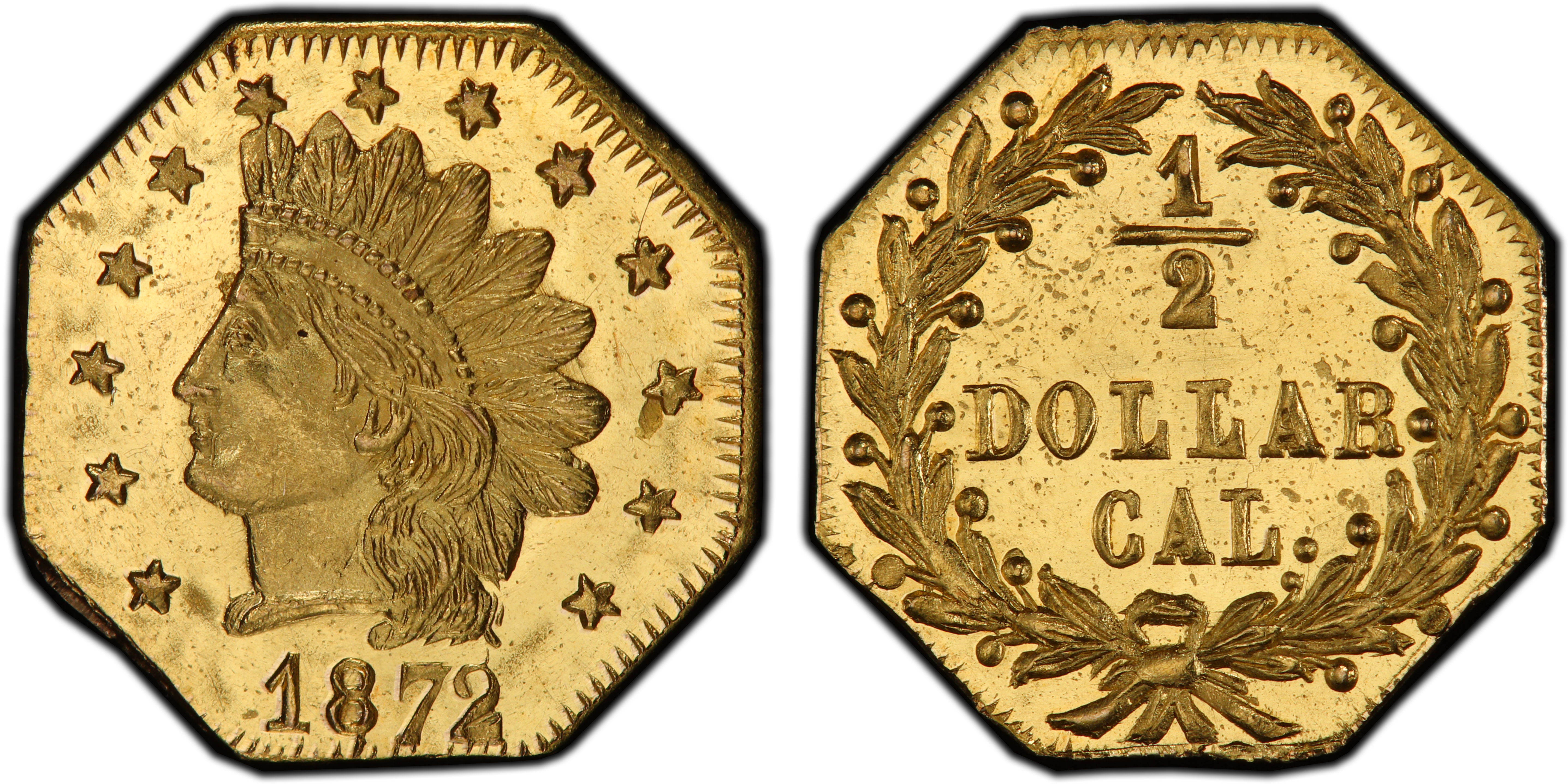
Obverse & Reverse
The 1872/1 BG-937 50 Cent piece emerges from the second great era of California Fractional Gold production, often termed 'Period Two' (1859-1882). Unlike their 'Period One' predecessors which were struck to alleviate a genuine shortage of small change during the initial Gold Rush frenzy, these later issues served a different purpose. By the 1870s, the San Francisco Mint was in full operation, supplying the region with ample federal coinage and rendering private issues for circulation obsolete. The impetus for pieces like the BG-937 had shifted from commerce to souvenir and novelty. San Francisco jewelers, such as Robert B. Gray & Co. and their contemporaries, recognized a burgeoning market among tourists, settlers, and those back East who were captivated by the romance of the Gold Rush. These tiny gold coins were tangible, affordable mementos of the Golden State. The BG-937 is a quintessential 'jeweler's issue.' These were not clandestine counterfeits but openly sold novelties, yet their existence occupied a legal gray area. The Coinage Act of 1864 had prohibited private coinage, but enforcement by the Secret Service was inconsistent and not fully applied until 1883. This allowed for nearly two more decades of production. A key characteristic of Period Two issues is that they were intentionally struck underweight, with their intrinsic gold value being significantly less than their face value. The gold fineness was also inconsistent, ranging anywhere from 14 to 22 karats, as minters used whatever alloyed gold was on hand. The manufacturing process often involved hand-operated screw presses, leading to variability in strike quality. The '1872/1' designation signifies an overdate, where a die from 1871 was re-engraved for use in 1872, a common cost-saving measure for these private ventures. The existence of Deep Mirror Proof-Like (DMPL) specimens indicates that some were struck using freshly polished dies to create a flashy, eye-catching product for the souvenir trade, mimicking the appearance of official U.S. Mint special strikings. Today, the BG-937 is a prized collectible, valued not for its bullion but for its rarity, historical connection to a transformative period in American history, and as a representative of the fascinating numismatic niche of jeweler's issues.
Associated EventPost-Gold Rush California Economic Expansion
Reason For MintingPrimarily struck as a souvenir or collectible item for the jewelry trade rather than for monetary circulation.
Minter HistoryThe specific minter of the BG-937 die pair is not definitively known, as many Period Two issues were unmarked. However, the style and period of manufacture are consistent with the work of prominent San Francisco jewelers like Robert B. Gray & Co., who purchased the operation of Antoine Louis Nouizillet in the late 1850s and became a prolific producer. Gray and his successors, including the California Jewelry Co. (Levison Bros.), dominated the fractional gold souvenir market until the Secret Service crackdown in 1883. These firms used a variety of designs, including the Indian Head motif, and their products are characterized by their souvenir-focused nature and typically underweight specifications.
Historical SignificanceThe BG-937 represents the transition of California's private gold coinage from a utilitarian response to a coin shortage to a commercial enterprise catering to tourism and nostalgia. It is a tangible artifact of the post-Gold Rush era, reflecting a maturing California economy and the enduring national fascination with the West. Its status as a 'jeweler's issue' highlights a unique and often overlooked chapter in American numismatic history.
BG-937
Denomination50 Cents
Minting Period1872
Assayer/MinterUnknown San Francisco Jeweler (Possibly Robert B. Gray & Co. or successors)
Geographic OriginSan Francisco, California
Obverse DescriptionFeatures a stylized Indian Head facing left, a popular motif for this period. The portrait is adorned with a feathered headdress. Thirteen stars encircle the portrait along the octagonal border. The date '1872' is below the bust, with the '2' clearly struck over a '1'.
Obverse Inscription1872
Reverse DescriptionA wreath of leaves and berries, open at the top, encircles the denomination. The wreath is tied with a bow at the bottom. The legend 'CALIFORNIA GOLD' is typically found outside the wreath, but on this variety, the reverse is dominated by the wreath and denomination.
Reverse Inscription1/2
CompositionGold
Stated Fineness Actual FinenessVariable, typically 14k to 22k (.585 to .917 fine)
EdgePlain
Unknown
Survival Estimate35-50
Rarity ScaleR-4+
The BG-937 is highly sought after for its status as an overdate, its octagonal shape, and the iconic Indian Head design. The added appeal of a DMPL designation makes specimens exceptionally rare and desirable, as it represents the highest level of original mint quality for these souvenir issues. Its R-4+ rarity places it among the tougher varieties to acquire, especially in high grade.
Key VarietiesThe primary variety is the 1872/1 overdate business strike. No original proof strikings are known. While no major die varieties of BG-937 are widely cataloged, collectors should be aware of different die states, which can show progressive die cracks or cuds; an early die state would be more desirable. The 'DMPL' designation is not a separate variety but a special surface characteristic found on a small number of regular strikes made with freshly polished dies. No later restrikes are known or documented for this specific variety.
Authentication TipsAuthentic BG-937 pieces will exhibit sharp, albeit sometimes uneven, strike characteristics from a genuine die, not the soft, mushy details of a cast counterfeit. Look for precise die markers, such as the exact positioning and shape of the numbers in the overdate. The surfaces of genuine pieces, especially DMPL examples, should show evidence of die polishing lines under magnification. Replicas and fakes often have incorrect luster, weight, or a soapy appearance. Many fakes are gold-plated brass and may show a coppery core in areas of wear. The absence of a denomination like 'DOLLAR' or 'DOL' is a major red flag for most fractional gold, but this variety correctly has only '1/2'. Comparing the coin to high-resolution images of certified examples is the best authentication method.
Shopping ConsiderationsFor a premium quality BG-937, a buyer should prioritize a sharp strike, particularly on the details of the headdress feathers and the digits of the overdate, which can be soft. A DMPL specimen should have deeply reflective, mirror-like fields on both sides, with frosted devices providing strong cameo contrast. As these were made from soft gold, even high-grade examples will likely have some minor ticks or handling marks; a 'premium' coin is one with minimal, non-distracting marks. Original, undisturbed surfaces with a hint of reddish-gold toning are highly prized. Avoid examples that have been harshly cleaned, which will appear unnaturally bright and show hairlines, or those that have been used in jewelry and show evidence of mounting or repair.
A coin's grade is its condition, rated on a 1-70 scale. For rare coins, this is the most critical factor in determining value, as a tiny difference in preservation can mean a huge difference in price.
Relevant Grade TypesOriginal period issues were business strikes, although intended as souvenirs rather than for circulation. They are found in Circulated (1-58) grades, though this is uncommon, and more frequently in Mint State (MS, 60-70) grades. A small subset of these business strikes were produced with highly polished dies, earning the designations Proof-like (PL) or Deep Mirror Proof-like (DMPL/DPL). No true Proof (PR/PF) examples were struck during the original minting period, and no later-date Proof restrikes of this variety are known to exist.
Mint State CharacteristicsAn uncirculated BG-937 is defined by its luster. A typical MS example has a soft, satiny luster. A PL or DMPL specimen will exhibit pronounced reflectivity in the fields. Strike weakness is common on the denomination on the reverse and sometimes on the lower portion of the date. Due to the softness of the gold alloy used, even Mint State coins that were never spent can have small contact marks from handling or storage with other pieces. A premium MS coin will have a bold strike, minimal marks, and vibrant luster.
Circulated Wear PatternsOn circulated examples, wear will first appear on the highest points of the design. For the obverse, this is the cheek of the Indian Head and the feathers of the headdress. On the reverse, the highest points of the wreath's leaves and the fraction '1/2' will show friction and loss of detail first. In lower grades (VF and below), the stars on the obverse and the finer details of the wreath will begin to merge with the fields.
Key Factors For ValueThe single most important factor for value is the grade, with a sharp increase for Gem (MS-65 and above) examples. The DMPL designation carries a significant premium over regular Mint State coins. Surface quality is paramount; collectors pay substantially more for coins with clean, original surfaces free of harsh cleaning, scratches, or jewelry mounting. Strike quality is a key differentiator, with well-struck examples that show full detail in the hair and feathers commanding strong prices. Finally, coins certified by a top-tier grading service (PCGS or NGC) and approved by CAC will realize the highest market values.
PCGS Price Guide
| Grade | Price | Population |
|---|---|---|
| 66 | $3,000.00 | 1 |
| 67 | N/A | N/A |