1876 G50C BG-1039A (Regular Strike)
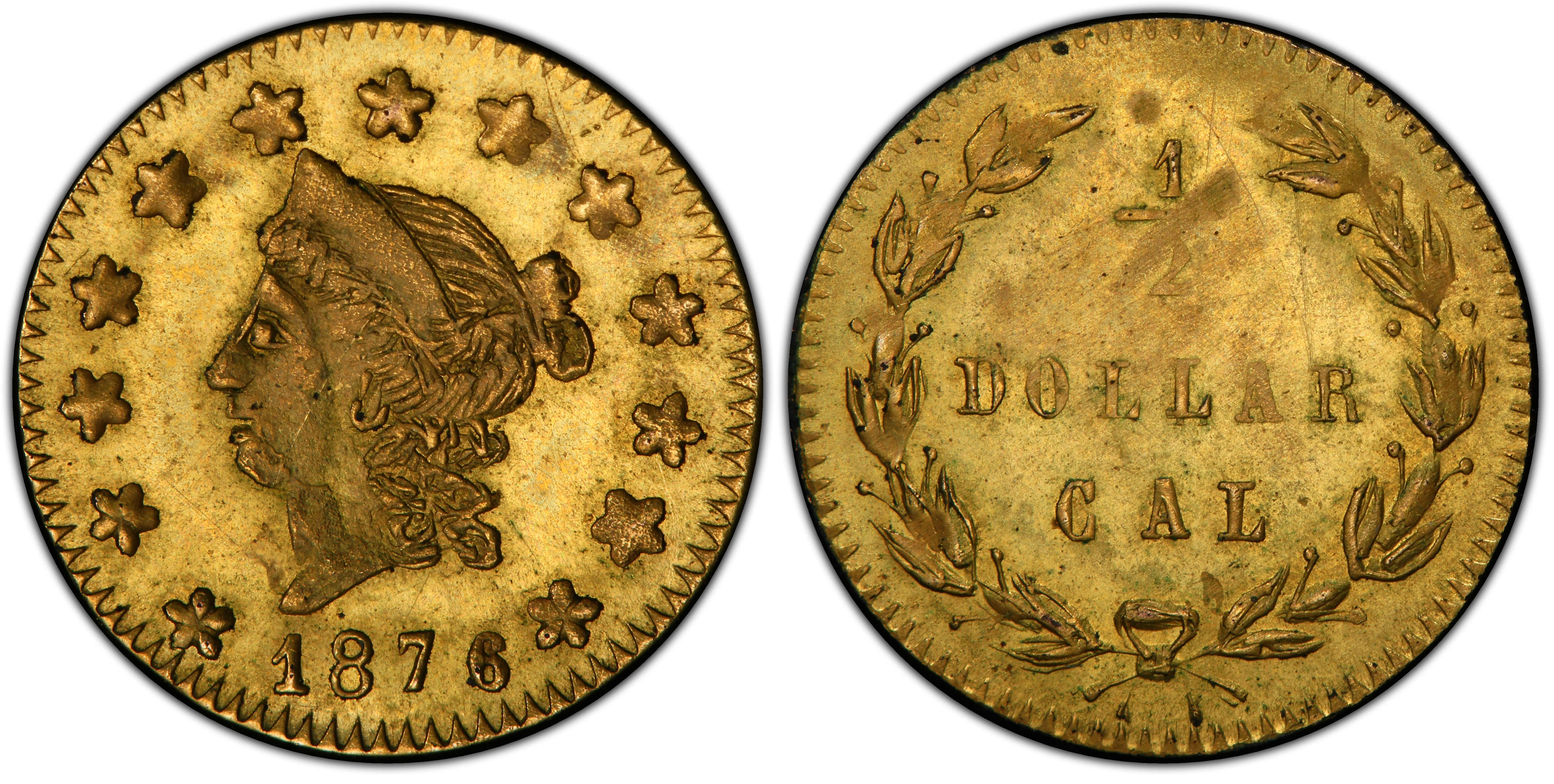
Obverse & Reverse
The 1876 BG-1039A 50 Cent piece emerges from the third and final period of California Fractional Gold production (roughly 1870-1882), a fascinating era that saw these miniature coins transition from a necessary medium of exchange to popular souvenirs and keepsakes. By 1876, the United States was celebrating its Centennial, and California's economy, while mature, still faced localized shortages of small change, a persistent issue since the Gold Rush began. The initial impetus for fractional gold in the 1850s was dire necessity; gold dust was impractical for small transactions, and federally issued coins were scarce on the West Coast. Private minters, primarily jewelers with the requisite skills and equipment, filled this void by striking quarter, half-dollar, and dollar denominations. The Coinage Act of 1864 officially outlawed private currency, but enforcement was lax in the West. This allowed for the continued production of denominated pieces, often called 'jeweler's issues,' which catered to a lingering commercial need and a growing tourist trade. These later issues, including the BG-1039A, were typically lighter and contained less gold than their Period One counterparts, reflecting their evolving role. They were no longer the rugged, essential currency of the forty-niners but rather charming mementos of the Golden State. Struck by anonymous craftsmen using hand-operated presses, these tiny gold coins captured the enduring spirit of the Gold Rush long after its peak, serving as tangible links to an era of unprecedented growth and ambition in American history.
Associated EventPost-Gold Rush California Economy / U.S. Centennial
Reason For MintingTo serve a dual purpose as both a medium for small transactions in a region with a continued shortage of federal coinage and as a popular souvenir for tourists.
Minter HistoryThe specific minter of BG-1039A, like many 'jeweler's issues' from this period, is unknown. Production was largely anonymous, carried out by various San Francisco-based jewelers and artisans who possessed the skills for die cutting and striking. These craftsmen capitalized on the demand for small gold pieces, often operating in a legal gray area after the 1864 Coinage Act. Their work is characterized by artistic and sometimes crude designs, reflecting their individual skill levels and the use of hand-operated machinery.
Historical SignificanceThis coin represents the final phase of a uniquely American phenomenon. While no longer a critical component of commerce as its 1850s predecessors were, it demonstrates the persistence of private minting and the high public regard for gold in California. Its existence speaks to a transitional period where these pieces evolved from necessity-driven currency to cherished souvenirs, encapsulating the romantic legacy of the Gold Rush for a new generation of visitors and residents.
N/A
Denomination50 Cents
Minting Period1876
Assayer/MinterUnknown private minter, often attributed to jewelers in San Francisco.
Geographic OriginSan Francisco, California
Obverse DescriptionA left-facing Liberty Head design. Liberty's hair is tied back, and she wears a coronet. The design is surrounded by thirteen stars, representing the original colonies.
Obverse InscriptionNo inscription.
Reverse DescriptionThe denomination '1/2' is centered within a wreath of leaves and berries. The wreath is open at the top.
Reverse Inscription1/2
CompositionGold
Stated Fineness Actual Fineness Weight0.24 grams
Diameter9.90 mm
EdgePlain
Unknown
Survival Estimate21-30 known
Rarity ScaleR-6+
The BG-1039A is sought after for its specific Breen-Gillio variety, its connection to the celebrated Centennial year of 1876, and its high rarity. As a 'jeweler's issue,' it is part of the extensive and popular California Fractional Gold series, which appeals to collectors of territorial gold, pioneer history, and miniature coins.
Key VarietiesThe primary variety is the regular business strike, BG-1039A. There are no known original proof strikings or official restrikes for this specific variety. The broader 1876 series includes other BG numbers with different designs (e.g., Indian heads) or shapes (octagonal). Collectors should be aware of a related variety, BG-1039, which is exceedingly rare. The 'A' in BG-1039A distinguishes it as a distinct die pairing.
Authentication TipsGenuine examples are very thin and have sharp, well-defined lettering and design elements, despite their small size. The surfaces should exhibit the characteristics of a genuine strike, not the porous or soapy look of a cast counterfeit. Replicas are common and often have incorrect weight, thickness, or lack the denomination. Any piece without a clear denomination (e.g., just '1/2' without 'DOL.' or a similar indicator) warrants extreme skepticism, though this specific variety is an exception. Always seek third-party certification from services like PCGS or NGC to guarantee authenticity.
Shopping ConsiderationsA premium quality example for this variety would exhibit a sharp strike, particularly on Liberty's hair details and the leaves of the reverse wreath. Original, prooflike or deep mirror prooflike (DMPL) surfaces command a significant premium. Look for coins with minimal contact marks and original, undisturbed luster. Avoid examples that have been used in jewelry, which often show signs of being mounted, soldered, or harshly cleaned. Given their small size, even minor imperfections can be distracting, so 'eye appeal' is paramount. Check for planchet flaws or irregular striking, which are common but should be factored into the price.
A coin's grade is its condition, rated on a 1-70 scale. For rare coins, this is the most critical factor in determining value, as a tiny difference in preservation can mean a huge difference in price.
Relevant Grade TypesOriginal issues are business strikes intended for circulation and as keepsakes, and are found in Circulated (1-58) and Mint State (MS, 60-70) grades. Due to their frequent use as souvenirs, many survivors are in high grades. No true Proofs were struck during the original minting period for this variety. Any coin described as 'Proof' is likely a high-quality business strike with reflective surfaces, often designated as Prooflike (PL) or Deep Mirror Prooflike (DMPL) by grading services.
Mint State CharacteristicsUncirculated examples of BG-1039A often display surprisingly sharp strikes for their size, a testament to the skill of the jewelers who made them. Luster can range from satiny to intensely prooflike. High-grade pieces are susceptible to tiny planchet flaws or hairline scratches that can disproportionately affect the grade. The highest points, such as Liberty's cheek and the wreath's highest leaves, are the most likely places to find small, grade-limiting contact marks.
Circulated Wear PatternsWear first appears on the high points of Liberty's hair, cheek, and coronet. On the reverse, the highest points of the wreath and the fraction '1/2' will show the initial signs of friction. In lower grades (VF and below), the stars on the obverse will begin to lose their definition and merge with the field.
Key Factors For ValueFor the BG-1039A, the key value drivers are grade, surface quality, and eye appeal. A sharp strike is critical. The presence of prooflike (PL) or deep mirror prooflike (DMPL) surfaces significantly increases value. Coins with original, lustrous 'skin' that have not been cleaned or polished are highly prized. Conversely, ex-jewelry pieces, which are common in this series, are worth significantly less. A CAC sticker indicates premium quality for the grade and will typically result in a higher market price.
PCGS Price Guide
| Grade | Price | Population |
|---|---|---|
| 53 | $400.00 | 1 |
| 53+ | $420.00 | N/A |
| 55 | $450.00 | 1 |
| 55+ | $475.00 | N/A |
| 58 | $550.00 | 1 |
| 58+ | $600.00 | N/A |
| 60 | $650.00 | 1 |
| 61 | $700.00 | 1 |
| 62 | $775.00 | 6 |
| 62+ | $1,000.00 | N/A |
| 63 | $1,500.00 | 3 |
| 63+ | $2,000.00 | N/A |
| 64 | $2,350.00 | 2 |
| 64+ | $2,750.00 | N/A |
| 65 | $3,500.00 | N/A |
| 65+ | $4,000.00 | N/A |
| 66 | $5,000.00 | N/A |