1870 G25C BG-755, PL (Regular Strike)
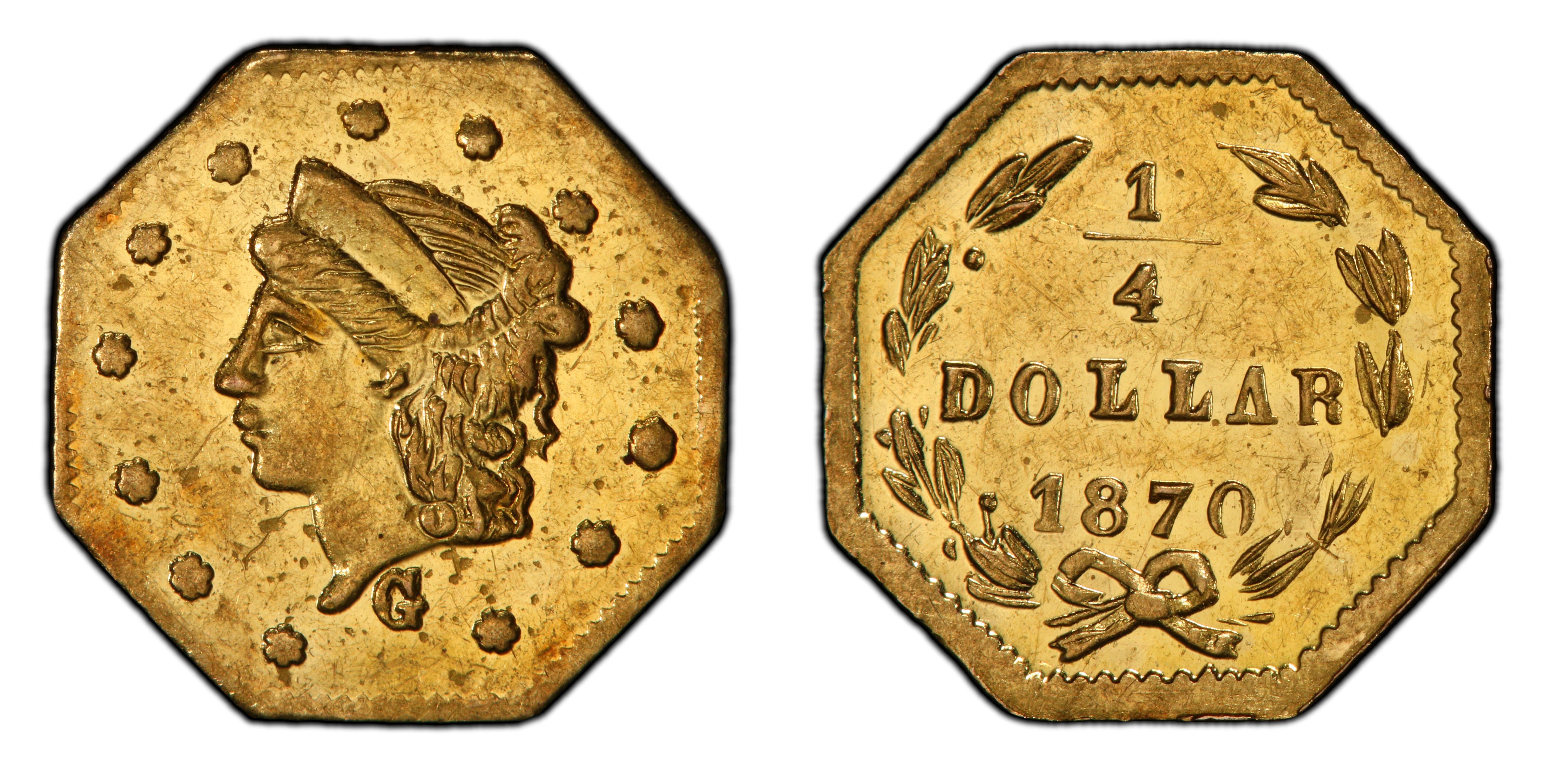
Obverse & Reverse
The 1870 octagonal 25-cent piece, cataloged as Breen-Gillio 755, emerges from the second major phase of California's private gold coinage. Unlike the 'Period One' issues (1852-1857), which were struck out of a genuine necessity to alleviate a critical shortage of small change during the initial Gold Rush boom, these 'Period Two' (1859-1882) pieces served a different purpose. By 1870, the San Francisco Mint was in full operation, producing ample federal coinage for commerce. The rationale for producing these minuscule gold pieces had shifted from utility to novelty. They were primarily created as souvenirs and keepsakes for tourists, merchants, and those wishing to send a small, tangible piece of the California dream back east. The minters, often jewelers by trade, walked a fine legal line. The Coinage Act of 1864 had explicitly forbidden private coinage, but enforcement was lax until the early 1880s. To circumvent the law, these pieces were often intentionally struck underweight relative to their face value, technically making them tokens rather than coins intended to circulate at par. The BG-755, attributed to Robert B. Gray & Co. of San Francisco, is a quintessential example of this 'jeweler's issue.' The use of a dated obverse, mimicking federal coinage with its Liberty head and stars, was a marketing tactic designed to enhance their appeal as legitimate-looking miniature coins. The quality of manufacture varied wildly during this period. Many, like the BG-755, were crudely struck by hand-hammering, resulting in poorly defined details and irregular planchets. Their survival in any condition is remarkable, and their modern numismatic significance lies in their direct connection to the romantic, albeit fading, legacy of the Gold Rush and the entrepreneurial spirit of the jewelers who supplied a burgeoning souvenir market.
Associated EventPost-Gold Rush California Souvenir Trade
Reason For MintingPrimarily struck to be sold as souvenirs and jewelry items rather than to alleviate a currency shortage, which had been resolved by this time.
Minter HistoryRobert B. Gray & Co. was a San Francisco-based firm active in the jewelry and watchmaking trade during the latter half of the 19th century. Like many jewelers of the era, the company ventured into the lucrative business of producing California fractional gold tokens. These items were a natural extension of their primary business, leveraging their skills in metalworking and die preparation. They produced a variety of these small denomination pieces, often characterized by a somewhat crude but distinctive style. Their operations were part of a larger, competitive market of San Francisco jewelers who supplied the public's demand for gold novelties. While not as prolific as some other private minters, the issues of Robert B. Gray & Co. are an important component of the Period Two fractional gold series.
Historical SignificanceThe BG-755 represents the commercial evolution of California fractional gold from utilitarian coinage to a souvenir commodity, reflecting the changing economic landscape of California two decades after the initial Gold Rush.
Not Applicable
Denomination25 Cents
Minting Periodc. 1870
Assayer/MinterRobert B. Gray & Co.
Geographic OriginSan Francisco, California
Obverse DescriptionA stylized Liberty head facing left, her hair tied in a bun. She is surrounded by thirteen crudely rendered six-pointed stars arranged in a circle near the octagonal border.
Obverse Inscription Reverse DescriptionThe denomination '1/4' is at the center, with the word 'DOLLAR' below it. The date '1870' is positioned beneath 'DOLLAR'. The entire central device is enclosed within a simple wreath or decorative border.
Reverse Inscription1/4 DOLLAR 1870
CompositionGold
Stated Fineness Actual FinenessVariable, typically 14 to 21 karats for Period Two issues.
Weight0.30 grams
Diameter10.00 mm
EdgePlain
Unknown
Survival EstimateFewer than 75; possibly as few as 31-75.
Rarity ScaleR-6 (31-75 Known). Some sources cite High R-4 (76-200 known), but R-6 is more commonly associated with this specific variety in auction records.
This variety appeals to specialists in the vast and complex series of California Fractional Gold. Its high rarity, octagonal shape, and crude yet charming style make it a challenging and desirable acquisition for completists.
Key VarietiesThe BG-755 is itself a specific die marriage (variety) within the broader 1870 25C octagonal series. No major sub-varieties, patterns, or restrikes from the original period are known or documented for the BG-755 pairing. Collectors should focus on die state and strike quality.
Authentication TipsAuthentic examples often exhibit a crude, soft strike, particularly on the stars and the date. The lettering and numerals can be unevenly spaced and weak. Look for die markers consistent with known genuine examples. Counterfeits may appear too sharp or have incorrect details, such as a different style of Liberty head, incorrect wreath, or a suspicious surface texture (e.g., casting bubbles). Any piece with a bear on the reverse is a modern replica. Genuine pieces have a dull, original luster, not a bright, brassy shine.
Shopping ConsiderationsA 'premium quality' BG-755 is one that, despite the inherent crudeness of the issue, displays the sharpest possible strike and minimal distractions. Look for an example where the date and denomination are fully legible. Original, uncleaned surfaces with a hint of reddish-gold patina are highly desirable. Avoid specimens that have been harshly cleaned, bent, or used in jewelry, as evidenced by solder marks or excessive rim damage. Due to the typically weak strike, any example showing unusual sharpness on the highest points, especially the Liberty head details, should command a premium.
A coin's grade is its condition, rated on a 1-70 scale. For rare coins, this is the most critical factor in determining value, as a tiny difference in preservation can mean a huge difference in price.
Relevant Grade TypesOriginal issues of BG-755 are business strikes made for commercial sale, not circulation, and are found in Circulated (AU-50 to AU-58 are most common) and Mint State (MS, 60-70) grades. The 'PL' (Proof-Like) designation in the user's input is exceptionally rare for this series and would refer to a regular business strike with unusually reflective, mirror-like fields, not a true Proof striking. No evidence exists of true Proofs being struck for this issue during the period. The manufacturing process was too crude to produce consistent Proof-Like surfaces, making any PL example a significant outlier.
Mint State CharacteristicsAn uncirculated (MS) example of BG-755 will retain original mint luster, though this is typically subdued and satiny rather than bright and flashy. The strike is almost universally weak, so even a high-grade piece will likely show softness in the stars and Liberty's hair. Small planchet flaws, fissures, or adjustment marks are common and should not be considered major defects unless they are severe. Contact marks are expected due to the softness of the gold and loose handling at the time of manufacture.
Circulated Wear PatternsWear first appears on the highest points: the cheek and hair bun of Liberty on the obverse, and the numerals '1/4' on the reverse. On lower-grade circulated examples, the stars will begin to merge with the fields, and the date will become faint. As a piece intended as a souvenir, true circulation wear is less common than damage from being kept as a pocket piece or mounted in jewelry.
Key Factors For ValueFor the BG-755, value is driven primarily by rarity and grade. Surface quality is paramount; an example with original, undisturbed skin will always be worth more than a cleaned or polished one of the same grade. Strike sharpness is a major determinant of eye appeal and value; a coin with a bold date and denomination is highly sought. The presence of a CAC sticker will add a significant premium, as it confirms both the grade and the quality of the surfaces for that grade.
PCGS Price Guide
| Grade | Price | Population |
|---|---|---|
| 61 | $450.00 | 1 |
| 62 | $525.00 | N/A |
| 62+ | $600.00 | N/A |
| 63 | $700.00 | 1 |
| 63+ | $1,000.00 | N/A |
| 64 | $1,750.00 | N/A |