1871 G50C BG-1043 (Regular Strike)
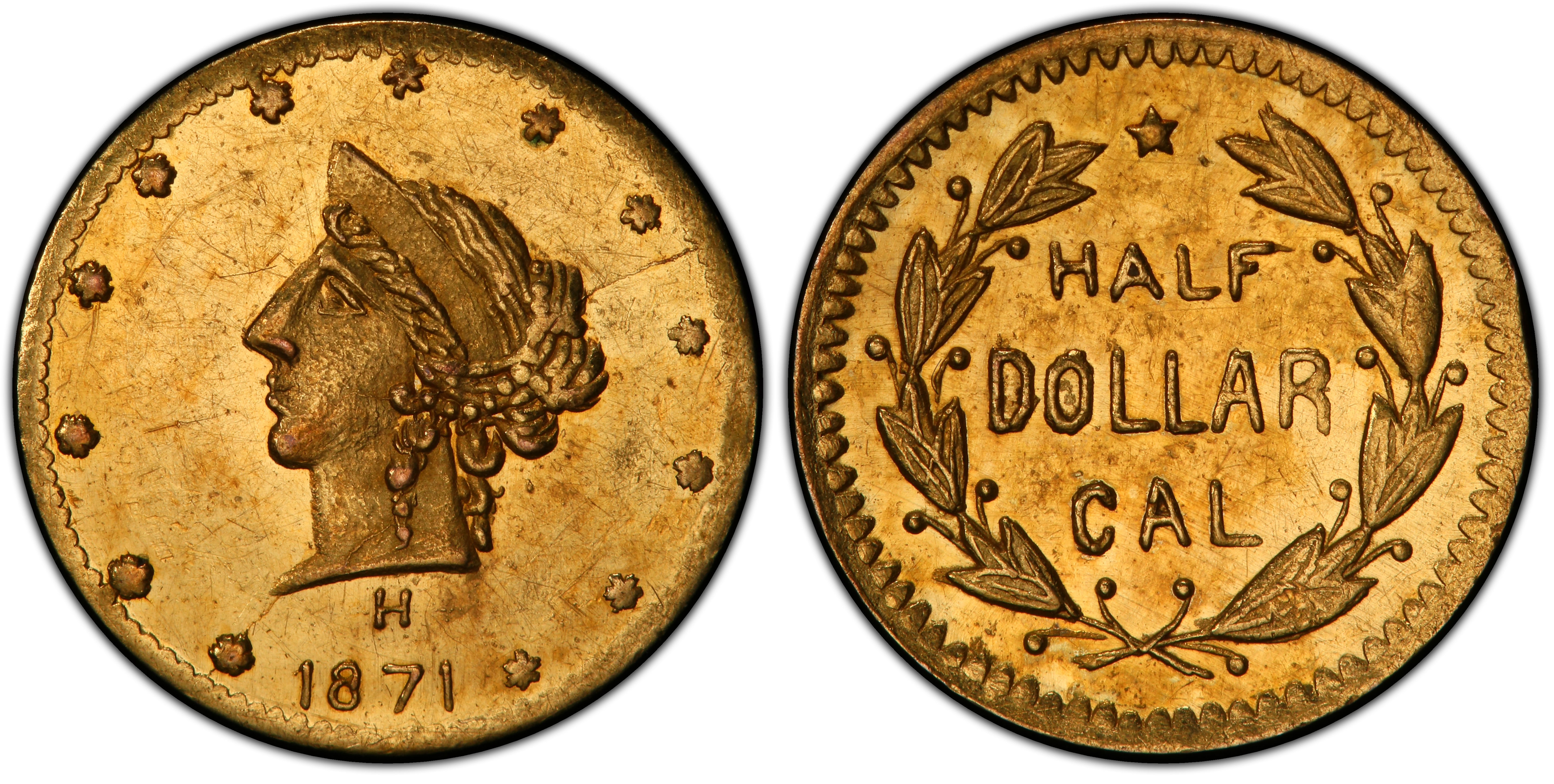
Obverse & Reverse
The 1871 G50C BG-1043 is a product of the second period (1859-1882) of California Fractional Gold production, a fascinating and complex chapter in American numismatics. The initial impetus for these tiny gold coins arose from a severe shortage of small change in California following the 1848 gold discovery. The massive influx of prospectors and settlers created a booming economy, but with gold dust as the primary medium of exchange, daily transactions were impractical. The smallest denomination U.S. coin was initially the quarter eagle ($2.50), leaving a gaping void for smaller purchases. Private minters, mostly jewelers in San Francisco, stepped in to fill this need starting in 1852, producing quarter dollar, half dollar, and dollar pieces. These 'Period One' issues were generally of high purity and intended to circulate as genuine currency. However, the Act of June 8, 1864, prohibited all private coinage, bringing this era to a halt. The second period, to which this 1871 coin belongs, saw a resurgence in fractional gold production under different pretenses. While the need for small change persisted, these later issues are often termed 'jeweler's issues.' They were typically lower in gold content relative to their face value and were marketed more as souvenirs and keepsakes for tourists and locals enchanted by the Gold Rush legacy than as circulating currency. Many minters of this period were French jewelers, and their work often displayed a distinct artistic flair. The production method for most fractional gold was crude, often involving a sledgehammer to strike the dies, resulting in coins of varying strike quality. The BG-1043 variety, struck in 1871, is a quintessential example of this later period—a tangible link to San Francisco's romanticized Gold Rush past, created decades after the initial frenzy but still inextricably tied to its economic and cultural impact.
Associated EventCalifornia Gold Rush Aftermath
Reason For MintingPrimarily created as souvenirs and novelty items for a burgeoning tourist trade and local market, capitalizing on the legacy of the Gold Rush-era coinage shortage.
Minter HistoryThe specific minter for the BG-1043 variety, like many 'Period Two' issues, is unknown. Production during this time was dominated by various jewelers and artisans in San Francisco, many of whom did not sign their work. These craftsmen, often immigrants, operated small-scale minting operations. Notable minters of the general period include Deriberpe & Nouizillet (D.N.) and Frontier & Deviercy (F.D.), though there is no evidence linking them to this specific die pair. The anonymity of the minter was also a practical consideration, given the questionable legality of producing items that resembled currency after the 1864 federal prohibition on private coinage.
Historical SignificanceThe BG-1043 and its contemporaries represent the commercialization of the Gold Rush legend. While not intended for widespread circulation like their 'Period One' predecessors, they demonstrate a continuing demand for gold and serve as important artifacts of California's economic and cultural development in the late 19th century. They are a physical testament to how the story of the Gold Rush was packaged and sold, transitioning from a desperate economic necessity to a cherished historical novelty.
N/A
Denomination50 Cents
Minting Period1871
Assayer/MinterUnknown Private Minter (Jeweler)
Geographic OriginSan Francisco, California
Obverse DescriptionA classic Liberty Head design, facing left, modeled after the contemporary federal gold coinage. The portrait is surrounded by thirteen stars, representing the original colonies.
Obverse InscriptionNo textual inscription; features a Liberty Head surrounded by 13 stars.
Reverse DescriptionThe denomination '1/2' is enclosed within a wreath of leaves and berries. The date '1871' is positioned below the wreath.
Reverse Inscription1/2 1871
CompositionGold
Stated Fineness Actual FinenessVaries, but typically lower than federal coinage of the era, ranging from 14 to 22 carats for Period Two issues.
Weight0.25 grams
Diameter10.00 mm
EdgePlain
Unknown
Survival EstimateFewer than 30
Rarity ScaleR-6 (13 to 30 known)
This variety appeals to collectors due to its high rarity (R-6), classic Liberty Head design, and its connection to the romanticized era of the California Gold Rush. As a 'Period Two' issue, it tells a different story from the earlier circulating coinage, focusing on the souvenir and novelty market that grew in San Francisco.
Key VarietiesThe primary variety is the regular business strike. No known proof restrikes, patterns, or trial pieces are recorded for the BG-1043 die pair. Collecting California Fractional Gold is primarily done by Breen-Gillio (BG) catalog numbers, each of which represents a unique die marriage. The broader series contains hundreds of varieties, with major distinctions being round vs. octagonal shape, and Liberty Head vs. Indian Head designs.
Authentication TipsAuthentic pieces should exhibit the correct die markers for BG-1043. The strike is often somewhat soft, particularly on the highest points of Liberty's hair and the center of the wreath. Look for parallel striations or 'draw marks' on the fields, which can be characteristic of the planchet preparation process for genuine fractionals. Counterfeits are rampant in this series; many are modern replicas or gold-plated tokens. Genuine pieces were struck, not cast, so casting bubbles or a seam around the edge are red flags. Third-party certification from PCGS or NGC is highly recommended for authenticity and protection.
Shopping ConsiderationsFor a premium quality example, seek a coin with a sharp strike, especially on the stars, date, and details within the wreath. Original, uncleaned surfaces with some remaining mint luster command significant premiums. The soft, high-purity gold is prone to contact marks and scratches, so finding a 'clean' coin is a major challenge and a key value driver. Avoid examples that have been holed, heavily cleaned, or used as jewelry, as this severely impairs value. Eye appeal is paramount; a choice specimen will have attractive, consistent original color and a well-centered strike.
A coin's grade is its condition, rated on a 1-70 scale. For rare coins, this is the most critical factor in determining value, as a tiny difference in preservation can mean a huge difference in price.
Relevant Grade TypesOriginal period issues were business strikes, technically intended for sale as novelties rather than circulation, but are graded along the same Circulated (1-58) and Mint State (MS, 60-70) scale. No proofs were struck during the original period of issue for this variety. Any piece described as a 'Proof' would be a later fabrication or a misattribution of a Prooflike (PL) business strike, which is noted for its mirror-like fields.
Mint State CharacteristicsUncirculated examples of BG-1043 are rare. A typical Mint State coin may still exhibit some softness in the strike, a common characteristic of privately produced fractionals. The luster is typically satiny rather than frosty. Due to the small size and rudimentary production methods, even uncirculated specimens can have minor planchet flaws or adjustment marks. Contact marks, even small ones, can be prominent on the delicate surfaces and will significantly impact the grade.
Circulated Wear PatternsWear first appears on the highest points of the design: Liberty's hair above the eye and ear, her cheekbone, and the high points of the wreath's leaves and bow on the reverse. On moderately circulated examples, the finer details of the hair will be flat, and the stars will begin to lose their definition. In lower grades (VG and below), the date and legends may become weak or partially obliterated.
Key Factors For ValueRarity is the primary driver, as BG-1043 is an R-6 variety. After rarity, grade is paramount. A Mint State example is worth many multiples of a circulated one. Surface quality is a critical factor; an example with original, undisturbed surfaces and luster is far more desirable than one that has been cleaned, polished, or damaged. Strike sharpness is also key, with well-struck coins commanding a premium. Finally, certification by a top-tier service like PCGS or NGC is essential for market acceptance and value realization. A CAC sticker for this issue would indicate superior quality for the grade and add a significant premium.
PCGS Price Guide
| Grade | Price | Population |
|---|---|---|
| 55 | $1,500.00 | 3 |
| 55+ | $1,650.00 | N/A |
| 58 | $1,750.00 | N/A |
| 58+ | $1,850.00 | N/A |
| 60 | $2,000.00 | 1 |
| 61 | $2,100.00 | 3 |
| 62 | $2,250.00 | 3 |
| 62+ | $2,500.00 | N/A |
| 63 | $3,000.00 | 1 |
| 64 | N/A | N/A |