1871 G25C BG-864A (Regular Strike)
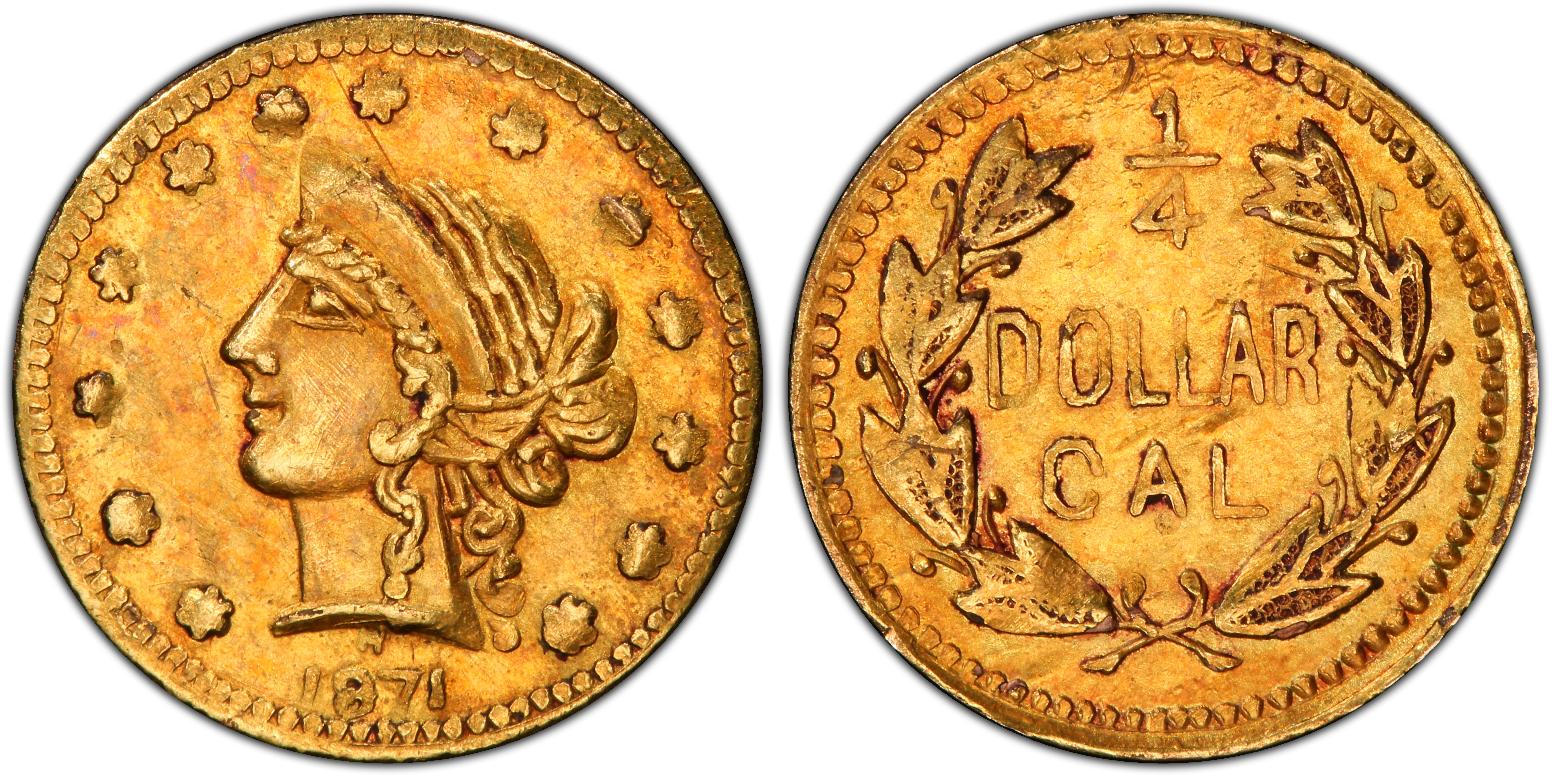
Obverse & Reverse
The 1871 G25C BG-864A is a numismatic ghost from the twilight of America's private coinage era. By 1871, the frenzied height of the California Gold Rush was a memory, but its economic aftershocks still resonated. The initial, desperate need for small circulating coinage that gave birth to fractional gold in 1852 had been largely met by the San Francisco Mint. However, a robust market for gold souvenirs persisted, eagerly supplied by the same jewelers who had once made quasi-currency. These 'Period Two' or 'Jewelers' Issues' (1859-1882) operated in a legal gray area. The Private Coinage Act of 1864 had expressly forbidden private minting, but enforcement by the Secret Service was sporadic and focused on larger denominations. Minter-jewelers in San Francisco continued their work, often backdating coins or using non-specific designs to avoid scrutiny. These tiny gold pieces were no longer essential for commerce but were popular keepsakes for tourists or gifts to be sent back East, tangible slivers of the 'Golden State.' The BG-864A is an artifact of this clandestine production environment. It is not a standard issue but a 'mule'—a coin struck with two dies not intended to be paired. Specifically, it combines the obverse die of the BG-864 variety with the reverse die of the BG-859 variety. Such an event could happen for several reasons: a simple mistake in the workshop, the intentional use of a serviceable die when its counterpart broke, or an experiment. Given the extremely low survival rate, it was likely an ephemeral, accidental issue, produced in a minuscule quantity before the error was corrected or the die run ended. The discovery of this mule variety is a modern one, credited to the legendary numismatist Walter Breen in 1987. Its existence was unknown to earlier generations of collectors, making it one of the most significant finds in the series and a testament to the chaotic and unstandardized practices of the period's private mints.
Associated EventPost-Gold Rush California Economy
Reason For MintingPrimarily produced as souvenirs or curios for tourists and collectors during a period when the original commercial need for fractional gold had largely subsided.
Minter HistoryThe specific minter is anonymous, a common characteristic of 'Period Two' issues made after the 1864 Private Coinage Act increased legal risks. Production is attributed to one of the several manufacturing jewelers active in San Francisco in the early 1870s. Firms like Robert B. Gray & Co. (active until 1871) were known to produce similar dated Liberty Head fractionals. These artisans used hand-operated presses or simple hammer-striking methods in small workshops, resulting in inconsistent quality and occasional errors like this mule.
Historical SignificanceThe BG-864A is significant not as a circulating coin, but as a rare 'mule' that provides a window into the ad-hoc nature of private minting in its final years. Its extreme rarity and recent discovery highlight that the numismatic story of this period is still being written. It stands as a prime example of a 'ghost' variety—a coin struck in such small numbers that it escaped notice for over a century.
BG-864A
Denomination25 Cents
Minting Period1871
Assayer/MinterAnonymous
Geographic OriginSan Francisco, California
Obverse DescriptionThe obverse is struck from the BG-864 die. It features a small, somewhat crude Liberty Head facing left, with hair tied in a bun. The portrait is surrounded by 13 five-pointed stars. The date '1871' is below the bust. The positioning of the stars and date relative to the portrait are key diagnostics for this die.
Obverse Inscription1871
Reverse DescriptionThe reverse is struck from the BG-859 die. It features the denomination '1/4 DOLLAR' and 'CAL' within a wreath. The wreath is composed of two branches tied with a bow at the bottom. The arrangement and style of the leaves and berries, particularly their relationship to the letters, are characteristic of this specific die.
Reverse Inscription1/4 DOLLAR CAL
CompositionGold
Stated Fineness Actual FinenessVaries, typically 14 to 22 karats (.583 to .917 fine) for Period Two issues.
Weight0.25 grams
Diameter9.50 mm
EdgePlain
Extremely low, likely accidental and numbering in the single digits.
Survival Estimate2-3 known examples
Rarity ScaleR-8
This coin's appeal is rooted in its ultimate rarity. As a 'mule' and a modern discovery by Walter Breen, it is a trophy piece for the most advanced specialists in California Fractional Gold. Its R-8 rating places it among the rarest of all United States numismatic items. Owning a BG-864A means owning a significant piece of numismatic history that was unknown for over a century.
Key VarietiesThe BG-864A is itself the key variety, being a mule of two distinct issues (obverse of BG-864, reverse of BG-859). No other significant variations, patterns, or restrikes of this specific mule are known to exist.
Authentication TipsAuthentication is a two-step process of die-matching. First, the obverse must perfectly match the known die characteristics of a genuine BG-864. Second, the reverse must perfectly match the die characteristics of a genuine BG-859. Any deviation indicates a counterfeit. Due to its high value and rarity, purchase should only be considered if the coin is certified by a top-tier grading service (PCGS or NGC) that explicitly recognizes the BG-864A attribution. Surfaces should exhibit the characteristics of a hammered or early screw press striking, not the uniform fields of modern copies.
Shopping ConsiderationsAcquisition of a BG-864A is a rare event, typically only occurring when a major collection is sold at auction. A 'premium quality' example would be one that is well-centered, sharply struck for the issue, and possesses original, lustrous surfaces. Given that the few known examples are in Mint State, the focus is on the quality of that grade. Look for minimal abrasions and an absence of distracting planchet flaws. The surfaces may exhibit some natural waviness from the strike. Avoid any examples that show signs of having been used in jewelry, cleaning, or tooling. The historical significance of this specific variety commands a massive premium over more common 1871 issues.
A coin's grade is its condition, rated on a 1-70 scale. For rare coins, this is the most critical factor in determining value, as a tiny difference in preservation can mean a huge difference in price.
Relevant Grade TypesAll original California Fractional Gold pieces, including this one, were business strikes intended for either circulation or sale as souvenirs. They are found in Circulated (1-58) and Mint State (MS, 60-70) grades. However, due to its status as a great rarity likely discovered and preserved by numismatists early on, the known examples of BG-864A are in Mint State. No Proof (PR/PF) examples were struck during the original period of issue, and no later-date Proof restrikes of this specific mule variety are known.
Mint State CharacteristicsUncirculated examples of this issue are defined by their luster, which is typically a soft, satiny canary-gold. The strike is often somewhat weak in the centers due to the hand-hammered or crude press technology used. Surfaces on genuine examples are characteristically imperfect and may exhibit slight waviness or minor planchet flaws 'as made'. Light contact marks are common and expected, even on high-grade pieces, due to the softness of the gold and rudimentary handling methods.
Circulated Wear PatternsWhile the known examples are uncirculated, were a circulated piece to be discovered, wear would first appear on the highest points of the design. On the obverse, this would be Liberty's cheek, the hair above the ear, and the tips of the stars. On the reverse, the high points of the letters in 'DOLLAR' and the leaves in the wreath would show initial friction and loss of detail.
Key Factors For ValueFor a great rarity like BG-864A, the primary value factor is simply its existence and authenticity. Among the 2-3 known specimens, value differences would be determined by surface quality and eye appeal. An example with minimal contact marks, strong luster, a relatively sharp strike, and a clean, original appearance would be considered superior. A CAC sticker, verifying premium quality for the grade, would add a significant premium, as it does for all desirable territorial gold.
PCGS Price Guide
| Grade | Price | Population |
|---|---|---|
| 55 | $3,500.00 | 2 |
| 55+ | $3,750.00 | N/A |
| 58 | $4,250.00 | N/A |
| 58+ | $4,750.00 | N/A |
| 60 | $6,500.00 | N/A |
| 61 | $8,000.00 | 1 |
| 62 | $10,000.00 | 1 |