1876 G50C BG-1040 (Regular Strike)
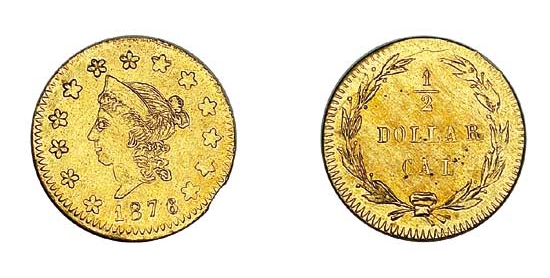
Obverse & Reverse
The 1876 G50C BG-1040 is a product of the second period of California Fractional Gold production (1859-1882), a fascinating chapter in American numismatics that diverged significantly from the monetary necessity of the Gold Rush. Unlike the 'Period One' issues (1852-1857), which were struck to alleviate a severe shortage of small change in the gold fields, these later 'Suppressed Jewelers' Issues' were created primarily as souvenirs and novelty items. By 1876, the United States Mint in San Francisco was in full operation, and the commercial need for private fractional coinage had evaporated. However, the allure of the Gold Rush and the romance of the West had captivated the nation, particularly with the Centennial Exposition of 1876 in Philadelphia fanning the flames of historical interest. Enterprising California jewelers, many of whom were skilled die sinkers, recognized a burgeoning tourist market and a demand for mementos of the golden state. They began producing these diminutive gold pieces, intentionally backdating them or using dates of current production, to sell as keepsakes. These pieces were not intended for circulation, a fact underscored by their typically low intrinsic value; the gold content was substantially less than their face value, rendering them, in essence, private tokens. The Coinage Act of 1864 had made such private minting illegal, but the law was not aggressively enforced by the Secret Service until 1883. This legal gray area allowed for a prolific output of hundreds of distinct varieties throughout the 1870s. The BG-1040 was struck in this environment. Its creation was not a response to economic need but a commercial enterprise catering to nostalgia and the tourist trade. Most examples were sold in jewelry shops in San Francisco and other locales, often mounted into pins, cufflinks, or watch fobs. For this reason, many surviving examples are either in pristine, uncirculated condition or show evidence of jewelry mounting. The eventual crackdown in 1883 brought an end to the era of denominated fractional gold, cementing the status of pieces like the BG-1040 as relics of a unique period of private enterprise and the enduring legacy of the California Gold Rush.
Associated EventPost-Gold Rush California Tourism
Reason For MintingTo serve a commercial market for souvenirs and jewelry items capitalizing on the romanticism of the California Gold Rush.
Minter HistoryThe specific minter for the BG-1040 variety is unknown, a common trait for many Period Two 'jeweler's issues.' These pieces were produced by numerous, often anonymous, jewelers and craftsmen in San Francisco and other cities. While some makers of other varieties are known (such as Robert B. Gray & Co. or Christopher Mohrig), the die work for BG-1040 has not been conclusively attributed to a specific individual or firm.
Historical SignificanceThe BG-1040 is significant not as a circulating coin but as a historical artifact representing the commercialization of the Gold Rush mythos. It illustrates a transition from utilitarian private coinage born of necessity to souvenir tokens created for a nostalgic market, produced during a period of lax federal enforcement against private minting.
N/A
Denomination50 Cents
Minting Period1876
Assayer/MinterUnknown Jeweler
Geographic OriginSan Francisco, California
Obverse DescriptionA classic Liberty Head motif, facing left, modeled after the contemporary U.S. federal gold coinage. The hair is tied in the back with a ribbon. The portrait is encircled by 13 six-pointed stars, representing the original colonies.
Obverse Inscription1876
Reverse DescriptionThe denomination '50 CENTS' is enclosed within a wreath. The wreath is composed of two branches tied together at the bottom with a bow.
Reverse Inscription50 CENTS
CompositionGold
Stated Fineness Actual FinenessVariable, often low fineness (ranging from .500 to .800) with gold alloyed with copper and silver. The intrinsic value was intentionally less than the face value.
Weight0.25 grams
Diameter10.00 mm
EdgePlain
Unknown
Survival Estimate13-30
Rarity ScaleR-6
This coin appeals to collectors of territorial gold, Old West memorabilia, and those fascinated by the diverse and semi-official coinage of the United States. Its tiny size, genuine gold composition, and direct link to the post-Gold Rush era make it a popular and historically rich collectible. Because they were souvenirs, many survive in high grades, allowing collectors to acquire a pristine piece of 19th-century history.
Key VarietiesThe primary variety is the BG-1040 regular strike. A significant and sought-after sub-variety is the BG-1040A, which is distinguished by its reverse die being rotated a full 180 degrees from the obverse (medallic alignment). No later-date restrikes or special collector issues are known to exist for this variety.
Authentication TipsAuthentication is paramount. First, consult the Breen-Gillio reference, as any unlisted variety is suspect. Genuine pieces are struck on very thin planchets, often the thickness of a business card. Crudely made modern replicas are often thicker and have a soapy, indistinct appearance. A key diagnostic of authenticity is the presence of a denomination (e.g., 'CENTS' or 'DOLLAR'). Post-1883 tokens, made to circumvent the law, typically lack a denomination. Ironically, signs of a weak strike in some areas can be an indicator of a genuine piece made by the crude hammer-striking process of the era. Fantasy pieces often feature a bear on the reverse; no genuine pre-20th-century fractional gold has this design.
Shopping ConsiderationsA premium quality example for its grade will possess sharp details, particularly on Liberty's hair and coronet and the leaves of the wreath. Because these were often sold as jewelry, carefully check for evidence of mounting, removal from jewelry (rim damage, solder), or excessive polishing. Many genuine examples exhibit prooflike or semi-prooflike fields from polished dies, which is a desirable characteristic and commands a premium. Seek out examples with clean, original surfaces and avoid those that have been harshly cleaned, which imparts a flat, lifeless look. A coin with attractive, original reddish-gold toning is highly prized.
A coin's grade is its condition, rated on a 1-70 scale. For rare coins, this is the most critical factor in determining value, as a tiny difference in preservation can mean a huge difference in price.
Relevant Grade TypesOriginal period issues were business strikes, although many were produced with prooflike surfaces for the souvenir market. They are found in Circulated (1-58) grades, though this is less common, and more frequently in Mint State (MS, 60-70) grades, as they were not intended for commerce. No true Proofs were struck during the original period of issue. Any reference to 'Prooflike' (PL) or 'Deep Prooflike' (DPL) is a surface characteristic of a business strike, not a separate striking method.
Mint State CharacteristicsIn uncirculated condition, the BG-1040 often displays a surprisingly sharp strike for its size, though minor weakness on the highest points is not uncommon due to the nature of hammer striking. Luster is typically bright and flashy, often with reflective, prooflike surfaces from polished dies. As these were made from relatively soft gold and handled as novelties, even high-grade Mint State examples may show tiny, scattered contact marks or hairlines.
Circulated Wear PatternsFor the few examples that saw any handling, wear first appears on the highest points: the hair above Liberty's eye and ear, the coronet, and the high points of the leaves and bow on the reverse wreath. On lower-grade circulated examples, the stars and legends will show softness and begin to merge with the fields.
Key Factors For ValueSurface preservation is paramount. An example with original, undisturbed luster and minimal contact marks will command a significant premium over a cleaned or polished coin of the same technical grade. The degree of reflectivity (Prooflike or Deep Prooflike) is a major value driver. Strike quality is also key; a fully struck specimen is always preferred. Finally, eye appeal, encompassing attractive toning and mark-free surfaces, can elevate a coin's value. A CAC sticker for this issue provides third-party verification of quality for the grade and is highly sought after by discerning collectors.
PCGS Price Guide
| Grade | Price | Population |
|---|---|---|
| 45 | $275.00 | 1 |
| 45+ | $285.00 | N/A |
| 50 | $300.00 | 1 |
| 50+ | $320.00 | N/A |
| 53 | $350.00 | 1 |
| 53+ | $360.00 | N/A |
| 55 | $385.00 | 1 |
| 55+ | $395.00 | N/A |
| 58 | $450.00 | 4 |
| 58+ | $475.00 | N/A |
| 60 | $550.00 | 4 |
| 61 | $700.00 | 3 |
| 62 | $850.00 | 3 |
| 62+ | $1,000.00 | N/A |
| 63 | $1,350.00 | 1 |
| 63+ | $1,750.00 | N/A |
| 64 | $2,500.00 | 1 |