1871 G50C BG-1029, DMPL (Regular Strike)
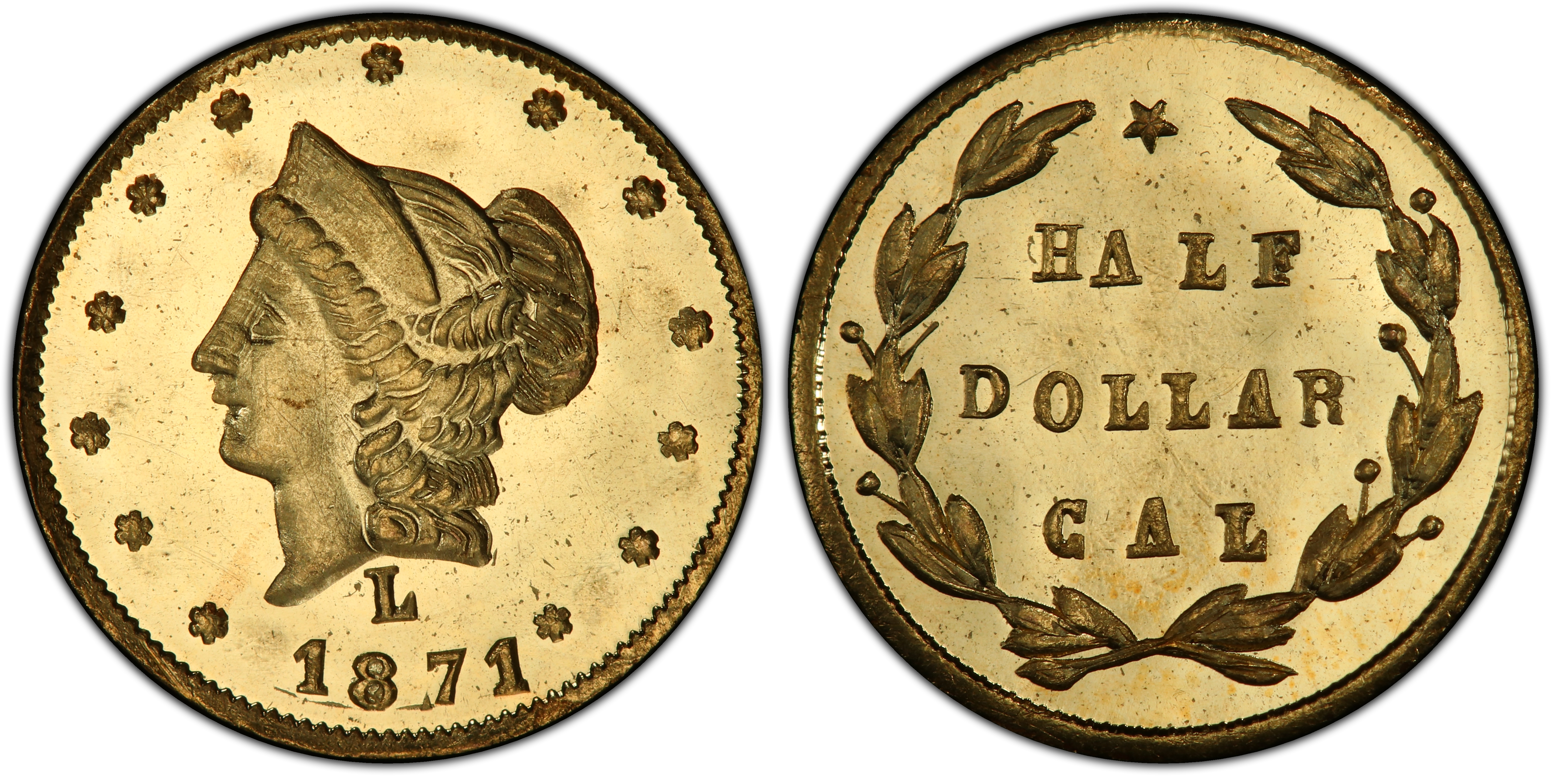
Obverse & Reverse
The 1871 BG-1029 50 Cents is a quintessential example of a 'Period Two' California Fractional Gold piece. By the 1870s, the initial, urgent need for small circulating coinage that characterized the Gold Rush of the early 1850s ('Period One') had largely subsided. The establishment of the San Francisco Mint in 1854 had supplied the region with ample federal coinage, rendering the private issues of fractional gold functionally obsolete for commerce. However, the allure of the Gold Rush and the romance of California's goldfields had created a robust market for souvenirs and keepsakes. Local jewelers and private minters in San Francisco stepped into this market, producing a dazzling variety of miniature gold 'coins' from 1858 through 1882. These pieces were not intended to, and largely did not, circulate as money. Their intrinsic value was substantially less than their face value, making them profitable tokens of a bygone era. The Act of 1864, which prohibited private coinage, was not strictly enforced against these small souvenir pieces until the early 1880s, allowing their production to flourish. The BG-1029 variety, dated 1871, was struck from skillfully prepared dies, as evidenced by the existence of specimens with Deep Mirror Prooflike (DMPL) surfaces. This indicates the die faces were highly polished before striking, a technique used to create coins with a special, aesthetic appeal for collectors and tourists, rather than for the rigors of circulation. These pieces were sold as curios, mounted into jewelry, or kept in wallets as pocket pieces, testaments to a visit to the still-mythic West. Today, they are studied and collected as a distinct and fascinating series, offering a tangible connection to the post-Gold Rush culture of California.
Associated EventPost-California Gold Rush Souvenir Market
Reason For MintingPrimarily created to be sold as souvenirs and keepsakes for tourists and collectors, not for general circulation.
Minter HistoryThe specific minter or jeweler who produced the BG-1029 variety is unknown, which is common for many Period Two California Fractional Gold pieces. Unlike some earlier issues that bore the initials or names of their makers (e.g., Frontier, Deviercy & Co.), many later souvenir pieces were produced anonymously by San Francisco's community of skilled metallurgists and die sinkers who capitalized on the souvenir trade.
Historical SignificanceThis coin is significant not as a medium of exchange, but as a cultural artifact. It represents the commercialization of the Gold Rush narrative and the transition of private minting from a necessity of commerce to a novelty industry. The quality of some specimens, particularly those with DMPL surfaces, showcases the high level of skill possessed by private die sinkers of the era.
N/A
Denomination50 Cents
Minting Period1871
Assayer/MinterUnknown Private Minter
Geographic OriginSan Francisco, California
Obverse DescriptionA well-defined Liberty Head facing left, her hair tied in a bun. She is encircled by 13 six-pointed stars, with the date '1871' positioned below the truncation of the neck.
Obverse Inscription1871
Reverse DescriptionThe denomination '50 CENTS' is displayed within a wreath composed of two olive branches tied together with a bow at the bottom. There are 18 berries on the wreath.
Reverse Inscription50 CENTS
CompositionGold
Stated Fineness Actual FinenessVariable, typically between .500 and .800 fine gold, though not consistently documented for this specific variety. The intrinsic value was significantly less than the face value.
Weight0.75 grams
Diameter11.30 mm
EdgePlain
Unknown, but very low.
Survival EstimateFewer than 75 believed to exist in all grades.
Rarity ScaleHigh R-4 / Low R-5
The BG-1029 is sought for its attractive Liberty Head design, its defined rarity, and especially for the aesthetic quality of high-grade examples. The DMPL designation is particularly prized, as it represents the pinnacle of production quality for these souvenir issues, offering a stark visual contrast between mirrored fields and frosted devices that is highly desired by collectors.
Key VarietiesThe primary variety is the BG-1029 business strike. While no original Proofs were made, the 'DMPL' (Deep Mirror Prooflike) or 'PL' (Prooflike) designations are awarded by grading services to early strikes from freshly polished dies that mimic the appearance of a Proof coin. These are not separate issues but rather represent the finest quality of the original regular strike and command significant premiums. There are no known later-date restrikes or patterns associated with this specific variety.
Authentication TipsGenuine examples have a sharp, albeit sometimes uneven, strike from manually operated presses. The stars on the obverse should be well-formed, and the lettering on the reverse should be clear and properly spaced. Counterfeits are common and often have a soft, cast-like appearance, incorrect weight, or soapy details. Many fakes are gold-plated brass. A key diagnostic for authenticity is the presence of a denomination like '50 CENTS'; most 20th-century replicas are legally required to omit a specific denomination, often using terms like 'CAL GOLD' instead.
Shopping ConsiderationsFor a premium quality example, a buyer should seek a well-centered, sharp strike with minimal marks. On DMPL specimens, the quality of the mirrored fields is paramount; look for deep, clear reflectivity with minimal distracting hairlines or scuffs. The contrast with the frosted devices is what creates eye appeal. Avoid coins that have been harshly cleaned, which destroys the original surfaces and imparts a dull or unnaturally bright appearance. Specimens that have been removed from jewelry will often show evidence of soldering or tooling on the rims and should be priced significantly lower. A coin certified by a major grading service (PCGS or NGC) is highly recommended for this series due to the prevalence of counterfeits.
A coin's grade is its condition, rated on a 1-70 scale. For rare coins, this is the most critical factor in determining value, as a tiny difference in preservation can mean a huge difference in price.
Relevant Grade TypesOriginal period issues were business strikes, although primarily intended as souvenirs rather than for circulation. They are found in Circulated (1-58) and Mint State (MS, 60-70) grades. No true Proofs were struck. However, some early strikes were made using highly polished dies, resulting in coins with mirrored surfaces. These are designated as Prooflike (PL) or Deep Mirror Prooflike (DMPL) by grading services. A DMPL specimen is a special category of business strike, not a Proof coin, and represents the highest production quality and collector appeal for this issue.
Mint State CharacteristicsAn uncirculated BG-1029 typically displays a soft, satiny luster. Strike quality can be inconsistent due to the use of hand presses, with some examples showing weakness in the center of the design, particularly on the highest points of Liberty's hair. DMPL examples are rare and are defined by highly reflective, mirror-like fields. Due to the softness of the gold alloy, even Mint State examples may show small planchet flaws or tiny contact marks from handling at the time of manufacture.
Circulated Wear PatternsWear first appears on the high points of Liberty's hair above her eye and on her cheek. On the reverse, the highest points of the wreath's leaves and the bow will show initial friction. In lower grades (VF and below), the smaller details of the hair and leaves will merge, and the sharpness of the stars and lettering will diminish.
Key Factors For ValueThe primary value driver is the surface quality, especially the presence of a PL or DMPL designation. A certified DMPL example can be worth several times more than a standard Mint State coin. Sharpness of strike is also critical; a fully struck piece is much more desirable than a weakly impressed one. Eye appeal, including original, unmolested surfaces and attractive toning (often a reddish-gold hue), adds a significant premium. A CAC sticker on a certified coin indicates premium quality for the grade and is highly sought after by discerning collectors of this series.
PCGS Price Guide
| Grade | Price | Population |
|---|---|---|
| 63 | $1,500.00 | N/A |
| 66 | $2,100.00 | N/A |
| 66+ | $2,750.00 | 1 |