1875 G25C BG-877, PL (Regular Strike)
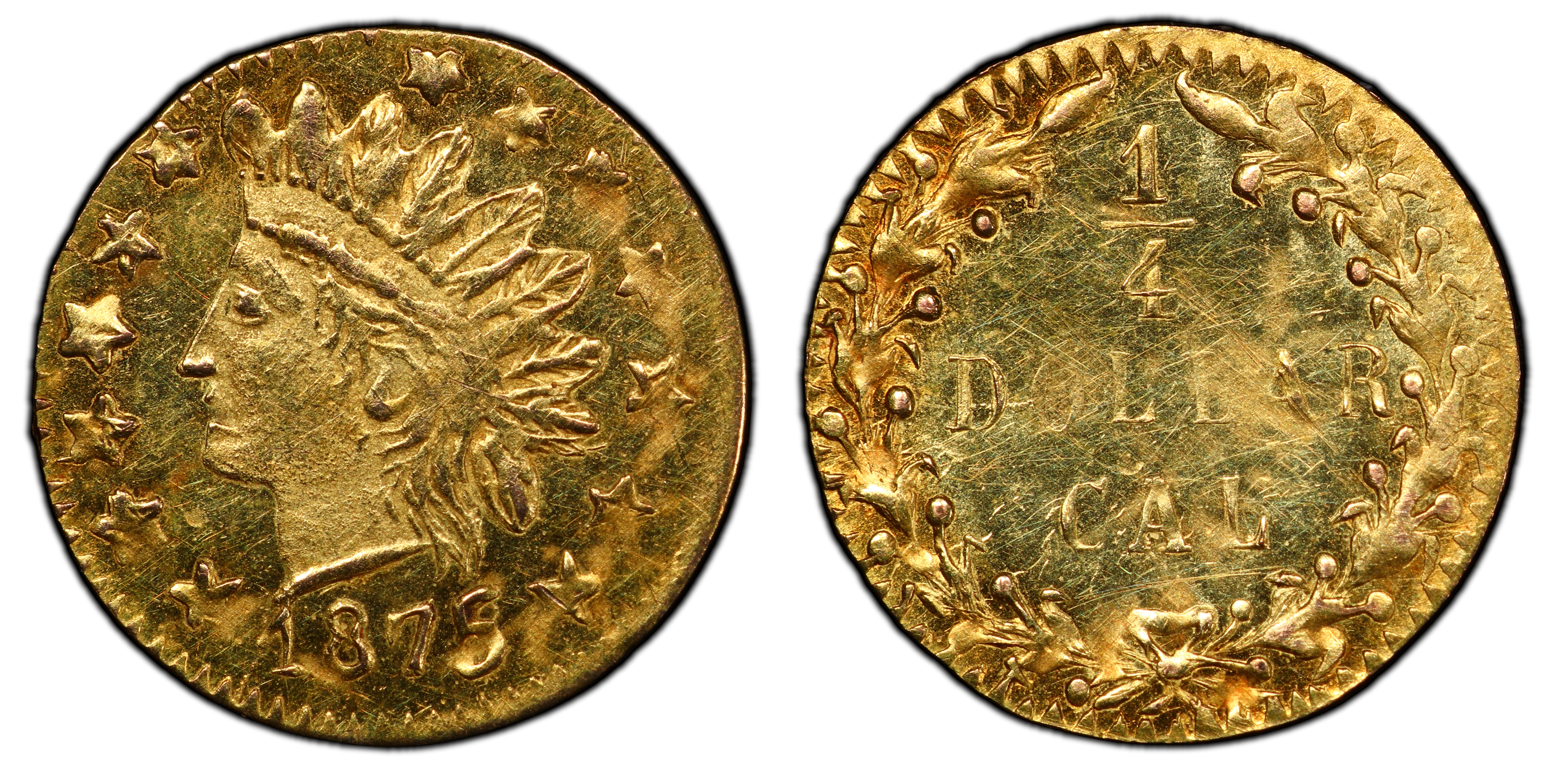
Obverse & Reverse
The 1875 Round Indian Head 25 Cents, cataloged as Breen-Gillio 877, is a quintessential example of a 'Period Two' California Fractional Gold piece. By the mid-1870s, the initial, desperate need for small denomination coinage that characterized the California Gold Rush had long since subsided. The San Francisco Mint, operating since 1854, was producing ample quantities of federal silver and gold coins for daily commerce. Consequently, the private production of fractional gold transitioned from a necessity to a novelty. These later pieces were not struck to facilitate trade but were instead created by local jewelers and artisans primarily for sale as souvenirs, keepsakes, and jewelry items for tourists and residents captivated by the romance of the Gold Rush. The makers of these 'Jewelers' Issues' are largely anonymous, as they rarely signed their work with initials, unlike the Period One minters. Production was centered in San Francisco, the commercial heart of the West Coast. The manufacturing process remained relatively crude, often employing the hammer striking method where dies were struck by hand. This resulted in significant variability in strike quality, with many pieces appearing weakly struck in areas, particularly at the centers or peripheries. The gold content was also not standardized and was often significantly less than the face value, a non-issue as they were not intended to circulate at par. The design of BG-877, featuring an Indian Head, was a popular motif of the era, evoking a romanticized vision of the American West. These tiny gold coins were tangible, affordable mementos of California's unique gold-laced economy. Because they were intended as souvenirs, many surviving examples are found in high grades, often with prooflike surfaces resulting from polished dies and planchets, though they were never officially struck as proofs. Their journey was not through cash boxes and pockets, but rather jewelry boxes and cabinets of curiosity, preserving them from the ravages of circulation that claimed most of their Period One predecessors.
Associated EventCalifornia Gold Rush (Later Souvenir Period)
Reason For MintingPrimarily struck for sale as souvenirs and jewelry items to tourists and locals, not for monetary circulation.
Minter HistoryThe minters of most 'Period Two' California Fractional Gold pieces, including BG-877, are unknown. Unlike the earlier Period One issues which sometimes bore the initials of their makers (like Deriberpe, Nouizillet, or Frontier & Deviercy), these later souvenir pieces were produced anonymously by various San Francisco-based jewelers who capitalized on the public's fascination with gold and the West.
Historical SignificanceBG-877 represents the evolution of California Fractional Gold from utilitarian coinage of necessity to a commercial souvenir. It is a tangible artifact of the post-Gold Rush tourism and memorabilia industry in San Francisco and reflects the romantic, popular imagery of the American West in the latter half of the 19th century.
N/A
Denomination25 Cents
Minting Period1875
Assayer/MinterAnonymous
Geographic OriginSan Francisco, California
Obverse DescriptionA small, stylized Indian Head faces left, adorned with a feathered headdress. The portrait is encircled by 13 five-pointed stars, representing the original colonies. The date '1875' is positioned below the bust.
Obverse Inscription1875
Reverse DescriptionThe reverse features the denomination '1/4' at the center, enclosed within a continuous wreath. The wreath is composed of two branches tied together at the bottom with a bow.
Reverse Inscription1/4
CompositionGold
Stated Fineness Actual FinenessVariable, often between .500 and .800 fine gold, and generally underweight for the stated denomination.
Weight0.25 grams
Diameter9.50 mm
EdgePlain
Unknown
Survival Estimate31-75
Rarity ScaleR-5+
This variety is sought after due to its classic Indian Head design, high rarity, and its connection to the romantic souvenir era of the California Gold Rush. High-grade, prooflike examples are particularly prized for their aesthetic beauty.
Key VarietiesThe primary known variety for this issue is the 1875/3 overdate, visible under magnification where the numeral '3' can be seen underneath the final '5' of the date. This overdate is a key diagnostic for the variety. No official restrikes or patterns are known to exist for this specific Breen-Gillio number.
Authentication TipsGenuine BG-877 pieces will have a denomination ('1/4') on the reverse. Many common, modern fakes are undenominated or feature a bear on the reverse, which is never seen on authentic period issues. The strike on genuine pieces is often somewhat soft in areas, particularly on the highest points of the hair and feathers, whereas modern counterfeits may have an unnaturally sharp, uniform, or 'soapy' appearance. The luster on original, high-grade examples should be flashy and prooflike, not dull or hazy. Examine the date for the faint remnants of the '3' underlying the '5' which is characteristic of this variety.
Shopping ConsiderationsA premium quality example for this issue is defined by a sharp strike, particularly on the details of the headdress and the wreath. Look for coins with brilliant, prooflike (PL) or deep mirror prooflike (DMPL) surfaces that are free of distracting marks or hairlines. Original, uncleaned 'skin' with reddish-gold toning is highly desirable. Avoid examples that have been harshly cleaned, which dulls the luster, or those that show evidence of being mounted in jewelry (solder marks, rim damage). Given the hand-struck nature, some central weakness may be acceptable, but look for examples with the strongest possible detail for the grade.
A coin's grade is its condition, rated on a 1-70 scale. For rare coins, this is the most critical factor in determining value, as a tiny difference in preservation can mean a huge difference in price.
Relevant Grade TypesOriginal period issues were business strikes, although produced with souvenir intent, and are found in both Circulated (1-58) and Mint State (MS, 60-70) grades. Due to their nature as keepsakes, many have survived in high grades. No official Proofs (PR/PF) were struck during the original period. The term 'Prooflike' (PL) is a designation added to Mint State coins that exhibit mirrored surfaces from polished dies, a common and desirable characteristic for this issue.
Mint State CharacteristicsUncirculated examples of BG-877 are characterized by their luster, which is typically bright and satiny, often with pronounced prooflike or even deep mirror prooflike fields. The strike is a key differentiator; many are softly struck on the highest points of the Indian's cheek and the feathers above the ear. The tiny planchets are prone to contact marks, which can appear disproportionately large. A premium MS example will have a sharp strike, clean fields, and minimal contact marks.
Circulated Wear PatternsOn circulated examples, wear first appears on the highest points of the design: the cheekbone of the Indian princess, the eyebrow, and the details of the feathers in her headdress. On the reverse, the high points of the wreath's leaves and the bow will show initial friction and smoothing. In lower grades (VF and below), the date and stars will begin to lose their sharpness, and the individual leaves of the wreath will start to merge.
Key Factors For ValueFor the BG-877, value is driven by three main factors: grade, surface quality, and strike sharpness. A high Mint State grade (e.g., MS-64 or better) carries a significant premium. Within a grade, coins with clean, original prooflike surfaces command more than those with hazy or cleaned surfaces. A sharp, well-centered strike that brings up the fine details of the headdress and wreath is highly prized and can make a coin worth more than a higher-graded but weakly struck example. The presence of a CAC sticker, indicating premium quality for the grade, adds a substantial premium for this series.
PCGS Price Guide
| Grade | Price | Population |
|---|---|---|
| 63 | $750.00 | 1 |
| 66 | N/A | N/A |